Martin Austermuhle
Officials in Mayor Muriel Bowser’s administration say they support some of the recommendations from the D.C. Police Reform Commission to change policing in the city, but are drawing the line at proposals to shrink the size of the Metropolitan Police Department, calling them “unreasonable,” “extremist” and “irresponsible.”
They’re also cautioning the D.C. Council against moving too quickly to remove police from schools, and are asking lawmakers to carefully review the commission’s recommendations and engage in what they describe as more intensive outreach with residents and communities before passing any of them into law.
The warnings were issued by Chris Geldart, the acting deputy mayor for public safety and justice, at the end of a day-long hearing in the D.C. Council on Thursday on the commission’s 259-page report released last month. It lays out 90 sweeping recommendations, ranging from changes to criminal law and curtailing police practices to increasing discipline and shifting current police responsibilities to other types of responders.
The hearing took place against a backdrop of increasing gun violence and homicides. This week alone a mother and her five-year-old son were shot and injured in Shaw, while a 65-year-old woman was shot and killed in Fairlawn. Homicides are up over the same period last year, and in a scathing statement the D.C. Police Union laid the blame at “the irresponsible, unfounded, dangerous rhetoric coming out of these nonsensical hearings.”
Geldart similarly cited the city’s increasing gun violence. “We are up over 35% in homicides this year,” he said, insisting MPD would have to continue using specialized police units the commission has called to put on hold because of their aggressive tactics and questions about their efficacy. “We are in epidemic proportions right now in the city.”
“If we’ve had these units and yet we have seen the number of gunshots increase… then it starts to question what is the value or effectiveness of this,” responded Ward 6 Councilmember Charles Allen.
Almost all of the 60 residents, activists, advocates, and members of the commission who spoke at the hearing pushed the council to move decisively and quickly on the commission’s recommendations.
“For my whole life I’ve listened to politicians call for reform of the police. Sensitivity training has not done the trick. Now cops use the right language before brutalizing us. Non-lethal weapons have not done the trick. Now they have a broad new arsenal of armaments to use against us,” said Imara Croons, a Ward 5 resident.
“The recommendations of the Police Reform Commission are an excellent place to start. Do not back down from these recommendations. Do not damn us to decades more of toothless reform while a new generation of Black bodies are savaged in your name, victims of your cowardice. If you know what the problems are, why are they so difficult to address?” he added.
Both parents of Karon Hylton-Brown, who was chased by police as he rode a scooter and later died when he was hit by a driver on Kennedy Street NW, called in to testify in passionate terms for lawmakers to act on a separate measure from Ward 4 Councilmember Janeese Lewis George that would largely ban police car chases. (“I just pray that you pass this bill,” said Charles Brown.) Other speakers pushed for more accountability for officers who break department rules, more limits on what police officers can do and to pull police from traffic enforcement and schools.
“We can no longer stand by with such blatant forms of over-policing and criminalization of Black youth,” said Samantha Davis, a member of the commission and executive director of the Black Swan Academy.
Geldart said Bowser does support some of the commission’s recommendations, pointing to her announcement this week to have more unarmed mental health professionals respond to 911 calls for service. Police Chief Robert J. Contee III has also said he is rethinking the tactics and goals of the Gun Recovery Unit, which has been criticized for its aggressive tactics. Geldart also said Bowser would include money for some of the commission’s recommendations in her upcoming budget.
But he cautioned against moving too quickly to remove police from schools, asking lawmakers to wait until a survey of principals and other school leaders could be completed. (Shannon Hodge, the executive director of the D.C. Charter School Alliance, similarly said the council “must engage with school leaders, students, and parents.”) “We’re always looking at how do we improve, but to pull [police] completely out of school, I don’t think that the community supports that,” said Geldart in an interview on Friday morning.
He also more starkly laid out Bowser’s opposition to shrinking the size of the police department.
“The commission recommended the city reduce its police force by at least the rate of attrition for the next five years. MPD’s police force is currently around 3,600 officers – that is the lowest level in more than 20 years. If the council adopted the commission’s police reduction proposal, the District would have less than 2,000 police officers by 2026. While this proposal is supported by the commission and advocates of abolishing the police department, it is extremist, irresponsible, and lacking, as a whole, community support,” Geldart said in his testimony.
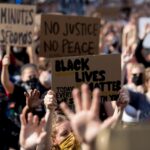
Geldart’s statements are starting to define the battle lines of what could be a complex and drawn-out process within the council to consider and implement the commission’s recommendations, especially as the city nears the one-year mark since racial justice protests erupted here and elsewhere after the killing of George Floyd. Those protests amplified and advanced local calls for police reform. Lawmakers were quick to respond with a package of emergency police reforms last year that has sped the release of body-camera footage and removed disciplinary matters from police union negotiations with the city.
But the commission’s report lays out more ambitious changes to minimize and curtail the role of police in more significant ways, prompting some councilmembers to start drafting individual bills to implement those recommendations — including the bill to ban most police car chases, and another to do away with qualified immunity for officers. Still, some lawmakers said the council would have to contend with how to properly implement the recommendations, and to do so in a methodical way.
“Sometimes we do things reactively because there are pressures but it may not be the right thing at the right time,” said Ward 3 Councilmember Mary Cheh. “I’m a little at sea on whether some recommendations should be done when other recommendation are done, or whether some should come first.”
The council also heard testimony on two separate bills, one calling for an assessment of white supremacist or other extremist ties within MPD, and another that would ask D.C. Attorney General Karl Racine to assess whether implicit bias within the department led officers to focus more attention on certain protesters and groups over others.
And with Bowser expected to unveil her budget next week, it could portend a busy year for lawmakers grappling with sustained demands for police reform. Still, one member of the Police Reform Commission said the council should not let the moment pass.
“We need these recommendations if we are serious about changing the way policing has been done in Washington, D.C.,” said Ronald Hampton, a former D.C. police officer and member of the commission. “This is our best chance to bring the much-needed changes.”