At the end of 2020, chef Alfredo Solis made a bet on pizza. His newest restaurant, Anafre, was still in its infancy, and packing up his seafood dishes for travel wasn’t working. The menu was a departure from Solis’ other Mexican offerings at Mezcalero and El Sol. At Anafre, grilled lobsters dripping with jalapeño butter, steaks sizzled over coals, whole snapper fish doused in a jalapeno tomato sauce, and tortillas crisped by the grill were best plated straight from the kitchen.
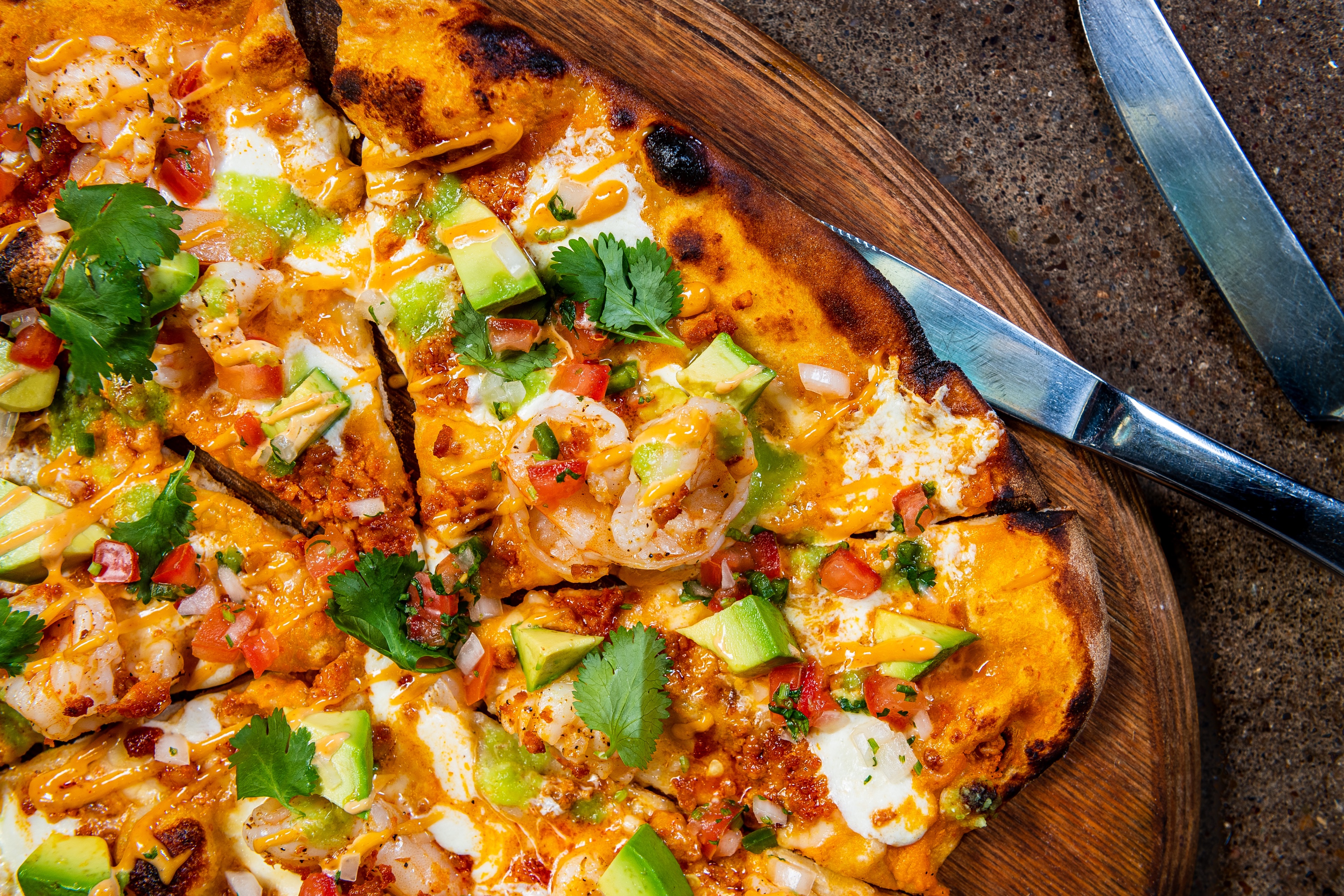
So Solis launched a Mexican pizza pop up in December to keep afloat with what he deems “a more portable, pandemic-friendly food,” using ingredients already on hand: dough kneaded with maseca (corn flour), tomato sauce simmered with chile de arbol, finishing touches like Oaxaca cheese, cactus, octopus, pico de gallo, and poblano pepper. With pies, Solis, who worked in pizzerias as a teenager, could keep more of his staff working and pay the rent.
“We replaced 50 percent of our entrees with pizza,” says Solis. “It was perfect for this situation. The numbers are not great, but at least I can keep doors open. Even when COVID ends, I like my pizzas and think we’ll keep them on the menu.”
Pizza has always been popular, but it became the pandemic food of choice for many Americans over the past year of necessitated takeout and delivery. Aside from its comfort food qualities — those strings of piping cheese! that bright tang of tomato sauce! those shimmering grease puddles atop a wedge studded with pepperoni! — pizza had the versatility, the range of style, the price point, and the ease of transport to meet the upheaval.
Last spring, as restaurants closed, fast-casual spots saw a 33% dip in sales, while pizza sales nationwide were down only about 5%, Restaurant Dive reported. National pizza chains like Domino’s and Papa John’s reported upticks in sales between 11% and 28% for the duration of 2020, though that rush is settling now as warm weather and vaccinations allow more restaurants to reopen. Pizza consumption also soared for independent pizzerias on marketplaces like Slice, which doubled its weekly sales throughout the last year. (Local names like Pizza Mart, Manny & Olga’s, Comet Ping Pong, Matchbox, and We the Pizza are all on the roster.)
And it was easier to open a pizza shop than other kinds of restaurants. The New York Times reported in February that amid the devastation of more than 68,000 shuttered restaurants nationwide throughout 2020, 11,000 restaurants opened — nearly 20 percent of which were pizzerias.
Fast-casual chain &pizza, which opened its first shop on H Street Northeast in 2012, was one brand that had a very good year. Pre-pandemic, 70 percent of business was done through in-person ordering, and customers would often stay to eat in, says Andy Hooper, &pizza’s chief operating officer. The pandemic pushed the group to focus on an existing digital ordering system, even as they reopened for takeout in June. Online orders have grown by 500 percent in the last year, and same-shop sales are ahead of last year’s numbers. In 2021, they’re slated to open 27 new locations.
“So much of &pizza’s history has been about the shop itself — the design, the interaction, the music, the connection with the neighborhood,” says Hooper. “We tried to replicate that experience digitally to stay connected to the brand. We offer dozens of pies on our app that you can’t get in-store or on other delivery apps, and that part of our business will be here to stay, even as people return to some degree of normality.”
In D.C., pizza choices are at an all-time high, buoyed by the pandemic’s changes. The city has traditionally specialized in wood-charred Neapolitan pies by the likes of 2 Amys, Pizzeria Paradiso, and Menomale, but pizza has now cropped up in just about every style. Detroit’s oil-resplendent square blocks at Red Light, Emmy Squared, and Motown Square. Americanized slices a la New York City at Slice Joint, Wiseguy, and Andy’s Pizza. New Haven’s thin and crispy white clam pie at Pete’s. Deep dish from Della Barba and Pi Pizzeria. Lactose-free slices at Sommer Street and gluten-free crust at Bacio Pizza. Square pan pizza at The Wharf’s Grazie Grazie. Supersized singles at Jumbo Slice. The list goes on.
And restaurants that hadn’t previously done much with pies switched to or doubled down on pizza when other offerings didn’t travel well. In addition to Anafre, Officina’s Coda Pizza, Reverie’s Lonely Hunter, Half Smoke’s Get Social, and Scarlet Oak’s Side Door Pizza popped up throughout 2020.
But the rosy picture for pizza becomes a little more complex when you start to talk with individual restaurants specializing in pies. Though pizza’s capital is rising and has offered a lifeline for some spots, just how well pizza supports a restaurant depends on a variety of factors, including the restaurant’s model of service, menu offerings, years in operation, and surrounding competition. Fast-casual and delivery-only options run a different kind of ship than a sit-down restaurant that also specializes in drinks, appetizers, and other accompaniments.
“When you look at a place like a Domino’s or a Chinese restaurant that does 70% to 80% of its business with takeout, they’ve built their business for that,” says Michael Schlow, the chef and owner of Schlow Restaurant Group. “But most sit-down restaurants don’t consider to-go in design.”
Pizza was already on the original Italian menu at Schlow’s Alta Strada and Glover Park Grill and comprised around 10% to 12% of the two Italian restaurants’ food sales prior to COVID, he says. Though that number hasn’t fluctuated much since then, the pandemic was still a good time to “geek out on pizza,” says Schlow.
“Pizza has always been one of the most popular foods in America, but I think the reason we see it skyrocketing right now is that it travels and reheats well compared to other foods,” Schlow says. “Every place in America has something a little different, but what we all agree on is that we love it. In times of stress and tension, we want food that is going to make us feel comforted.”
Last summer, Schlow talked to other chefs and experimented with recreating some of his top pizzas from around the world—the Sonny Boy pizza from Pizzeria Bianco in Phoenix, grilled pizza from Al Forno in Providence, square Roman pizza with hydrated dough. The restaurants added Little Prince Pizza in January, a ghost kitchen offshoot that also carries hot wings and burgers. For Schlow’s current favorite Little Prince pizza, he grates broccoli as fine as confetti and pairs it with fennel sausage and mozzarella.
The pizza brings enough extra revenue to buffer support and keep staff. Schlow is even considering a brick-and-mortar Little Prince Pizza shop post-pandemic.
All the fresh pop up options are good news for those ordering pizza, but it does also ramp up competition. For Peter Pastan, the owner of 2 Amys, any “pizza boom” was quashed by safety concerns for his staff and increased competition from all the new pizzerias around the city. 2 Amys reopened for takeaway in June and is doing about 60 percent of its pre-COVID business. The restaurant hasn’t been able to make delivery services work, and as a result, Pastan hasn’t been able to make up dollars with to-go orders alone. The shop is waiting to reopen for in-person dining until all staff have been vaccinated.
“Strictly speaking, pizza numbers are pretty good, but it’s different than if we were completely open,” says Pastan. “Every other restaurant in town is making pizza — a lot of people who were not doing pizza transitioned — so that kind of dilutes the gene pool. Now that it’s springtime, I think a lot of them are going back to more of what they regularly do. But there’s been so many pop ups.”
Meanwhile, newcomers to the pizza scene are hoping to stake down roots to operate well beyond the pandemic. Paulos Belay, who started cooking his Motown Square Pizzas out of Mess Hall in August, and Rachael Marie, who opened her first Slice Joint location outside of New York City at The Roost food hall in October, decided to take a gamble in an unusual time. Both say their businesses have had steady growth.
Marie is in a similar market hall in NYC, but has been operating at “about 25 percent on a good day” there because of no walk-up service and struggles with delivery apps. But in D.C., where Slice Joint already had fans and “there’s not a pizzeria on every block” like in New York, they’ve seen gains week over week. “We’re kind of trying to imagine, as busy as it is now, how we’re going to operate once we’re business as usual,” says Marie.
Belay grew up in Detroit and started working on a pizza idea two years ago that merged the square pies and his Ethiopian roots. The push he needed to open came after he lost his pastry job at DGBG Kitchen & Bar early last year. Because there is minimal equipment involved and the pizza goes from pan to oven to box for takeout and delivery, Belay says he can keep the process relatively simple. Most varieties pile on brick cheese; one uses Ethiopian beef tibs and fresh herbs.
“I went all in on pizza, and it’s been tough but totally worth it,” Belay says. “I was kind of watching over the first few months to see how other businesses were doing. Were people still ordering out to eat because it’s tough financially? I know how the industry is from seeing the ups and downs in a regular year. Now we constantly sell out of pizzas every weekend.”
Previously:
D.C.’s Restaurants Are Swapping Fine Dining For Comfort Food On Their Takeout Menus