Margaret Barthel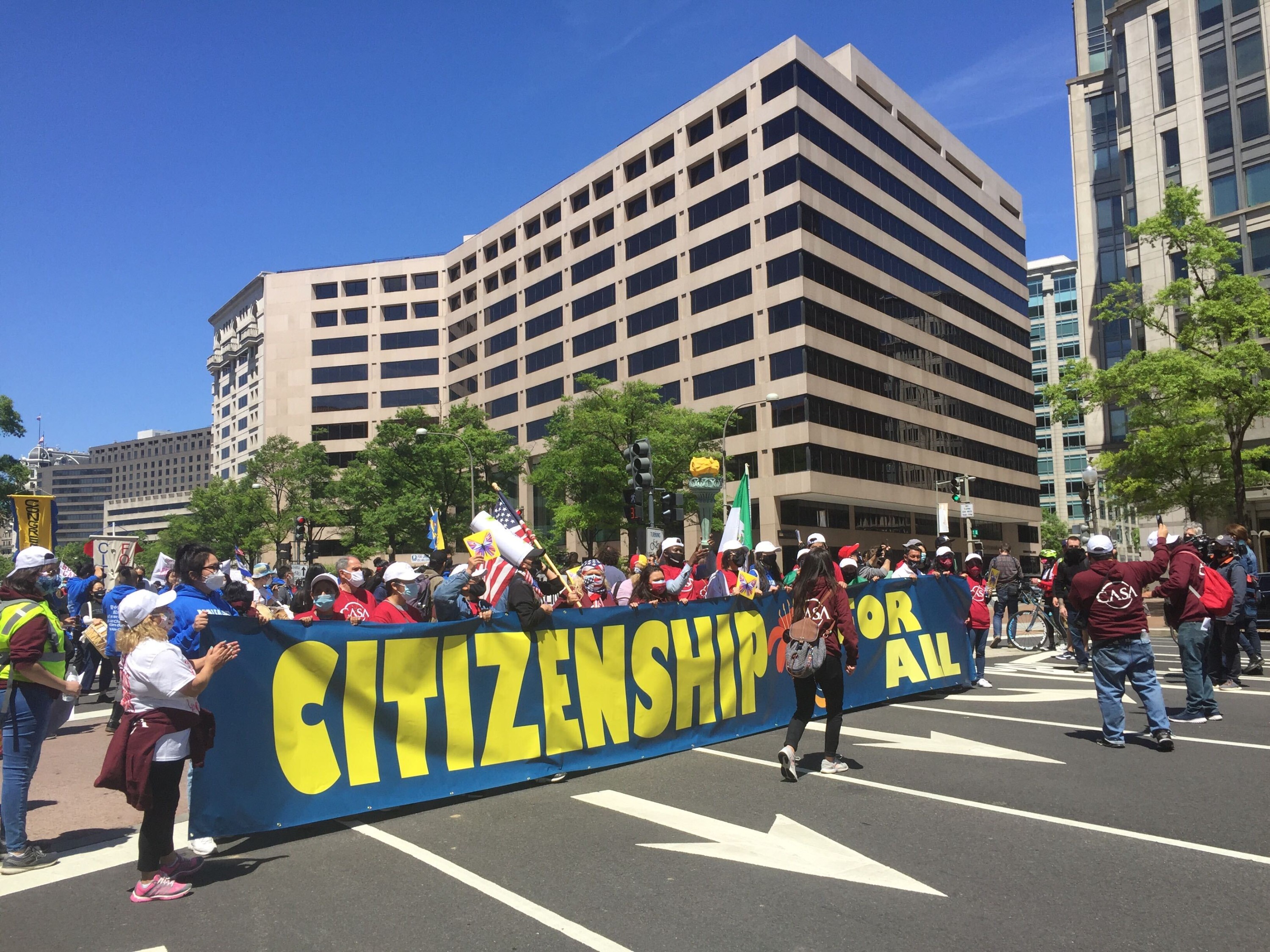
Isabel Aguilar doesn’t want to worry about being deported away from her children anymore. She wants a pathway to citizenship for all undocumented immigrants in the United States.
“It’s more than, [having] a document or not [having] a document, or [having] a good job, or [having] a big house,” she says. “It’s this: you can imagine knowing [that] when my husband is outside, if the police [stopped] him because of whatever situation and called immigration, he can be deported at any moment.”
Aguilar, 50, is undocumented and lives in Owings Mills, Md. She’s been in the United States for 16 years, ever since she left Honduras, where she grew up. Her children are American citizens, and she can’t imagine going back to her home country and missing out on their milestones, like graduations, weddings, and children of their own.
“We want to stay together,” Aguilar said. “We’re trying to. Please.”
The past year, especially, has been hard on Aguilar and her family. Everyone in her household caught the coronavirus, and her husband, the family’s primary breadwinner, was so sick he missed three months of work. The family was not able to make rent payments for that period.
Aguilar spoke to WAMU/DCist at a march and rally for immigrant rights on the National Mall on Saturday. The event was hosted by a broad coalition of local and national advocacy groups, faith organizations, unions and more. They hoped to use International Workers’ Day — which falls every year on May 1 — to call attention to the essential worker status of many immigrants and demand that the federal government create a pathway to citizenship for all 11 million undocumented people in the U.S.
“Now, in the 100 days of the Biden administration, we want more than just a good bill. We want something that turns into actual law. We want actual policy,” said Luis Aguilar, the Virginia director for the immigrant rights organization CASA.
Aguilar, who is a DACA recipient, acknowledged that major immigration policy changes will be difficult to get through a deeply divided Congress. But he said “a real solution” is needed urgently.
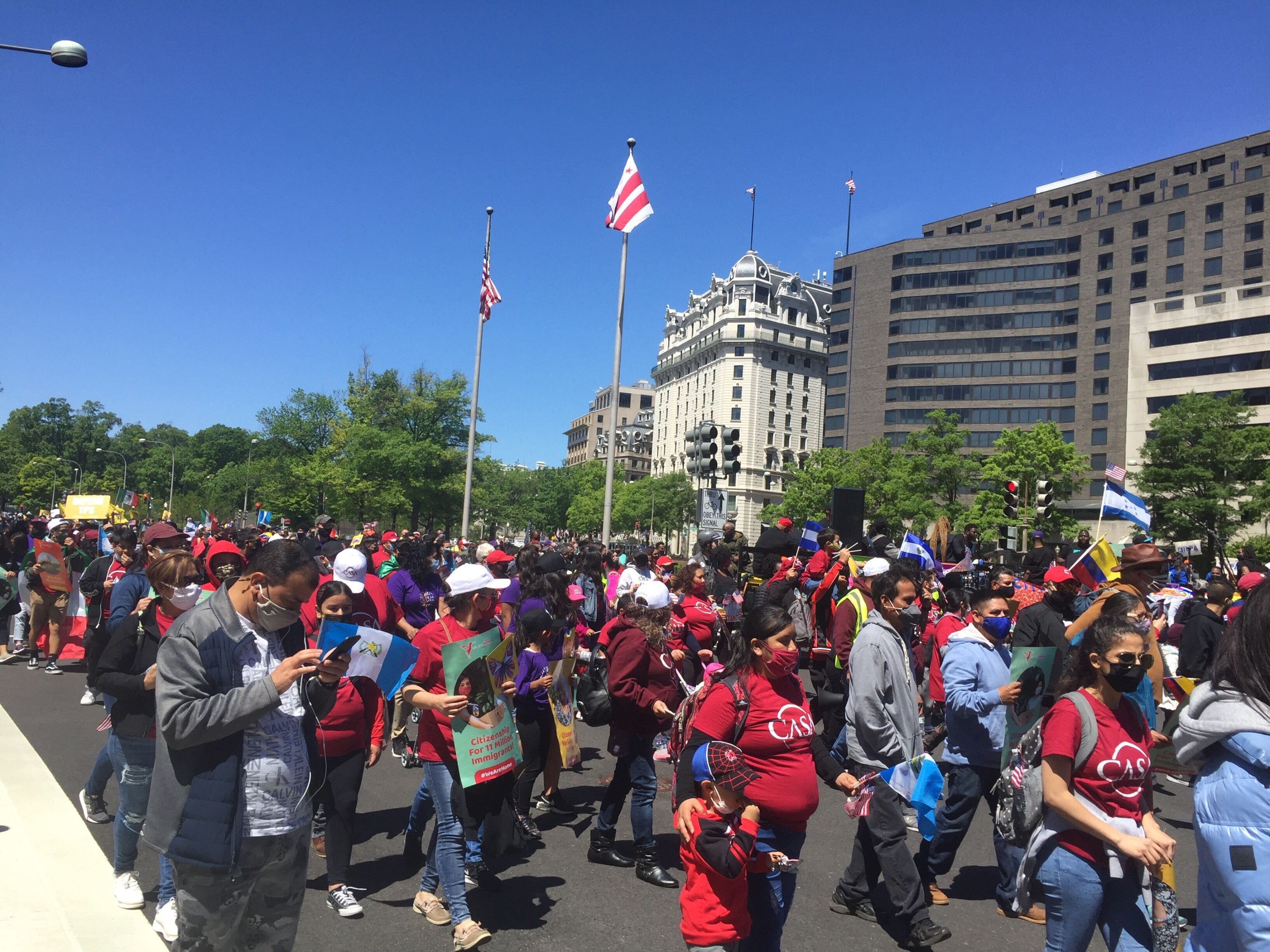
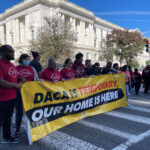
Hundreds attended the march, which began in Black Lives Matter Plaza, then turned on to Pennsylvania Avenue. The crowd headed for the National Mall, chanting in multiple languages, waving banners, and dancing to the beat of a go-go band, the quintessential music of the local protest scene. Many of the chants — “This is what democracy looks like!” and “The people, united, will never be defeated!” — were identical to those heard at housing rights and Black Lives Matter protests.
Aguilar was encouraged by the diversity of the people and organizations in attendance, which he called “a rainbow coalition.”
“We started at Black Lives Matter Plaza because we know that this is not about Latinos or about a specific race,” he said. “This is all types of colors, Black, white, Asian…we have to be united and together.”
Aguilar connected the struggles of immigrant communities to broader issues of socioeconomic class.
“Finally, workers and oppressed people and poor people are coming together and saying, ‘Hey, enough is enough,’” he said.
That resonated with Lemoyne Miles, 42, a unionized worker with 32BJ branch of the Service Employees International Union (SEIU), who attended the rally with her daughters, Aniya, 14, and Arialle, 11.
“Hopefully they’ll see the importance that it is to everyone, not just Latino, Hispanic, but African-American, Asian, everybody,” she said.
Miles, who is Black, said she brought her daughters to the march in solidarity with friends who are Latino.
“I want them to learn early, that we all have a role to play in here, and you know, support one another,” she said.
Yasmin Yoon, an immigrant justice organizer with NAKASEC Virginia (National Korean American Service & Education Consortium), an organization that works with undocumented people in the D.C. region, said the solidarity is especially meaningful to her as an activist.
“Being reminded that I’m not in this fight alone, I think it’s really meaningful for me and it’s really profound,” she said. “I think that with, you know, hearing Korean drums and the middle of D.C., hearing Korean and Spanish spoken and the middle of D.C., again, I think a lot of people did tear up today. it’s emotional.”
Yoon specifically called for action on immigration issues from Virginia senators Mark Warner and Tim Kaine, both Democrats who sit on the senate committee that oversees the budget. Yoon and other advocates want Democrats in Congress to pass immigration reform as part of a budget reconciliation process, which would only require a simple majority in the almost-evenly-split Senate.
In front of the Capitol building, speakers told stories and musical groups sang songs about the experiences of immigrant workers. Families relaxed in the shade and ate ice cream and snacks from food trucks. Kids chased each other across the grass. Isabel Aguilar said her group brought tamales to share.
Some marchers were from as far away as San Francisco. Others came to D.C. from Maryland and Virginia.
Rocio, 35, made the trek from Charlottesville, Va., with her five-year-old daughter Seily, who hugged a fluffy blue stuffed animal and sucked on a snow cone. Like Isabel Aguilar, Rocio, who did not give her last name, is undocumented and constantly worried about her family being forced to split up.
“When my daughter is at school, we don’t know [if] we are going back to home,” she said. “I don’t know [if] you know how this feels, you have to tell your husband, ‘Okay, see you later,’ but in your mind, you know something can happen.”
The mother and daughter were there to demand a change to that reality.
“We are here to tell the president that we want —” Rocio began. “Green cards!” Seily finished.
“We are good people. We work so hard. We pay taxes. We are families, we are not criminals,” Rocio said.
On the local level, Rocio and Luis Aguilar both pointed to a recent policy change that allows undocumented people to apply for driver’s licenses in Virginia. But while they called that a step in the right direction, both said local governments could do much more, including fully ending information sharing between local police forces and immigration enforcement and helping immigrant communities devastated by the pandemic.
“When the stimulus, the relief happened for people, it did not happen for immigrant families,” Luis Aguilar pointed out. “Localities could have done something about it. Some localities did something very small…They discount communities, immigrant communities, as if they don’t matter.”
Idalia Ramirez, a junior at Bowie State University who attended the rally with fellow members of the campus’ multicultural sorority, agreed. Her father is undocumented, which meant her family missed out on badly needed stimulus checks.
“I just thought that was very ridiculous,” she said. “It’s not his fault. He came to this country to find a better life for himself and to provide for his family back in Mexico.”