Martin Austermuhle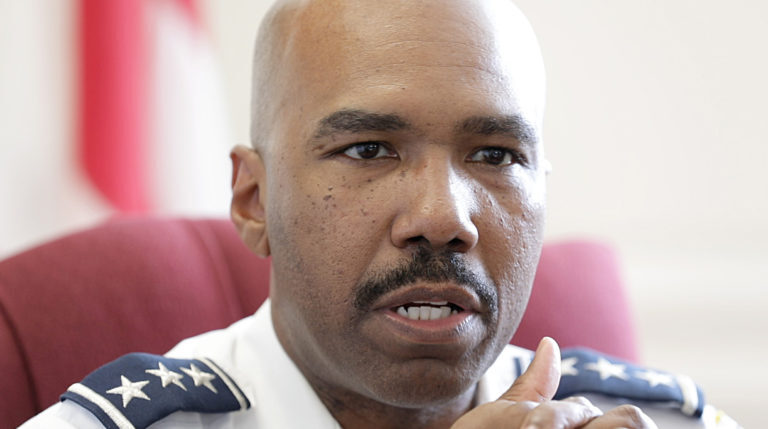
The D.C. Council on Tuesday unanimously approved Robert J. Contee III to serve as chief of the Metropolitan Police Department, putting him in charge of the law enforcement agency he joined three decades ago and which now faces twin challenges of addressing rising homicides and responding to calls for reform.
Despite the fraught context in which he was put forth for the police department’s top job — MPD has been criticized by both the public and lawmakersfor its tactics in everything from seizing illegal guns to handling racial justice protests — his nomination drew no opposing votes from councilmembers.
But members did take the chance to say during Tuesday’s vote that while they supported Contee, they did not want to let the energy around police reform to dissipate or let their vote in his favor be seen as a sign that the department will fix itself.
“He’s proven himself to be a professional, open-minded, collaborative, and dedicated public servant. He has already — unfortunately — had to demonstrate his ability to guide the department in times of crisis. He has clearly and publicly acknowledged the need for change in policing culture and practice,” said Ward 6 Councilmember Charles Allen, who chairs the Council’s judiciary committee. “For a profession that prides itself on accountability for others, and in a moment defined not just by calls for justice around the country but also at home, it must be able to look internally. This is the chief’s charge.”
Contee, 48, grew up in Northeast, experiencing both troubles at home (he has been open about the fact that his father was addicted to drugs) and in his community, where he said crime was a persistent problem. He joined MPD as a cadet at the age of 17 in 1989; by 1993, he was a patrol officer and four years later a sergeant. He took command of the Second District in 2004, working his way up the ranks to assistant chief. In December, Mayor Muriel Bowser tapped Contee to replace outgoing chief Peter Newsham, who left for the top cop job in Prince William County.
Despite being hailed as homegrown talent who rose through the department he was asked to lead, councilmembers did take the chance to grill him at a confirmation hearing in March on everything from MPD’s on use-of-force investigations, officers not being punished when they fail to turn on their body-worn cameras, and the department’s spotty track record of collecting and making data public on things like police stops.
Almost every public witness at the nomination hearings spoke on his behalf, saying they trusted Contee to take charge of MPD and manage the reforms that would be needed. But some activists dissented; April Goggans from Black Lives Matter DC said she didn’t believe a man who once led the department’s Narcotics and Special Investigation Division could be trusted to change policing in the city.
Contee now takes the top job at MPD at a particularly challenging moment. Gun violence and homicides continue rising in D.C. — as of Monday, homicides are up 35% over last year — spurring calls from some community leaders for more police presence in certain neighborhoods. On Monday, Bowser and Contee announced six locations where they would increase police presence as part of the annual Summer Crime Prevention Initiative.
At the same time, activists and advocates are pushing lawmakers and Contee to not increase police presence — but rather expand the use of violence interrupters and other social services, which they say can better prevent crime from happening in the first place. (Earlier this year Bowser did announce an initiative to do that on designated blocks; she also appointed the city’s first director of gun violence prevention.) The list of demands for police reforms is also growing. The D.C. Police Reform Commission unveiled 90 recommendations for changes to policing in the city last month, ranging from shifting more responsibilities to other responders to shrinking the size of the department from it’s current staffing of 3,600 officers.
While Contee has said that he does plan to reform how the controversial Gun Recovery Unit operates, as the commission recommended, he’s been cool to the idea of reducing the size of MPD’s force.
“When I assess the needs and I look at the calls for service, I look at the violent crime… you know, the police department gets pulled into a thousand different directions. And until we get to that point where that’s not the case and there’s less reliance on law enforcement officers, I think that’s something that we assess then. But as of today, for the safety and security of the city today, that is not a very wise move,” he said about shrinking the department on WAMU’s “The Politics Hour” last month.
Beyond the responsibility of managing outside demands, Contee has also been balancing day-to-day challenges of running a police department. Hundreds of his officers responded to the insurrection at the U.S. Capitol on Jan. 6, and have since been credited for taking back the building. More recently, he’s had to contend with foreign hackers stealing sensitive police data for ransom, four officers crashing their cruises after drag racing down a residential street, and the city’s first fatal police shooting of the year last weekend.
Still, speaking last month on “The Politics Hour,” Contee said he was excited to take on the job — and set big expectations for what he wants to come of it.
“I’ve been doing this work and I know that there is a long road ahead of us,” he said. “But I want to be — as a kid homegrown here — one of the people who will go down in the history books as one of the people who changed the trajectory of law enforcement not just here in the nation’s capital, but across our country. And I know that’s a tall order.”