 Jenny Gathright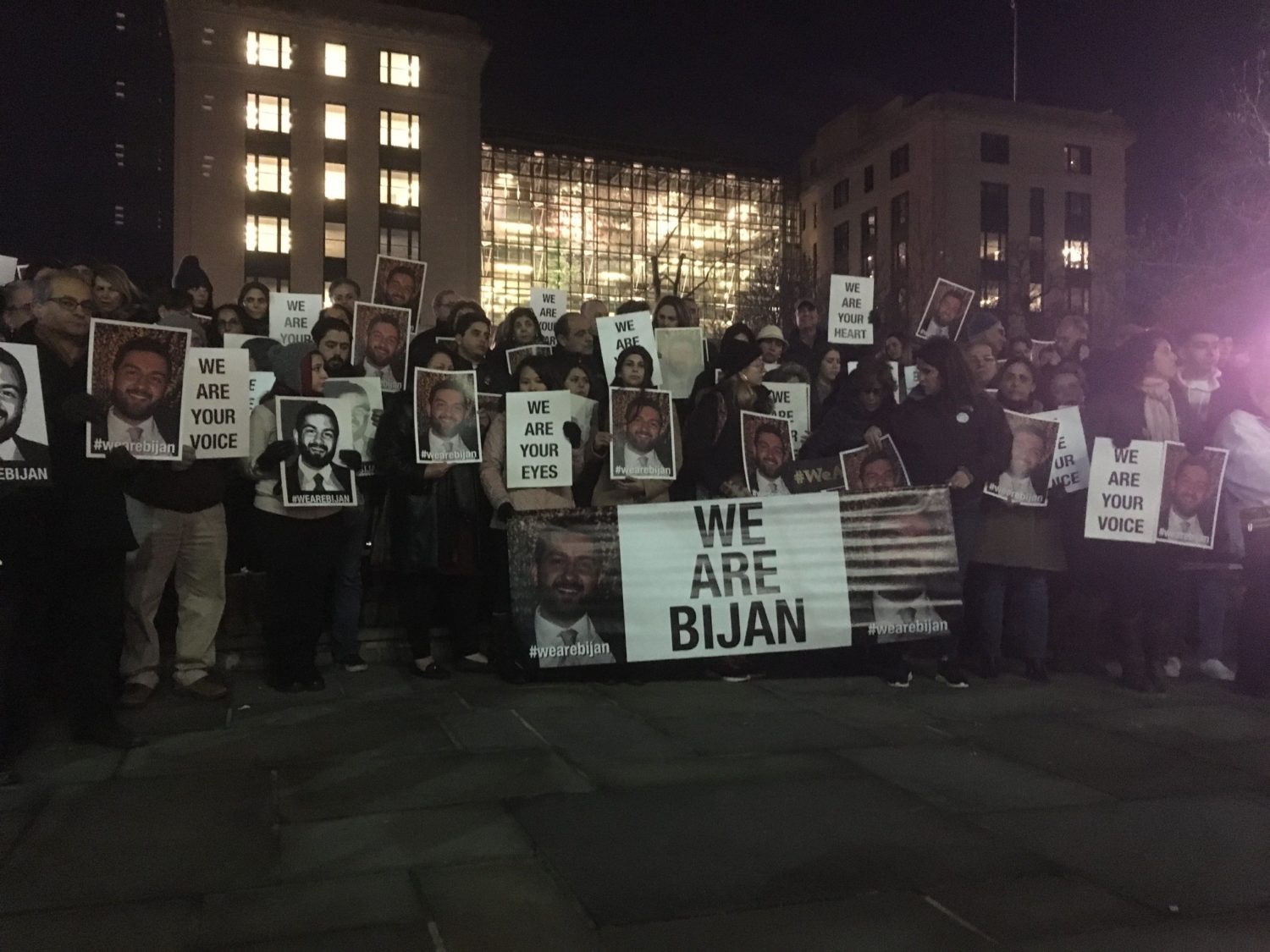
Virginia Attorney General Mark Herring and Fairfax Commonwealth’s Attorney Steve Descano are asking president Joe Biden’s new attorney general, Merrick Garland, to prosecute two Park Police officers for the 2017 killing of Bijan Ghaisar — and reverse the decision of his predecessors in Donald Trump’s administration to not pursue charges in the case.
Ghaisar was 25 years old when two Park Police officers, Lucas Vinyard and Alejandro Amaya, fatally shot him in his car in November of 2017. The officers’ pursuit of Ghaisar began along George Washington Memorial Parkway and ended in a residential neighborhood in Fairfax County, where they shot at him multiple times as his car slowly moved away from them. Ghaisar died in a hospital 10 days later.
In 2019, the Justice Department — at the time led by former attorney general William Barr — declined to pursue charges against the police officers. The department said its investigation could not prove that the two U.S. Park Police officers “willfully” violated the federal criminal civil rights statute.
“As this requirement has been interpreted by the courts, evidence that an officer acted out of fear, mistake, panic, misperception, negligence, or even poor judgment cannot establish the high level of intent required” to prove such a violation, the department wrote in its press release.
But in a letter sent to Garland on Wednesday, first reported by the Washington Post, Herring and Descano asked that the Department of Justice reconsider prosecuting the officers — and placed the killing of Ghaisar, the son of Iranian immigrants, within a larger context of police violence.
“The dash camera footage showing yet another young person of color being killed by law enforcement resulted in a cry for answers and justice that emanated not just from the Commonwealth of Virginia, but from across this country,” said the letter. “Sadly, the most significant impediment to answering that cry was the Trump Administration. The Trump Administration refused to seriously explore the prosecution of these officers for their actions.”
Herring and Descano also urged the department to allow the federal agents who investigated Ghaisar’s killing to testify and share evidence in a separate case against the Park Police officers that is pending in a Virginia federal court. The Justice Department has refused to allow the agents to testify in the case; federal attorneys have said such testimony would present a conflict of interest with the government’s defense of a civil lawsuit Ghaisar’s family filed against the Park Police.
It’s unclear whether Garland would make the rare decision to reverse a previous Justice Department decision in the absence of new evidence in the case; a spokesperson for the department did not respond to a request for comment on whether they will honor Herring and Descano’s requests. But more broadly, Garland has already begun to diverge from policies in place under the Trump Department of Justice: For example, he rescinded a Trump policy that limited the use of consent decrees to address police misconduct.
The FBI has released little information about its investigation of Ghaisar’s killing. Instead, the most detailed video accounting of the events leading up to Ghaisar’s death was released by former Fairfax County police chief, Edwin C. Roessler, in 2018. That video of the shooting, captured by the in-car video camera of a Fairfax County officer who was trailing behind Ghaisar and the Park Police, showed that Ghaisar did not appear to provoke the Park Police officers right before they shot him. His window was closed, and as his car was slowly moving forward away from police, officers fired a total of at least nine shots at him. The Park Police’s use of force policy, the Washington Post reported, says that officers should not fire at moving vehicles without a reasonable belief that “the subject poses an imminent danger of death or serious physical injury to the officer or to another person.”
Ever since Ghaisar’s death, his family has been fighting to hold both the Park Police officers and the Park Police department accountable.
Last month, their efforts met additional resistance when a judge granted the officers’ request to move the case against Vinyard and Amaya from state court to federal court. Attorneys for Vinyard and Amaya argued that the officers were immune from state prosecution because they were acting in their official capacity as federal officers — and they reportedly plan to seek dismissal of the case in federal court on those same grounds of immunity.
After that decision, which came days after Derek Chauvin was found guilty of murdering George Floyd in Minneapolis, Bijan’s mother Kelly Ghaisar said the experience of sitting in court and seeing Vinyard and Amaya in person was traumatic.
“I somehow thought that maybe things were about to change,” she told DCist/WAMU. “After everything that’s happened since last summer, here we are in cases like this and we had to be disappointed yet again.”
Herring and Decano also referenced the country’s broader political climate in their letter to Garland on Wednesday, pointing out the Biden administration’s stated commitments to racial justice.
“This administration has expressed a genuine commitment to criminal justice reform, accountability, and racial equity,” they wrote. “Few cases touch on these issues as squarely as this case does.”