 Jordan Pascale
 Colleen Grablick
Update: The National Park Service wants your input on whether to keep a portion of Beach Drive NW permanently closed to traffic.
On July 8, NPS will host a public virtual meeting, where officials will present options for the future of Beach Drive and kick off a feedback period. Residents can tune into the meeting from 6 to 7:30 p.m., and submit their thoughts on the proposed plans to NPS through Aug. 22, 2021.
In the fall, NPS will use the feedback to further adjust its proposals, analyze the environmental impacts of the options on the table, and then ask again for another round of resident input.
Original:
A majority of D.C.’s lawmakers are calling for the upper part of Beach Drive through Rock Creek Park to remain the way it’s been during the pandemic: open to walkers, runners, cyclists and closed to most cars.
The D.C. Council voted 9-4 on Monday to ask the National Park Service to keep the road closed to most through traffic on a permanent basis. D.C. Del. Eleanor Holmes Norton wrote a letter last week asking for the same. And the Montgomery County Council is expected to vote on a similar resolution on June 15. All nine councilmembers are supporting the measure.
But it’s unclear whether pressure from the elected officials will move the needle. The decision is solely up to NPS, which controls the road through Rock Creek Park. Last year, an NPS spokesperson said the road will return to vehicular traffic after the public emergency is over.
D.C.’s pandemic public emergency is slated to end July 25, though Mayor Muriel Bowser can request 15-day extensions after that.
NPS did not respond to a request for an interview with park superintendent Julia Washburn or return a request for comment on Tuesday. In May, an NPS spokesperson told the Washington City Paper that they “recognize that temporarily limiting vehicle access to Beach Drive has provided value to many people. We are taking steps to evaluate how to best manage Beach Drive in the future and need to consider factors such as accessibility, the effects of traffic diversion, and impacts to park resources.”
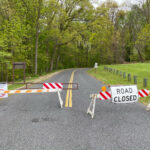
The 4.3-mile upper section of Beach Drive goes from Broad Branch Road to the Maryland border. Some sections are currently open to traffic to allow access to parking at picnic areas, but most of it is closed to vehicles.
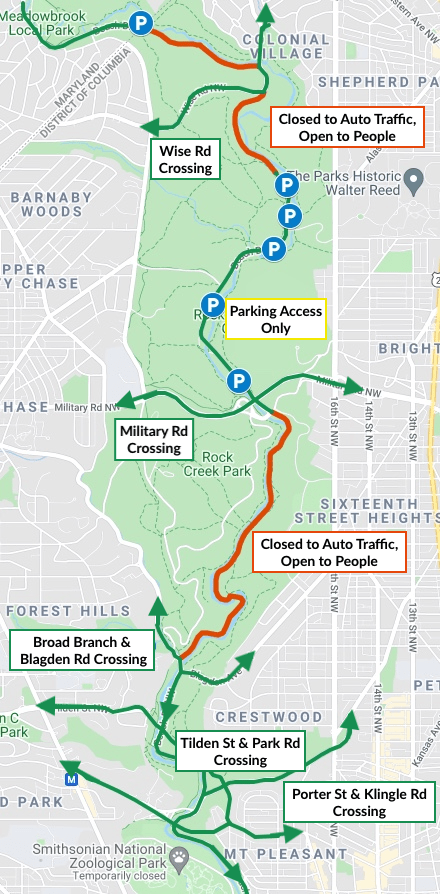
Since the 1980s, this portion was closed to traffic on weekends for recreational purposes. But during the pandemic, with outdoor space limited and a need for six feet of social distancing, NPS closed the section in April 2020 — and it’s remained that way during the entire pandemic.
Now at issue is whether the park’s main roadway should be for recreation or commuting. Before the pandemic, between 5,500 and 8,000 cars used the stretch on a daily basis. The D.C. Department of Transportation said during a roundtable that it could ensure alternative routes to Beach Drive were sufficiently able to absorb the likely increase in traffic should NPS decide to close Beach Drive.
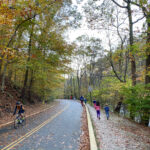
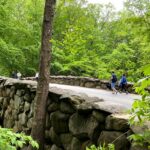
Dog walkers, joggers, cyclists, rollerbladers, and more have spilled onto Beach Drive during the pandemic, and many are now calling for it to stay closed permanently.
A petition from the People’s Alliance for Rock Creek and the Washington Area Bicyclist Association has garnered more than 4,000 signatures to keep the road closed to traffic. Last August and September, volunteers counted nearly 29,000 users — including 17,000 cyclists, 5,000 runners, and 5,000 walkers — during 56 hours of periodic counting over 12 days.
“There was also one cat on a leash, one bird on someone’s shoulder, children on shoulders, bike trailers, wheelchairs, a unicycle, skateboards, and electric single-wheel vehicles,” PARC’s Peter Harnick said last year.
He’s worked on the issue for decades and told DCist/WAMU last October that he expects an uphill fight. “We have our work cut out for us,” Harnick said. “We’ve had our work cut out for 40 years.”
The Rock Creek Conservancy has also supported the idea, saying it would reduce runoff, create less noise, and in turn bother less wildlife. Jeanne Braha, head of the conservancy, says it may take an environmental assessment or some other impact study to make changes to the park’s management plan.
“The park’s founding documents do include scenic roadways as a purpose of the park,” Braha said. “But a commuter thoroughfare is not the same thing as a Sunday drive… the way it’s used now is not really consistent with the spirit of the founding document.”
A competing petition to return the road to vehicles on weekdays has more than 700 signatures. The effort from D.C. resident Katherine Heretik says the issue is far more complicated with other road closures and altered bus routes during the pandemic. Traffic spillover on Oregon Avenue and Chestnut Street is a big concern, she says.
“Beach Drive is an important north-south artery in the congested D.C. region that also facilitates connections between destinations west and east of Rock Creek Park,” says her petition.
The petition says trails should be added so both cyclists and drivers can use the route simultaneously. But closure advocates with PARC says the road is narrow and there isn’t enough room for that without “destroying the character of the park.”
Opponents of closing off Beach Drive also point out that people do still recreationally drive through Rock Creek Park.
“People who find fulfillment in engaging with nature with their car windows down are still park patrons,” the petition reads. “And some of them are seniors who would not be able to enjoy the park but from their cars.”
The council vote on Tuesday was nearly as contentious. Several lawmakers spoke in favor of the resolution, but also wanted a more thorough study of traffic impacts.
Councilmembers Janeese Lewis George (D-Ward 4), Kenyan McDuffie (D-Ward 5), and Trayon White (D-Ward 8), along with Chairman Phil Mendelson, voted against asking NPS for the permanent closure of Beach Drive to traffic.
Lewis George, a co-sponsor of the bill, wrestled with her vote.
“I think closing upper Beach Drive is a promising idea,” she said during the council meeting. “And I know many D.C. residents, including myself, have enjoyed Beach Drive as a sanctuary during the pandemic, for walking, running, biking, and more. I’ve seen residents from all walks of life, all age, all demographics, enjoying [it].”
But she voted no after she heard from neighbors who said more cars were speeding through their neighborhoods during the pandemic. Speeds were up across nearly every type of road — from residential streets to interstates — as fewer cars were on the roads, creating less congestion.
Some residents criticized her vote, saying that traffic calming measures — speed bumps, cameras, and other enforcement — would address that safety issue rather than opening Beach Drive back up.
But others, like Lisa Gore, a Ward 4 ANC commissioner who lives near Oregon Avenue, tweeted that she’s had to deal with diverted traffic for years. She says there needs to be a study or data to back up DDOT’s assertion that traffic would not clog surrounding roads.
Portions of Beach Drive were closed in recent years as it was rebuilt in phases. Councilmember Mary Cheh (D-Ward 3), who represents areas west of the park, said those closures were a perfect experiment and that traffic actually decreased on nearby 16th Street during the construction.
Some neighbors say they still have concerns. The Shepherd Park Citizens Association expressed similar frustration with the closing. They voted 5-2-1 on a resolution recommending the council not act until more information is available and more voices have been heard. They say that when post-pandemic traffic volume returns to normal, it could affect the safety of neighborhood streets, hurt residents’ ability to leave their neighborhoods and navigate the city easily, and create traffic jams.
In 2003, the council voted to express the desire to keep the roads open for traffic to decrease congestion on other north-south routes. This time, a majority of its members think D.C. would be better off with no traffic there at all.
This story was updated to clarify the SPCA’s position and the correct number of cars that used the road pre-pandemic.