 Dominique Maria Bonessi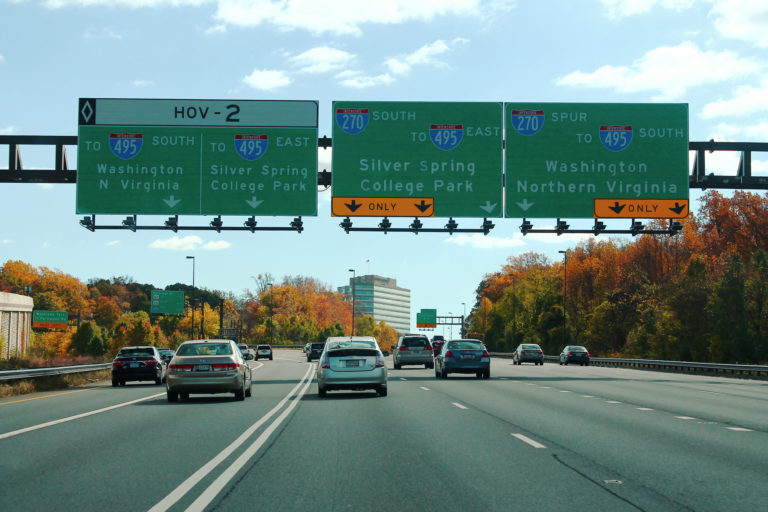
The Maryland Transit Authority Board granted preliminary approval Tuesday to an amended project that will expand the Beltway around the American Legion Bridge.
In a unanimous vote, board members gave initial approval to a proposal to add two high-occupancy toll managed lanes in each direction on the bridge from I-270 to I-370 in the northern region. To cut down on congestion, HOT lanes would allow cars with three or more people, including transit buses, to ride for free, while others could opt to pay a variable toll to escape a congested lane.
The project would also expand a 12-mile stretch on I-270 from the American Legion Bridge through Gaithersburg. Unlike previous iterations of the Beltway expansion plan, the current proposal does not include the eastern portions of the Beltway in Montgomery and Prince George’s counties.
Board members also approved the state’s partners in developing the public-private partnership (P3): Transurban Operations Inc. and Macquarie Infrastructure Development.
Greg Slater, director of the Maryland Department of Transportation and chair of the transit board, reiterated to board members that the approval was strictly for pre-construction efforts and not for the actual construction plan. Slater told board members in a virtual meeting that the current project does not displace any properties, exists mostly within its current footprint, and increases the throughput of cars in 2045 by up to 50%.
“This corridor has been the most congested in Maryland for many years, and simply providing a wider bridge will not provide that congestion relief,” Slater said. “We need a solution that will accommodate multimodal travel connections and incentivize people to carpool and get together. That’s exactly what these HOT lanes will do … it’s going to include new options for biking across the Potomac.”
But activists spoke out against the proposal, claiming that it was being approved prior to a completed and finalized environmental impact statement.
“It is irresponsible of the board to rush to approve a $50 million contract before the environmental review of the project is complete,” Arthur Katz, with the group Citizens Against Beltway Expansion, told board members. “The draft environmental impact statement had many deficiencies that must be addressed in the final environmental impact statement. For example, the draft failed to assess whether the project’s adverse impacts would be disproportionately borne by communities of color and low income communities.”
Katz added that the draft also failed to address the project’s impact on global warming, remote work effect on traffic patterns, and fiscal and social risks of adding toll lanes.
“The public has the right to know the facts and the pros and cons before any contracts are signed,” Katz said.
MDOT officials did not immediately respond to request for comment from DCist/WAMU about the concerns raised in the meeting.
Josh Tulkin, president of Maryland’s Sierra Club, agreed and requested that the vote by the board be delayed until the final environmental impact statement or “at least the release of the supplemental draft environmental impact statement with comments made by the public and responded to by the agencies.”
Tulkin said because the project changed in the past few months it requires a new traffic assessment, air pollution reviews, and water and stormwater impact reports.
“We’ve seen numerous false starts on this project,” Tulkin said. “This project, at this point, does not deserve a leap of faith where we’re putting the cart before the horse.”
Montgomery and Prince George’s counties’ bi-county planning commission have already rejected MDOT’s highway widening plan. Montgomery County Council President Tom Hucker said the project was also unpopular with most of his constituents.
“Secretary [Greg] Slater is trying to have it both ways,” Hucker said. “The march he’s trying to create to make this project inevitable is unbelievable.”
In addition to environmental and financial concerns, Ben Ross, chair of the Maryland Transit Opportunities Coalition, said that Virginia’s agreement with the developers needs to be released to the public. The coalition received a copy of the redacted, 18-page agreement between Virginia’s Department of Transportation and Transurban Operations, Inc. via a Freedom of Information Act request. The coalition says that the contract, which DCist/WAMU has reviewed, gives Transurban the sole right to extend its Virginia Beltway toll lanes to the Maryland border.
“Every single one of these blacked out clauses is being kept secret for a reason,” Ross told board members. “[The board] cannot vote on the selection of the P3 developer until the unredacted development framework agreement is made public and its meaning is fully understood.”
Ross alleges that Transurban was given an unfair advantage over his competitors in Maryland’s bidding process because it was already given the contract to work on the Virginia side of the American Legion Bridge. He says more transparency is needed in the process. According to Slater, the agreement between the developer and the Virginia Department of Transportation was under the purview of the commonwealth and not his department.
The proposed project still needs final approval from the state’s Board of Public Works, which is chaired by Gov. Larry Hogan, comptroller Peter Franchot, and treasurer Nancy Kopp.