 Dominique Maria Bonessi
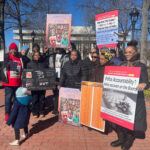
A group of activists demonstrated in front of the Upper Marlboro Courthouse Monday afternoon to demand the release of police officers’ names on a “do not call” list maintained by Prince George’s County State’s Attorney Aisha Braveboy.
According to Braveboy, the list — also known as a Brady list — contains the names of 39 county and local police officers whose involvement in a case could undermine the integrity of a case. Prosecutors in many jurisdictions maintain such lists, in order to keep track of officers with disciplinary or criminal backgrounds that could make them unreliable witnesses.
“It is a total lack of transparency,” Archie Elliott Jr. told DCist/WAMU. Elliott’s son, 24-year-old Archie Elliott III, was stopped for a DUI then fatally shot by Maryland State Police in 1993. “We don’t know anything [these police officers] have done…we can’t even name them.”
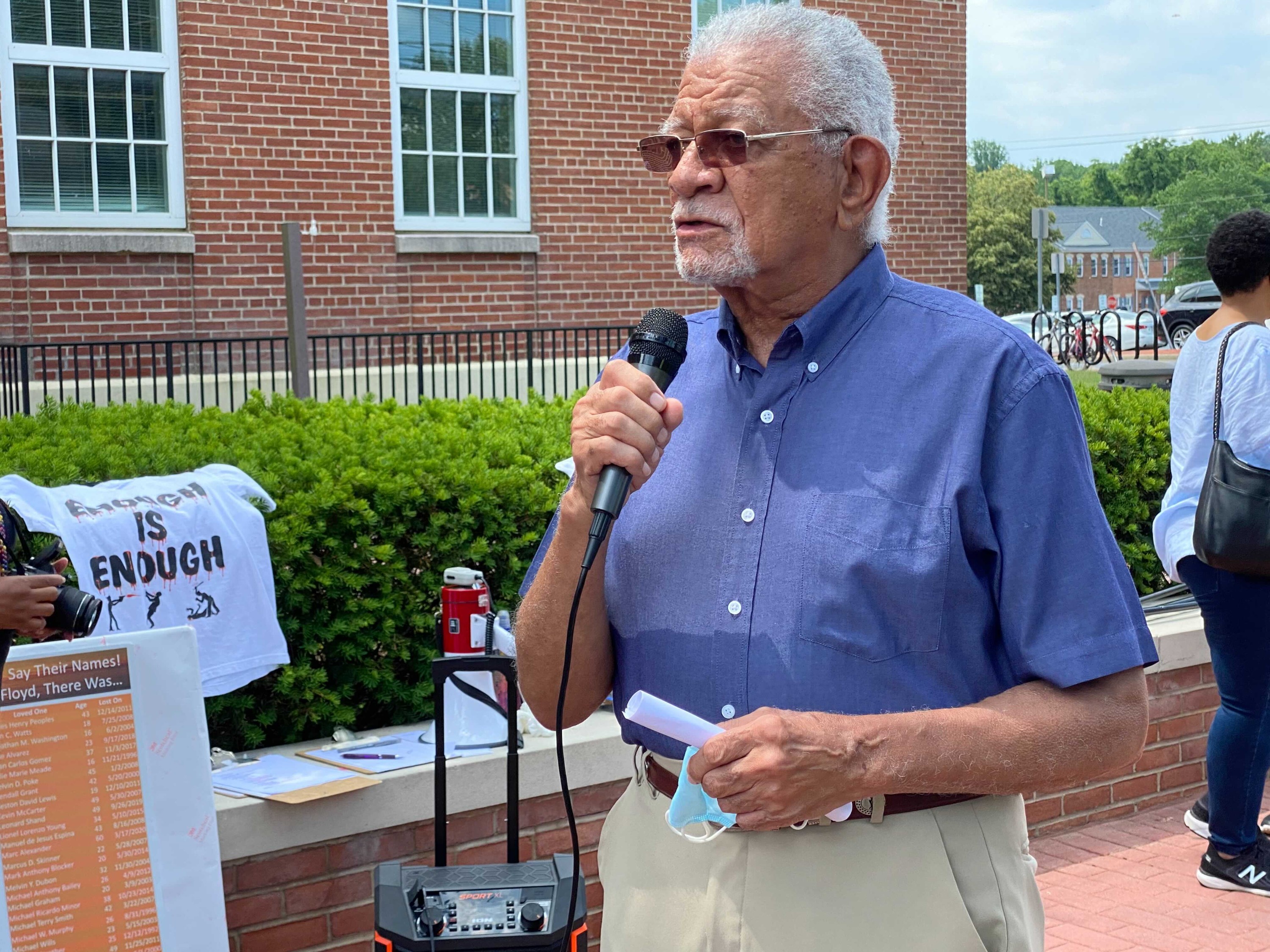
Elliott and other county residents, who have lost their children and relatives to police brutality, gathered in front of the courthouse Monday demanding that the list be made public, and that the officers on the list be prosecuted. They say the list undermines the justice system, protects officers who have committed criminal acts. The protest followed a myriad of police reforms that were implemented by county and state officials earlier this year.
“With this state of affairs, we can’t trust Prince George’s County policing or its prosecutors,” said Thomas Ruffin, chair of the International Association of Black Lawyers and a member of the Archie Elliott Coalition for Justice. “We refuse to allow elected officials like Ms. Braveboy to protect police who break the law.”
But Braveboy’s office defended its use of the “do not call” list.
“Based on our review, what we’ve found out is that these officers we’re not calling… have a tendency towards bias or we found that they have proven to not be credible,” Jason Abbott, the county’s deputy state’s attorney, told DCist/WAMU. “They’ve made some false statements in their past that we feel that they lack credibility.”
Abbott says the false statements fall short of perjury–or, lying under oath–which is illegal. But, others on the Brady list could have committed acts including falsifying reports, fabricating or tampering with evidence, lying on the witness stand, coercing witnesses, or blatant racism, according to the American Civil Liberties Union. The list came to light when Braveboy casually mentioned it in an April press conference. NBC Reporter Tracee Wilkins requested access to the list and was told it was confidential.
At least 17 of the officers, Braveboy says, she will not call to testify on behalf of the state. The other 22 can testify, but must have their disciplinary records disclosed to the court. The use of Brady lists stems from the 1963 U.S. Supreme Court case, Brady v. Maryland. In that case, the court ruled that the prosecution failed to turn in all the evidence, in violation of the defendant’s constitutional right to due process.
Last week, activists sent a list of demands to Braveboy and County Executive Angela Alsobrooks. First, they want officers on the list who have committed crimes to be prosecuted. Second, they want to allow the community to fire corrupt officers and make decisions about how police operate. And third, they want to hire special prosecutors for police misconduct cases.
But Abbott says the police on the list can’t be prosecuted because they haven’t committed any crimes.
“So it’s two different things, really. That they’re not credible or they have a tendency towards bias and we can’t call them as witnesses doesn’t mean that they’ve committed a crime for which we would then be prosecuting,” Abbott said.
The county’s new police chief, Malik Aziz, says police are working with Braveboy’s office to “develop a process for the Brady list.” Aziz added, “I don’t know enough about each case to say if officers should be prosecuted.”
However, the issue of the Brady list doesn’t stop with the lack of transparency, the County’s Public Defender Keith Lotridge says. Lotridge says there could be individuals currently sitting in jail whose cases were tainted by officers on the list.
Lotridge agrees with activists and says the list is a systemic problem because his clients, who are mostly Black males, don’t get fair trials in court.
“In every case, if there’s something bad about an officer that could be used to kind of show that what the officer did: that the officer’s essentially not truthful…or that he’s sloppy, anything that could in any way….exonerate, the defendant has a constitutional absolute right…right isn’t strong enough, it’s a demand that we as a society have that information be provided,” Lotridge told DCist/WAMU.
Earlier this year the Maryland legislature passed a series of police reform measures, including one called Anton’s Law. The law goes into effect Oct. 1 and requires that police disciplinary records be available to the public. Braveboy testified in Annapolis, earlier this year, in favor of Anton’s law and says she will make the list public if required by law.
But Lotridge says he’s cautiously optimistic about the new law because there maybe local, state, or other federal laws that keep the list private. He says he hopes the names on the Brady list will be subject to public information requests.
This story was update with the number of officers on the list and added description of Braveboy’s testimony in favor of Anton’s law.