Rachel Kurzius
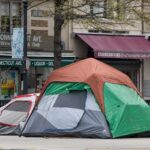
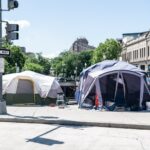
A small homeless encampment in Dupont Circle was scheduled to be cleared earlier this month, the tents slated to make way for café tables and chairs. At the last minute, D.C. switched to a trash-only cleanup, meaning that the people living there wouldn’t have to leave the area.
Advocates for people experiencing homelessness say it’s the first encampment clearing they’ve seen scheduled to make space for a “streatery,” the additional outdoor restaurant and café seating that has popped up across city sidewalks and parklets during the pandemic. Bill McLeod, the executive director of Dupont Circle Main Streets, applied for the public-use permit from the District Department of Transportation, listing coffee shop Zeleno as the beneficiary of the temporary sidewalk seating.
Shortly before the scheduled clearing on June 8, advocates posted about it on social media, drawing outrage. But ultimately, it was put on hold because the table and chairs for the space had not arrived, according to city officials and McLeod.
Now, some local government officials and advocates are calling on the city not to issue permits in public spaces where unhoused residents are living, raising concerns that the Dupont permit was specifically designed to displace people. McLeod denies this.
One D.C. official called the episode a “learning experience.” Jessica Smith, the deputy chief of staff at the Office of the Deputy Mayor of Health and Human Services, tells DCist that the encampment team likely won’t be scheduling cleanups because of the existence of public-use permits in the future, based on this occurrence. (DMHHS calls these clearings “cleanups” because the department does not prevent residents from returning.)
“I think we’ll have to probably wait for people to actually be trying to set up a table and chairs, or an encampment to be in the way, which would constitute, potentially, a health or safety risk,” says Smith. “I don’t think we can just take a permit [at] its word at this point.”
The two residents who live on the overpass at the intersection of Q Street and Connecticut Avenue NW say they believe the permit intentionally targeted them. And the owners of the coffee shop the permit lists as the intended recipient of the space say that they were interested in having expanded seating right outside their storefront, not across the street where the tents are located and the clearing was scheduled.
City officials say there are no current plans for additional clearings at the intersection, as first reported by Street Sense.
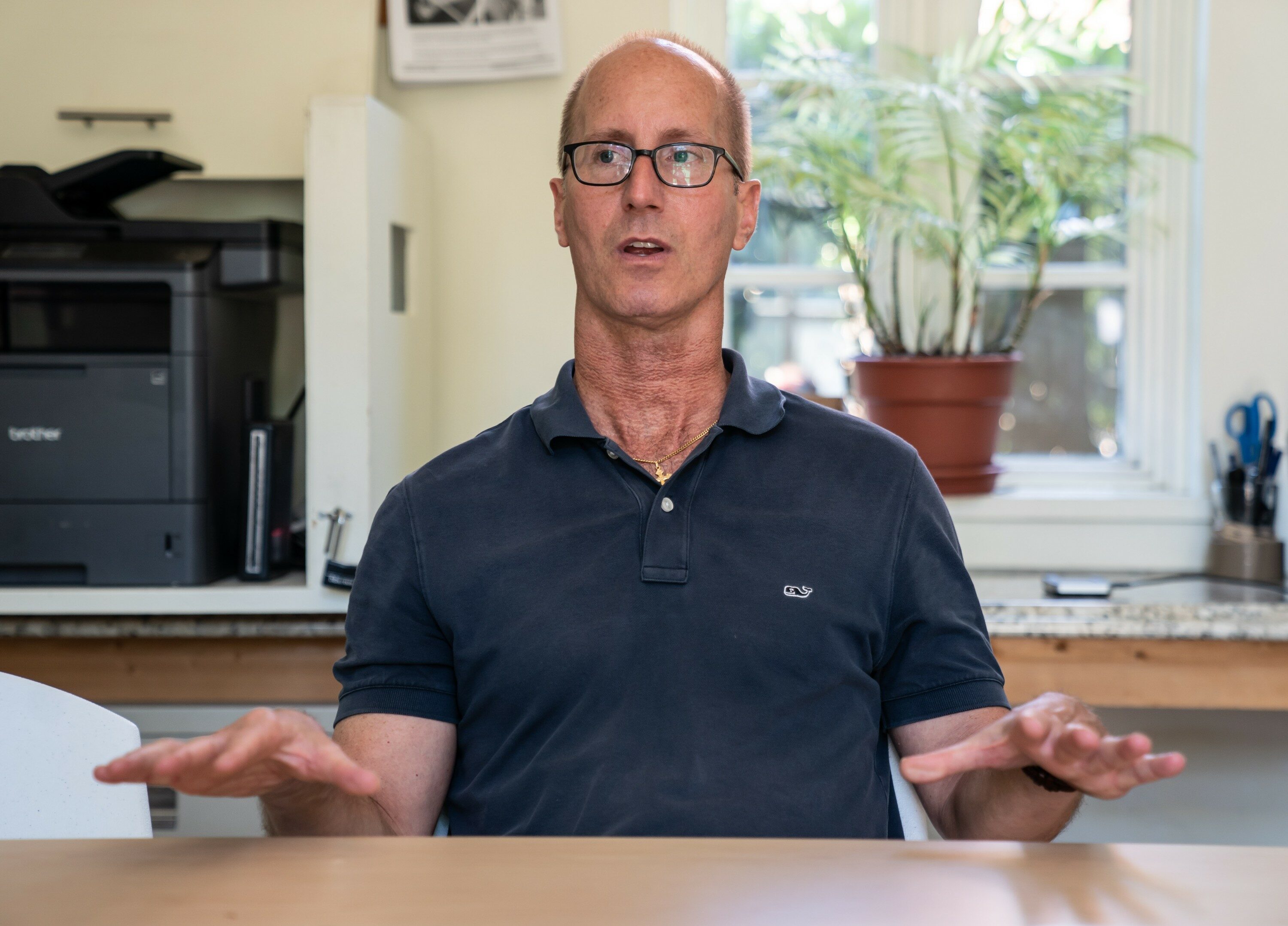
At the beginning of the year, McLeod applied for a public-use permit for additional tables and chairs for Zeleno, a coffee shop and health foods café that opened last September. Dupont Circle Main Streets has spent much of the pandemic applying for grants and permits on behalf of businesses in the neighborhood. The organization is among the civic associations and local government groups that have been granted access to express permitting for streateries during the pandemic, meaning McLeod can submit permits without review from the area’s Advisory Neighborhood Commission.
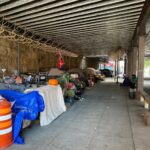
McLeod maintains that there were no tents on the overpass when he first applied for the permit. But eventually, he contacted DMHSS to say that he could not exercise his permit because there was an encampment in the way. That’s when the agency scheduled the clearing. (An additional, trash-only cleanup was scheduled for the same day on the other side of the overpass, where there are more people living in tents.)
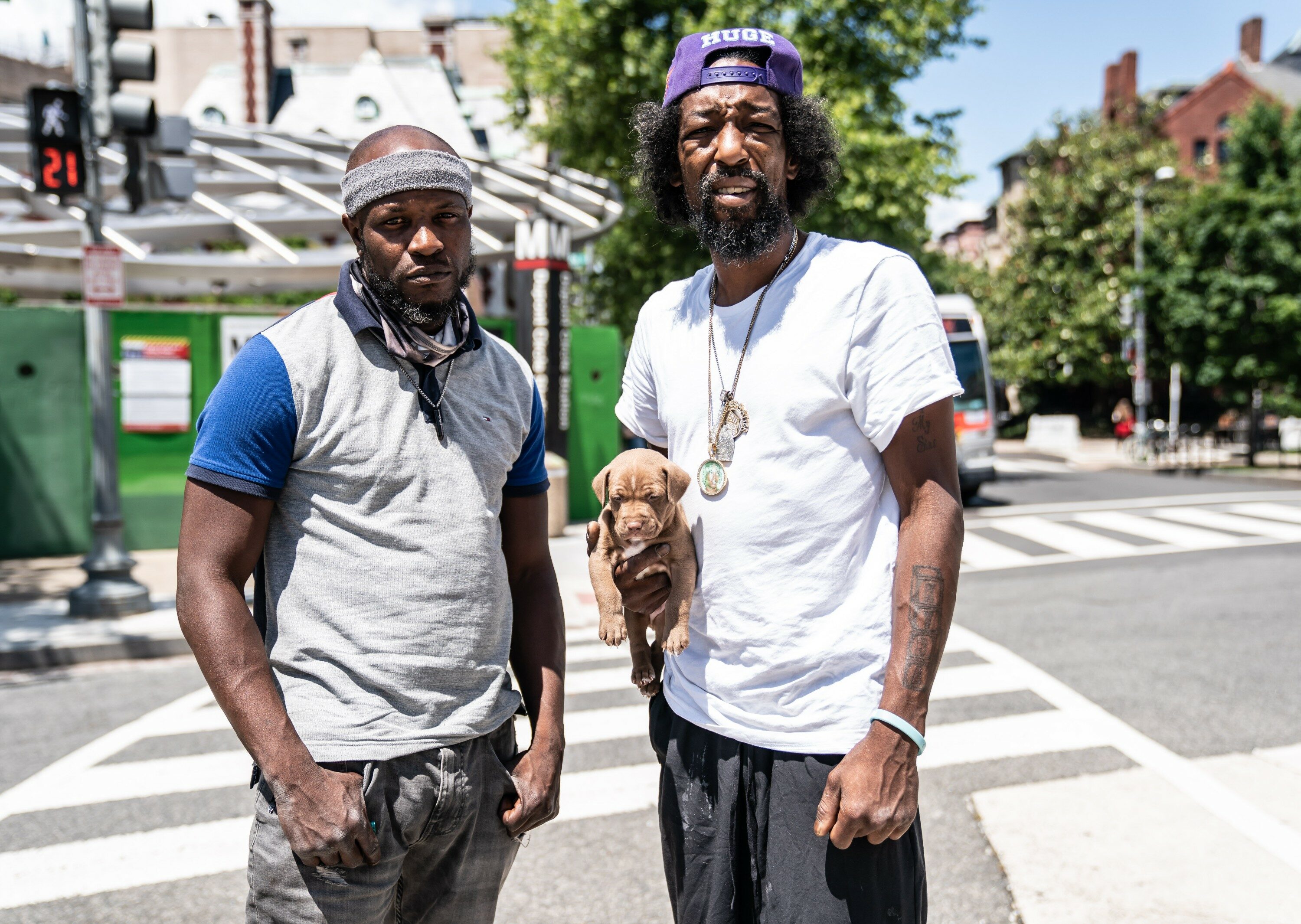
Michael Daniel, who goes by the nickname JP, was among the people living in the encampment. He grew up and went to school in the Dupont neighborhood, and returned after he was released from prison. He discovered upon his release in 2016 that his mother had died, and he had nowhere to go.
“I just started from scratch,” he says. He has lived on-and-off in different parts of Dupont since, and he delivers food for third-party apps. Despite that work, he doesn’t have enough money for an apartment.
Daniel has tried to find permanent housing through the city, but says the process takes years. “They’re saying, ‘Oh yeah, you just go sign up, sign up. It’s easy.’ Yeah right,” he says. “If that was the case, you wouldn’t see all these tents.”
Daniel and Sean, the other person living in a tent on that overpass, both express skepticism about the public-use permit (Sean asked that we not use his last name for privacy reasons). Busy streets separate the stretch of sidewalk from nearby restaurants, and they’re doubtful a restaurant would ask its employees to cross those streets to serve customers or clean up after them.
McLeod maintains he filed the permit to help Zeleno. “I’m trying to save a small business during a pandemic,” he says.
But the co-owner of Zeleno, Alex Gotzev, says that the coffee shop isn’t involved with the permit. He says McLeod called and asked if he wanted more tables, but it was his understanding that the tables and chairs would be placed outside of his coffee shop, replacing some newspaper boxes, not on the overpass down the block. He added that Zeleno currently doesn’t have the money to purchase outdoor furniture for the location.
McLeod says that he didn’t think that the clearing would lead the people living on the overpass to be displaced from their current homes. “I thought what was going to happen is that they were going to get housing,” he says. “That’s my hope.” He says it is “an injustice” that people are living on District streets and blames the city government for not finding them housing. He added that camping in public space is illegal under D.C. Code “but the mayor is not enforcing it right now.”
DCist obtained a letter that McLeod sent to Mayor Muriel Bowser in late May, which called on the city to house homeless people in shelters or vacant hotels, and enforce the “no camping in public space” law. “Business owners are incensed, residents are shocked, and visitors are frightened by encampments on public space,” the letter says.
Not everyone in Dupont Circle agrees that the city should enforce the prohibition on camping in public space. Robin Nunn, the ANC commissioner whose single-member district includes the overpass in question, says she was taken by surprise when she learned about the planned clearing.
“There’s nothing more important than people and human life,” she says. “And while I would like to sit out on a bench and have a sandwich, I don’t want people to suffer and have to move all of their worldly possessions in a cart to who knows where under intense circumstances.”
Nunn has since been working on making sure the permit does not get automatically renewed by DDOT in July. She sent a letter to the agency with the request: “While DDOT’s permit process has ensured the ongoing success of local businesses during the pandemic, those benefits do not extend to permits, like those at issue, which serve solely to displace people.”
As of Friday afternoon, Nunn says that her request has been rejected, and that DDOT will contact Zeleno — if the coffee shop doesn’t want the permit, then the agency won’t renew it. She is concerned that another clearing could be scheduled as long as the permit remains on the books.
DDOT has not responded to multiple requests for comment.
Nunn is one of 30 ANC commissioners who have signed a letter calling on Bowser, the D.C. Council, and DDOT to ensure that no additional permits are issued for outdoor seating in places where people are currently living, suggesting that ANC commissioners could confirm whether or not there was an encampment there if DDOT staffers couldn’t.
Ann Marie Staudenmaier, an attorney at Washington Legal Clinic for the Homeless, called using DDOT public-use permits as a justification for clearings an “end run around the protocol” used to engage with encampments.
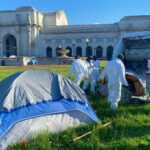
Ever since D.C. issued a state of emergency in March 2020, the city has been limiting — though not entirely forgoing — engagements with encampments, and favoring trash-only cleanups to clearings, per CDC guidance. That posture remains in place, Smith says.
That’s part of why Smith says that DMHHS is being cautious when it comes to scheduling clearings based on public-use permits moving forward.
“If we’re limiting engagements whenever possible and then we learn at the last minute that someone’s not prepared to occupy their permit, that doesn’t help us limit the engagements,” she says. “I do think this was a learning experience for us … If someone were to request this in the future, we’d have to do a lot more review and discussion before we could just schedule a cleanup because someone has a permit.”
It’s unclear if the city will continue to limit engagements with homeless encampments when the public health emergency ends. Advocates like Staudenmaier hope so, especially because of the consensus that homelessness will increase once the eviction moratoriums lapse.
“They’ve done this now for more than a year and the sky hasn’t fallen,” she says. “Our position is, can’t we just continue in this vein of, clean up the encampments. Try to get people in the encampments into housing, but in the meantime, don’t evict them from the only place that they have to call home.”
This year’s point-in-time count, which surveys people experiencing homelessness on one night in January, found that there was a slight decrease in single individuals experiencing homelessness, compared with a large drop in families experiencing homelessness.
But there’s no current data on the amount or population of Washingtonians living in encampments. Jesse Rabinowitz, the senior manager of policy and advocacy at organization Miriam’s Kitchen, says encampments have grown “pretty astronomically” during the pandemic, citing a number of reasons. Among them, some people lost housing despite the eviction moratorium; and some chose living on the streets over shelters due to concerns about contracting COVID. The chair of the Federal Reserve, Jerome Powell, told the Washington Post that the growth of an encampment near his office in Foggy Bottom served as a reminder that the economic recovery was not reaching everyone.
Daniel compares the permit situation in Dupont to people who put spikes on buildings to prevent pigeons from resting there. “That’s what they’re doing,” he says. “The pigeons ain’t breaking the law, but they just don’t like them. They make it so you can’t get comfortable.”