Colleen Grablick
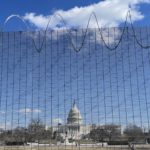
Six months to the day after law enforcement erected a black, metal, 8-foot-tall fence surrounding the Capitol complex in the wake of the Jan. 6 insurrection, the detested structure is finally coming down.
Reporter Jake Sherman first shared the news on Twitter.
In a memo to Congress members and staff on Wednesday, House Sergeant at Arms William J. Walker stated that “based on USCP’s assessment of the current threat environment,” police recommended that the temporary fencing around Capitol square be removed. U.S. Capitol Police did not immediately return DCist’s request for comment.
Removal is slated to begin this Friday, and conclude within three days, weather permitting.
The fence’s deconstruction wraps up the months-long saga of petitions, protests, and legislation, which began calling for its removal almost immediately after it was erected. In February, a group of residents formed a “Don’t Fence The Capitol” group, and their petition now has gathered 35,000 signatures. D.C. Del. Eleanor Holmes Norton repeatedly spoke out against the security measure, and introduced a bill that would ban a permanent fence after both the Capitol Police Chief and House Sergeant at Arms recommended making it permanent.
The fence took different forms in the nearly half a year that it surrounded the Capitol complex. It shrank in size in March, and residents watched gleefully as crews removed the foreboding razor wire that lined its top. It also interrupted hallmarks of D.C. life —from cutting off demonstrators from an iconic protest spot, to sucking the fun out of Capitol Hill sledding.
Allison Cunningham, a Capitol Hill resident who started the “Don’t Fence The Capitol” petition, says she’s excited to say goodbye, but wishes the fencing would’ve come down months ago. For residents on Capitol Hill, not only was it a logistical inconvenience, blocking off areas of outdoor green space and major thoroughfares, but she says it also served as a constant, visual reminder of the events of Jan. 6.
“It really just stands as a painful reminder of what happened January 6,” Cunningham says. “It’s also a reminder that people, and neighborhoods throughout D.C. and on Capitol Hill, don’t have as much power as we need in Congress, and are a little frustrated by our lack of ability to respond and react. I don’t think anyone would deny that there are challenges being a resident of the District of Columbia than someone with full congressional representation.”
According to Walker’s memo, authorities will continue to monitor threats to the Capitol, and the Architect of the Capitol will have the ability to “expeditiously reinstall temporary fencing should conditions warrant.”
Cunningham says that when she and other residents know more details about exactly when it’ll be gone for good, they’ll plan a celebratory going away party to mark the end of a particularly dark era for the city.
“Our hope is to go down to the fence and wish it goodbye, and celebrate the fact that we’ve moved on from that portion of this chapter of our history,” she says.