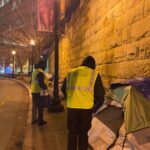
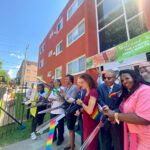
Mayor Muriel Bowser last week released the next five-year phase of her plan to end homelessness entirely in the District by 2025. Coming at the tail end of a pandemic that derailed Bowser’s initial goal of reducing overall homeless by 65% at the end of 2020, the new plan, dubbed Homeward 2.0, now hopes to play catch-up.
Authored by the Interagency Council on Homelessness, the plan recommends further investment in permanent supportive housing, a program that provides chronically homeless people who meet certain eligibility requirements with a long-term housing subsidy.
It also introduces a focus on racial equity, a guiding principle born out of lessons learned from the original plan. And while D.C. has been relatively successful in its approach to housing families, advances in tackling single individual homelessness have lagged, prompting a sharper focus in the new plan.
“We are a self-critical community,” says D.C. Department of Human Services Director Laura Zeilinger, who sits on the ICH and oversees services for the unhoused in D.C. “So we understand what works and also we’re constantly learning from our data and our strategies to improve our services.”
The trick, housing experts and advocates say, will be throwing real money behind the strategies outlined in Bowser’s plan. As Homeward 2.0 itself points out, it will not meet its own goals if the plan continues to see current levels of funding.
“Is this document going to have an impact on moving funding forward?” asks Adam Maier, director of housing partnerships at Pathways to Housing. “Is it going to be used by the council and the mayor to provide funding that’s going to be needed for individuals?”
Since its implementation in 2015, Homeward DC’s success has been mixed.
Its major goals included ending homelessness among veterans by the end of 2015; ending chronic homelessness among single adults and families by the end of 2017; and reducing overall homelessness by 65 percent by the end of 2020.
As Washington City Paper reported in 2020, D.C. has made some progress, but ultimately fallen short of these goals. It shuttered D.C. General, opened smaller shelters in most wards, and opened a long-desired day services center for homeless adults. But despite that progress, the overall rate of homelessness has decreased by 39% since fiscal year 2016, roughly 26% short of the mayor’s goal.
A 2019 report by the mayor’s office that examined the success of Homeward DC found that while D.C. managed to reduce homelessness among families by 38% between 2014 and 2018, overall homelessness only declined by 18.1% between 2014 and 2018. Between 2020 and 2021, homelessness in D.C. declined by another 19.9%, again with family homelessness declining at a much faster rate than it did for individual homelessness.
The Community Partnership for the Prevention of Homelessness, an organization contracted by D.C. to manage some homeless shelters and lead an annual count of unhoused people, attributed some of these reductions to federal and local action taken during the pandemic, including a ban on evictions and the temporary opening of hotel shelter for medically vulnerable people.
Meanwhile, efforts to fully fund the proposal waned after its first year, and the city has struggled to meet the affordable housing goals outlined in Homeward DC’s original plan. On top of that, the pandemic has also caused setbacks, forcing service providers, already stretched-thin, to adapt to the rapidly-changing landscape.
“We’re now behind on our strategies [to end homelessness]” laid out in the initial plan, says Kate Coventry, a senior policy analyst at the D.C. Fiscal Policy Institute. She says that the pandemic forced service providers to think about how to safely transfer people to shelter or quarantine them, and strategizing about longer-term housing stability sometimes fell to the wayside, “because there just was not enough bandwidth,” she says.
The new plan, Homeward 2.0, aims to build upon Homeward DC’s existing proposals, as well as reflect on the previous plan’s shortcomings. According to Zeilinger, the Interagency Council on Homelessness had over 45 community meetings for public input, and she calls the plan a “living document.”
It starts out by listing key guiding principles. Among them: recognizing that structural racism and racial inequities as a root cause of homelessness and acknowledging that homelessness is caused by policy failures, not people.
In 2021, 86.5% of all adults experiencing homelessness are Black, although just under half of all residents in D.C. are Black.
“There are years of discriminatory practices that harm Black households in the District and across the country,” says Coventry, who also sits on the Interagency Council on Homelessness, the collection of D.C. officials, local advocates, people experiencing homelessness, and service providers who helped develop the draft plan.
Reginald Black, executive director of the People for Fairness Coalition, praises the plan for its racial equity lens and emphasizing housing as a right. Homeward 2.0 also acknowledges that while D.C. doesn’t have the money to make housing a proper entitlement benefit for eligible people, it urges the federal government to do so.
“If we provide leadership in ‘housing as a right,’ other cities can reproduce our leadership,” says Black, who also sits on the Interagency Council on Homelessness. That goal, he says, was created with input by him and others with lived experiences of homelessness. But Black also says that the plan could’ve gone further in its racial equity lens, such as by pushing to have homelessness added as a protected class under the D.C. Human Rights Act to protect people from discrimination.
(Zeilinger says the plan includes an enhanced collaboration with the Office of Human Rights to increase enforcement of fair housing policies.)
Strategically, the plan puts more emphasis on supporting single people experiencing homelessness. Advocates for the homeless criticized Homeward DC for its often single-minded focus on reducing family homelessness – at times to the detriment of single people, who saw homelessness rise some years during Bowser’s first term.
The population of individuals experiencing homelessness is also aging, and those people require more support. The plan recommends that 35% of all of D.C.’s future investment in permanent supportive housing be in on-site projects, rather than through money for housing vouchers that force recipients to independently search for an apartment on the private rental market.
To meet this goal, the plan calls for working with the Partnership to End Homelessness to find organizations interested in this type of housing; identifying potential legal mechanisms that neighbors can use to block the development of supportive housing in their neighborhoods; and raising awareness around homelessness and its connection to structural racism and housing equity.
Black also applauds proposals in the plan to provide people with employment opportunities, which he says is crucial for single adults, particularly men.
“I think it’s really important to know how successful the city has been in housing families, just based on the fact that the city’s succeeded in reducing the number of families that are homeless. The same can be true for individuals,” Maier says.
To help the voucher distribution process operate more efficiently, Homeward 2.0 recommends retraining shelter staff who help applicants complete their paperwork, updating training guidance and expectations of case managers, and expediting the housing inspection process. It also suggests piloting a program to match voucher-seekers who might be able to share housing, an attempt to shave program costs.
Amber Harding, a staff attorney with the Washington Legal Clinic for the Homeless, points out that the strict eligibility requirements for permanent supportive housing means that it’s unlikely that dramatically expanding the program will widen housing access for many people. “This idea that all families and individuals can just qualify for [permanent supportive housing] with some level of light services or heavy services—that does not match up with what is currently in law,” she says. (In response to those concerns, Zeilinger points to rapid re-housing, which she says offers the support for single adults who don’t qualify for permanent supportive housing.
Homeward 2.0 also suggests addressing issues with the city’s rapid re-housing program, which quickly places individuals and families into available housing through short-term rental and utility assistance.
Housing advocates have long maintained that the central issue with rapid re-housing is that it’s functionally a revolving door back into homelessness when housing subsidies expire and people exit the program.
But Zeilinger says Homeward 2.0 hopes to change that by working with rapid re-housing participants on job retention and career building, which would hopefully enable participants to become financially independent by the time their housing subsidy expires.
Beyond rapid rehousing and permanent supportive housing, the plan says D.C. aims to complete its ongoing construction of short-term family shelters, as well as explore shelter options for people with pets and LGBTQ+ people by 2025.
Advocates emphasize the plan’s success depends on robust funding behind it, and for that, they’re looking to the city’s proposed fiscal year 2022 budget.
The mayor’s fiscal budget for 2022 proposed investments for Homeward 2.0 include 758 new permanent supportive housing units for individuals and 347 for families. The budget also proposes expanding Project Reconnect, which provides one-on-one support to adults at risk of homelessness. It additionally proposes $102 million in renovations to D.C.’s existing permanent and temporary supportive housing and shelters.
But The Way Home Campaign, a coalition of advocates for people experiencing homelessness, is says the city should spend another $66 million for permanent supportive housing, which the group estimates would end homelessness for an additional 2,300 households.
Homeward 2.0 acknowledges that, without more funding, it will not meet the goals outlined in the document. Maintaining fiscal 2020 funding levels would “push our system and existing provider capacity to the limits,” the plan estimates, failing to fully meet the needs of existing people who need permanent supportive housing, as well as failing to house those entering the system. Dramatically increasing funding, the plan says, would not only allow it to meet its goals, but also have enough resources to manage an increased demand for services.
And there is resistance in the D.C. Council to boosting funding even further for some housing programs. Just last week, chair Phil Mendelson wrote in a newsletter post that he was opposed to raising taxes to add more money into the budget unless agencies like the D.C. Housing Authority better manage the funding already allocated to them.
“I would just say to the council: Increase the budget,” Coventry says.