Martin Austermuhle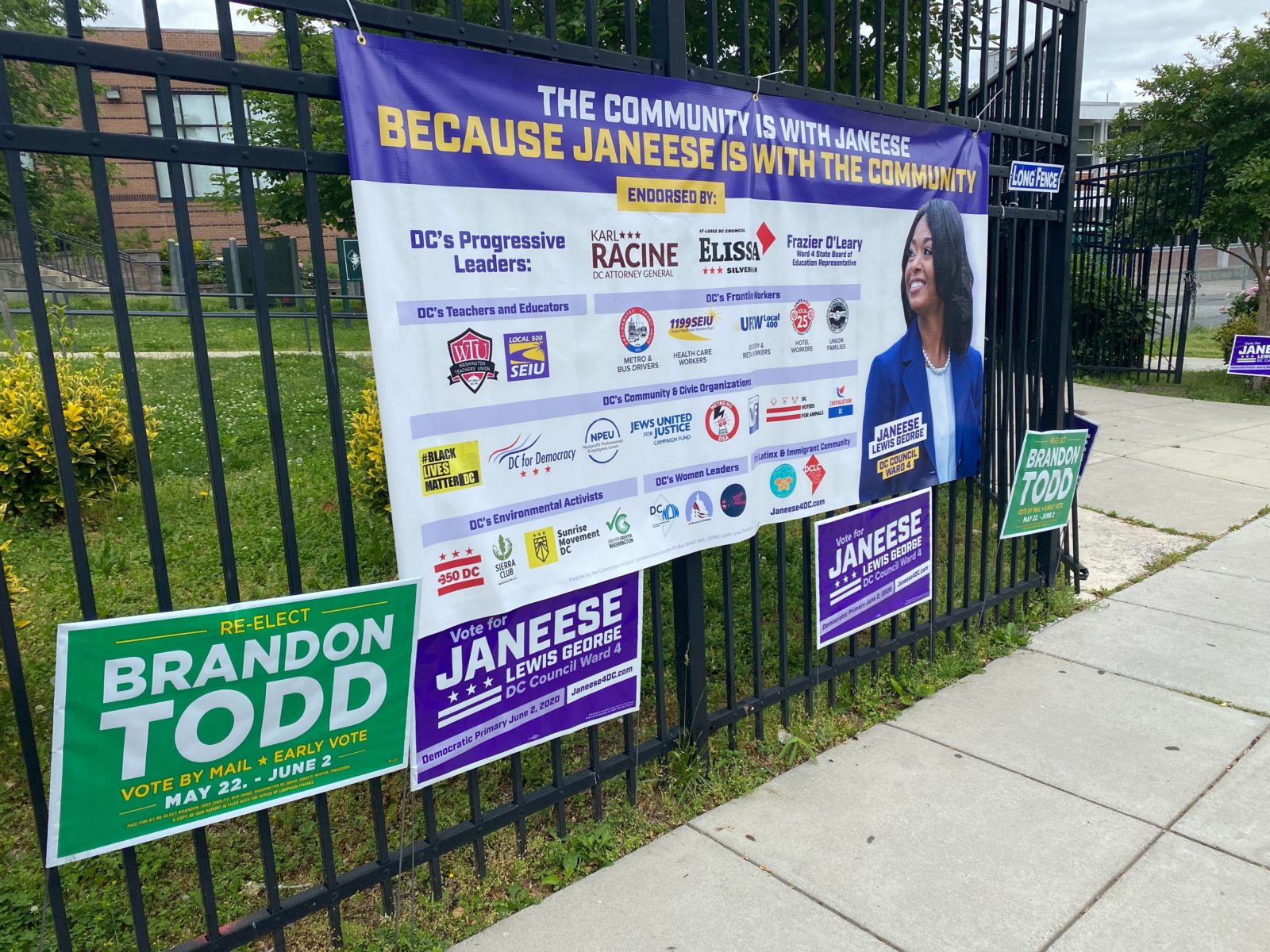
The number of people running for elected office and contributing to local D.C. campaigns increased in 2020, likely because of the city’s new program that offers public financing to candidates running for elected office.
Those are among the conclusions of a new report from D.C. Auditor Kathy Patterson assessing the Fair Elections Program, which was passed into law in 2018 and first implemented during last year’s election cycle, when it distributed almost $4 million to dozens of candidates for seats on the D.C. Council and State Board of Education.
Under the program, candidates who meet basic qualifications — a certain number of small-dollar donations from D.C. residents — and agree not to take corporate contributions receive a lump-sum payment to kickstart their campaigns and then a 5-to-1 match for every small donation they get from residents thereafter. Advocates say public financing — which is used in places ranging from New York City to Montgomery County, Maryland — can help make elections more competitive and diverse by reducing the reliance on traditional fundraising, which usually benefits incumbents and can by heavily influenced by big donors and businesses.
The auditor’s report says D.C.’s new program largely succeeded on those metrics. There were 25 candidates for two At-Large seats on the council and 12 for a Ward 2 seat, more than at any point over the last decade. And many of those candidates used public financing. (Earlier this year, the Office of Campaign Finance also found the program increased candidate diversity.) All told, there were 24 candidates in all D.C. Council races in 2016, and 53 last year.
Additionally, the auditor found that candidates who participated in the program were successful — Christina Henderson (I-At-Large) and Janeese Lewis George (D-Ward 4) won their respective races — and the usual dynamic favoring incumbents weakened slightly.
“Between 2012 and 2018, incumbents won 77.3% of their elections for D.C. offices. In 2020, two of the six incumbents running for office were unseated by challengers,” reads the report.
The report also concludes that the number of people contributing to D.C. campaigns jumped in 2020 relative to election cycles dating back to 2012. The number of smaller contributions (considered to be anything under $200) increased, while corporate contributions continued an eight-year decline; financial contributions also were more evenly distributed among candidates.
All told, the report — which included interviews with candidates who used the program — found that public financing helped boost first-time candidates, both in making money available but also setting specific requirements for candidates to qualify for it.
“[F]irst-time candidates indicated that [Fair Elections Program] funding was key to mounting a competitive campaign and getting their message out to constituents. In many cases, these two factors were linked: many candidates indicated that soliciting donations from a broad group of small donors throughout Washington, D.C., also provided an opportunity for lesser-known candidates to get their message out to a wider audience,” reads the report.
Still, the report found that improvements can be made to the Fair Elections program, largely in better advertising it to ensure all first-time candidates know that it exists and improving the system candidates use to report their contributions.
The program will get a bigger test in 2022, when seats up for grabs include mayor, D.C. Council chairman, and attorney general. The city is expected to set aside almost $16 million for public financing as part of the budget for the upcoming year — and it will allow candidates participating in the program to use the funds they receive to help cover child care costs incurred during campaigning.
So far, three candidates have committed to using public financing for next year’s elections: Councilmember Mary Cheh (D-Ward 3), Ward 5 candidate Gordon Fletcher, and attorney general contender Ryan Jones. Mayor Muriel Bowser, who hasn’t yet indicated whether she will run for a third term, remained non-committal on the program when recently asked about participating in it.
The council also may soon face another election-related debate that often comes hand in hand with public financing: whether to move to ranked-choice voting for elections. New York City now uses both; some advocates in Montgomery County, which also has public financing, have similarly pushed for ranked-choice voting, which they say can be especially helpful when a large number of candidates run for office.