Margaret Barthel
 Colleen Grablick
Jane Baber had stopped dating completely.
From March 2020 through June 2021, she kept mostly to herself, splitting time between her apartment in D.C. where she lives alone, and her parents’ home in Virginia. But after businesses began reopening at full capacity and vaccination numbers rose, she decided it was safe enough: the 35-year-old attorney scheduled her first date in more than a year.
Hours before she was supposed to head to an indoor cocktail bar, D.C. Mayor Muriel Bowser reinstated the indoor mask mandate.
“It feels like Groundhog Day,” Baber says. “You wake up and it’s the same day over and over and over again except they’re different like tweaks that happen throughout the day.” (She wound up meeting her date at an outdoor bar instead and has more first dates planned in outdoor settings.)
The surge of the highly contagious Delta variant has drastically shifted the nation’s experience with the pandemic, and the D.C. region is no exception. “The sense of urgency among public health folks is that the game has really changed,” says Neil Sehgal, a public health professor at University of Maryland.
D.C. was among the first localities to reinstate an indoor mask mandate; Montgomery and Prince George’s counties followed suit shortly after. Five local health departments in Northern Virginia issued a joint recommendation for mask-wearing indoors, though there isn’t a commonwealth-wide mandate in effect.
For many residents, the new rules — and rising case counts — have triggered old anxieties that they’d hoped would never return. And they’re once again rethinking how to navigate life at yet another unprecedented pandemic chapter.
Theaters, which have been gearing up for long-awaited fall seasons, are now confronting uncertainty in those reopening plans as cases tick up and people consider cutting back on entertainment activities.
Keri Schultz Kent, who worked as a production stage manager at a show at the Kennedy Center, and her husband Paul, a stagehand at various local venues, have been largely unemployed since the pandemic began.
“It felt like we had a moment of hope and that just got yanked away,” says Keri Schultz Kent, 41, of Deanwood. “It’s like when you’re downloading a big file on your computer and then it gets to eighty five percent, you’re excited that you’re going to finally get to move on with your project and then it just stops and you’re sitting there watching it and the time to finish just ticking up and ticking up. And there’s nothing we can do.”
Paul Kent says one of his employers recently cut back on their staffing plans due to the Delta variant, and he worries that he and Schultz Kent may be at risk of losing their union-provided health insurance, which expires at the end of the year if they don’t work enough hours on qualifying jobs.
The couple expresses deep frustration with people who remain unvaccinated.
“Other people refusing to take care of their health is quite literally affecting our health,” Paul Kent says.
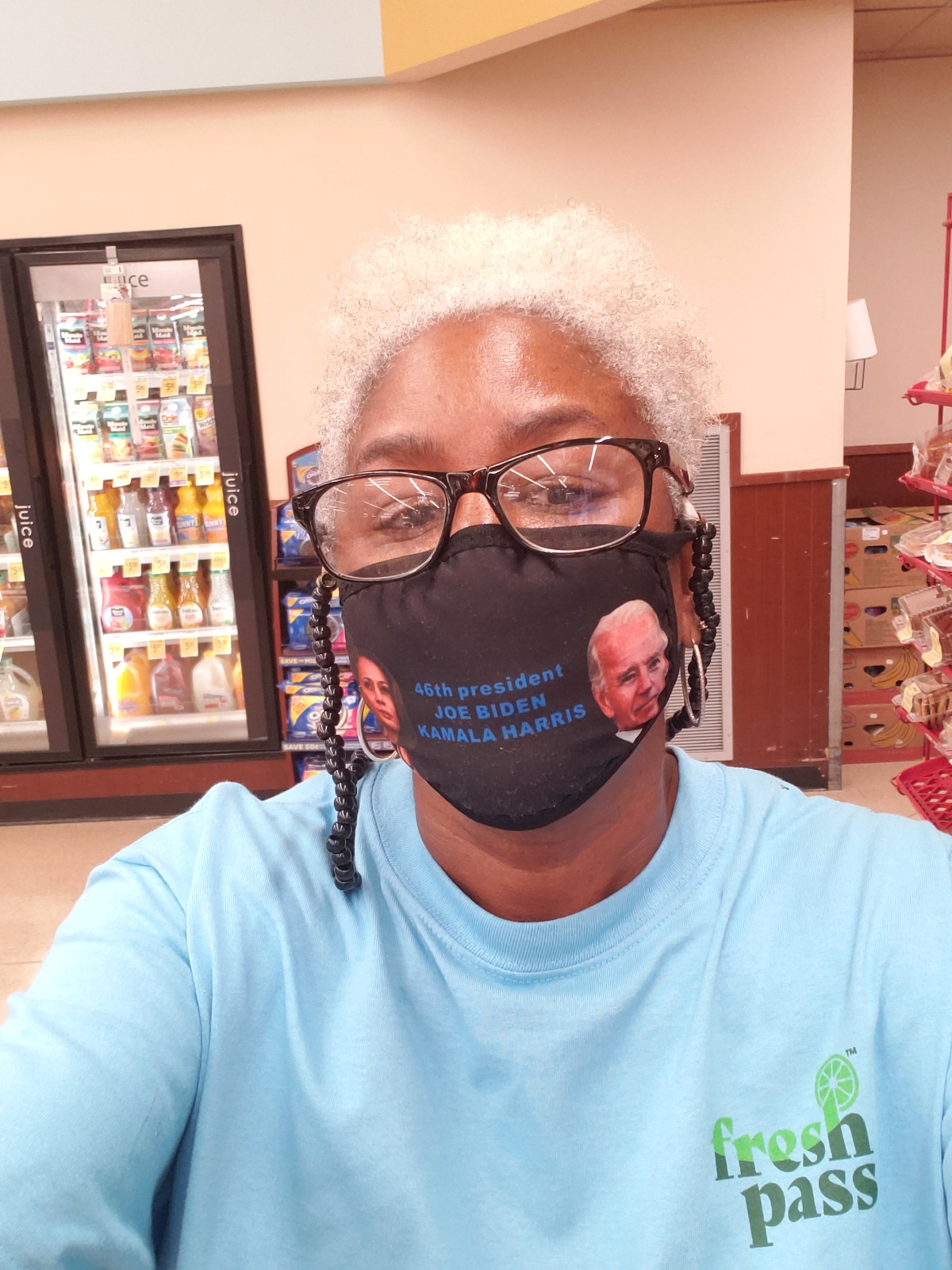
Jackie Echavarria shares in that frustration. A long-time employee of a Safeway in Petworth, Echavarria has been working full-time throughout the pandemic, often left to litigate mask enforcement with customers who don’t follow the store’s — or the city’s – policies.
A breast cancer survivor, Echavarria says she never felt comfortable taking her mask off or being around others maskless, even after receiving both shots of a vaccine earlier this year. As the region lifted restrictions and vaccination numbers rose, Echavarria didn’t jump back into indoor gatherings, opting for pool hangouts with friends instead.
While she can stand the masking and the social distancing, Delta’s rise has taken one major thing away from her: a trip to California to see her daughter. Echavarria hoped 2021 would be the year she’d reunite with her daughter on the West Coast, but she says there’s no way that’s happening now.
“That’s the only thing — not being able to see the people I love and care about,” Echavarria says “I promised everybody, [hopefully by] the beginning of next year, I’m going to brave the virus elements and hop on a plane.”
While some have compared the current moment to the discombobulated feelings of March 2020, Baber says the need to pivot has come to feel familiar.
“It took at least six months [since the start of the pandemic] for me to get used to the fact that I wasn’t going to know what was going to happen, and there wasn’t a lot of certainty,” Baber says. “To suddenly feel a bit of freedom and a bit of hope and then to be thrust back into uncertainty and a little bit of fear and trepidation — that’s almost more comfortable at this point, because it’s what I’ve been living through since last March.”
In many ways, though, the current moment is vastly different from March 2020. Unlike 15 months ago, a little over half of the population in D.C., Maryland, and Virginia is fully vaccinated against coronavirus. Even as D.C. is now reporting “high” transmission of the virus — the CDC’s definition for the highest level of spread — deaths remain at the lowest they’ve been since the pandemic began. Breakthrough infections, while possible, rarely result in hospitalization or death — proof, experts say, that the vaccines are working. According to DC Health data, 13 fully vaccinated individuals have been hospitalized due to COVID-19 since vaccines became available in January, less than 1% of all fully vaccinated individuals in D.C.
But the renewed uncertainty for the future still has residents approaching the fall with apprehension, unsure of what’s next for the region. Employers are delaying return-to-office plans, and more and more businesses are requiring proof of vaccination for entry to keep patrons and staff safe.
Sehgal, the public health expert, says the Delta surge is likely to last for at least several months.
“I think most reasonable folks who study the science of this pandemic don’t think we’re gonna be past this current wave completely until October. And so on the one hand, there’s a light at the end of the tunnel; we know that early fall, before Halloween, we’ll start to see a return to more reasonable case rates. But it’s going to be a hard road getting there.”
Meanwhile, the shift in the pandemic arrives just a few weeks before most area school systems return to full-time in-person instruction, including for students under 12 who are not yet eligible for a coronavirus vaccine. And vaccination rates for older kids are still patchy: in Northern Virginia localities, close to 60% of young people ages 12-15 have received at least one vaccine dose, compared to 26% in D.C. In wards 7 and 8, that percentage is dramatically lower.
In response to a survey about back to school anxieties, dozens of parents told DCist/WAMU that they were concerned about the transmissibility of the Delta variant and the safety of their children, particularly in communal settings like school cafeterias. Many also worried that students would struggle to adhere to all-day indoor mask mandates and social distancing requirements.
Emboldened by vaccines and driven by the need to regain some sense of normalcy, some residents are being a little more adventurous than they once were, even as they continue to take precautions.
Erin, a D.C. resident who preferred to not give her last name to protect her employment, has started taking trips out to Virginia to attend indoor yoga classes without a mask. She says she wears a mask everywhere that it’s required, but thinks the discrepancies between jurisdictions (D.C. has a mask mandate indoors, Virginia does not) make it difficult to assess how cautious she should be right now.
“I think there is a sort of disconnect with the fact that D.C. has a mandate, but if I just hop over the river,” Virginia doesn’t, Erin says. “So there [are these questions] like, are we social distancing, what does this entail?”
Others are maintaining the basic pandemic preference — socializing outside — but are more willing to make exceptions if that option isn’t available.
“We prefer outdoor dining,” says Ayala Pourat, 29, of Logan Circle. But unlike earlier in the pandemic, when they would have skipped out on a restaurant that didn’t have outdoor seating, “this time we kind of bite the bullet and we dine indoors.”
Pourat says she’s happy to comply with the reimposed mask mandate, knowing it’s the only way to get case counts under control. But that doesn’t mean masking up again isn’t without its frustrations.
“Putting it back on for the first time, it was like, ‘Wow, this is annoying. Am I turning into a Republican?’” she says.
Pat Daniels, who lives in a senior affordable housing building in Adams Morgan, has also gotten more cautious since the rise of the Delta variant. She’s still going in person to work as a receptionist at a senior wellness center five days a week, but she’s pulled back on some activities, like going on walks at bustling local malls. And she keeps away from people on the Circulator bus who wear their masks under their noses.
“My social life is sort of thin due to the fact that a lot of people do not like to wear masks,” Daniels says.
Daniels cancelled a long-awaited trip to a family reunion in the South earlier in the summer, and she’s no longer planning a hoped-for visit to New York City, either. The new stage of the pandemic has been difficult for her, an extrovert who enjoys being out and about seeing friends and family. But COVID-19 hasn’t clouded her sunny disposition yet.
“It’s going to get better,” she says. “It’s just that we have to all work together to improve things. One person cannot do it. You know, as they say, it takes a village.”