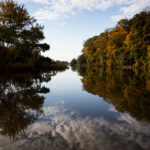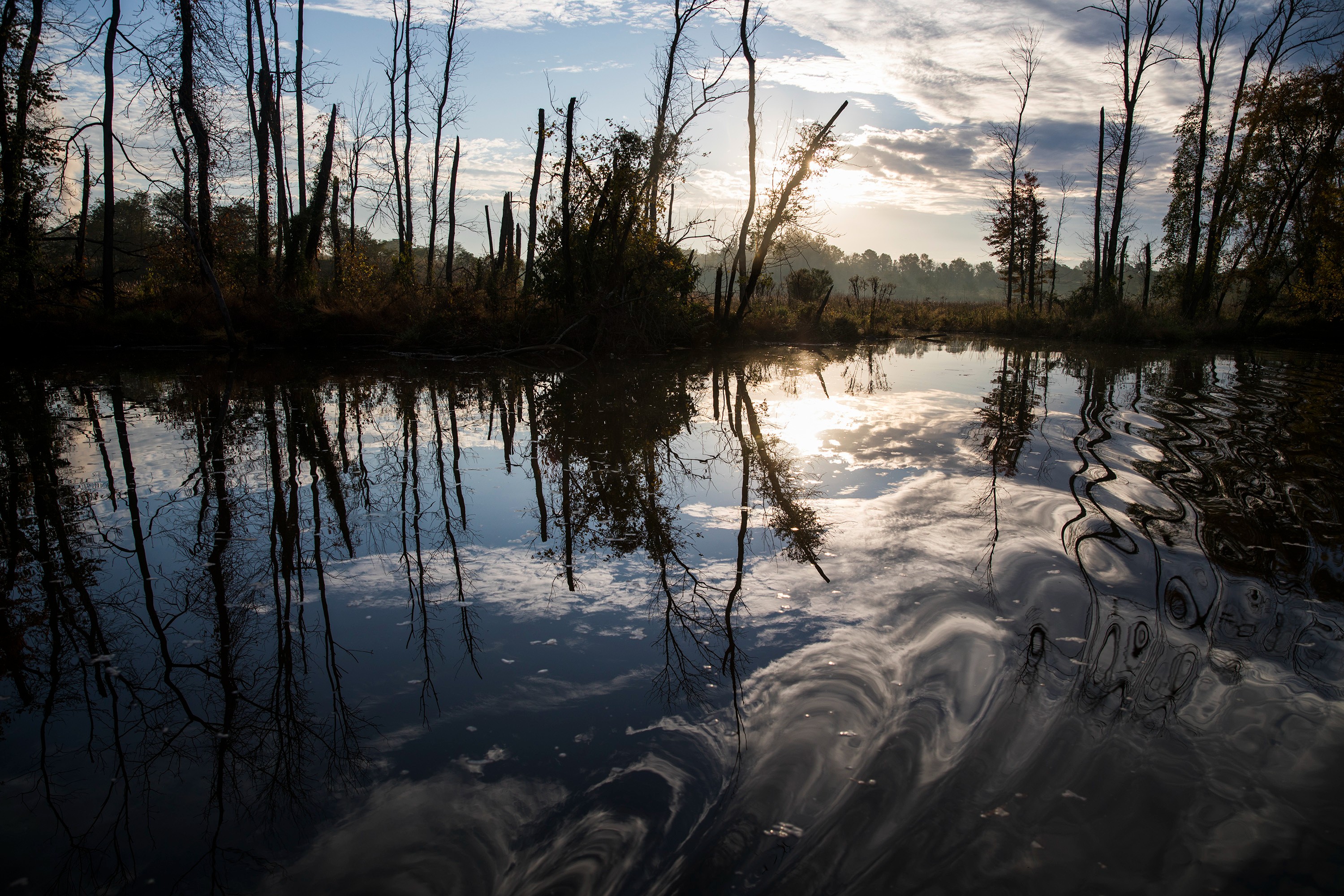
“Seeking refuge” like ospreys and kingfishers. Examining how “the hues of the earth not sedimented / in your banks, but always remade, / painting fresh reflections.” Forecasting that “In fall, the leaves / will cover the ghosts / as the last rower skims past.”
These are some of the words used by poets Susan Bucci Mockler, Kathryn Sadakierski, and Marianne Szlyk, respectively, in a new anthology about a District landmark: the Anacostia River.
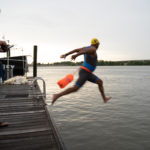
The Forgotten River is a collection of poems and other artwork from members of the Anacostia Swim Club, an organization that uses community events, education, and advocacy to help create a river that is healthy enough to swim in. The group’s founder, Robert Bettmann, led the project, and the book was curated by three women: Kim B Miller, poet laureate of Prince William County; writer and editor Thea Joselow; and arts educator Hope Greenleaf. The D.C. Department of Energy and the Environment provided financial support through The Chesapeake Bay Trust.
And on Saturday, in true pandemic fashion, the work will debut with a virtual launch party on Zoom.
Years before the Anacostia earned its nickname for its environmental degradation, the river flowed cleanly on Nacotchtank (or Anacostan) land. When the city of Washington, D.C., first broke ground, it was known as a “river city” — and the renamed Anacostia River was one of its pillars.
By the 1970s, after decades of sewage and runoff had polluted the river, the Environmental Protection Agency pushed city lawmakers to ban swimming in the river altogether. The subsequent ban – which also applies to the Potomac River — comes with a fine or up to 10 days in jail.
“There are some instances where we don’t know what we’re missing,” Bettman says. “The Anacostia has been polluted [for so long]. By marketing the idea of a swimmable Anacostia River, we’re hoping that more people will get engaged and push policymakers [to protect it].”
Today, residents are beginning to see some bright spots: Billions of dollars have been spent or committed to the waters’ clean-up; the District continues to drill tunnels that have already prevented more than 80% of the sewage overflow that used to seep into the river; and the Anacostia Watershed Society has even deployed small mussels that naturally filter the water.
Earlier this summer, the river even received a passing health grade from the Anacostia Watershed Society: a D, only the third time it received a rating higher than an F. As recently as last month, the U.S. Geological Survey began installing a “super gage” to measure bacteria levels and water clarity, with the aim of eventually being able to predict windows when the water is safe enough to swim. As technology has evolved to develop a clearer picture of what lies beneath the water’s surface, the District’s Department of Energy and the Environment loosened the swim ban to allow exceptions for specially sanctioned swimming events.
And though some can remember taking a dip in the Anacostia’s waters, a whole generation of Washingtonians might be baffled by the idea of the river as a destination for cooling off in the summer.
“The Anacostia wasn’t much a part of my experience — except as a punch line,” says Joselow, a D.C. native who grew up in the region during the 1980s.
Then last year, as the pandemic hit, Joselow kept hearing the same comment: “nature is healing.” The Anacostia Swim Club turned towards the nature it has been trying to heal, and looked for a new way to express what the natural landscape meant to them — even if they couldn’t do it in person. Enter a collection of poetry and art: organized online, all about the same subject.
The curators held an open call for submissions and then admitted pieces of work as a committee. The artists who submitted work were a mix of existing Swim Club members and local creatives who learned about the collection through organic outreach and (digital) word-of-mouth. Applications were free, artists were unpaid but kept full copyright of their work, and each one received a copy of the finished work.
Each piece of the collection takes a different perspective, but all of them carry an appreciation for the District’s natural landscapes: joy for what exists, contemplation for what could happen, or remorse for what has already been lost. All three curators say they were struck by the different ways in which District residents interact with our region’s water — and how, in many cases, residents are reclaiming the relationship with the river where it had been lost.
W.F. Lantry, in their poem Intricate Forms Lead to Contemplation, approaches the river figuratively and literally by walking the forest along the Anacostia’s banks. Marlena Chertock examines the river as a metaphor for nature more broadly in her work, “Migration,” which begins:
To block off the imaginary borders of our country,
as if we own land — an ever moving creature
Ruth Trevarrow, whose print Shad is featured in the book, takes a narrower approach by “becom[ing] focused on something that catches my eye: fish swimming in the water, birds flying, silhouettes of bare trees. Then I study that type of thing for a long long time, over time, up close, from a distance.”
The poet Marlena Chertock chooses to examine rainfall. Pacyinz Lyfoung references the Japanese practice of mending broken pottery with gilded lacquer in her poem Anacostia Kintsugi. Gregory Luce offers a poem that is a part of his longer series of haikus “regarding the seasons.”
Although the artists brought different approaches to the assignment, the curators found similarities in their experience with the work. After considering the entries separately, the three women would come together (still via Zoom), to discuss it.
“I was surprised how much we agreed,” says Greenleaf. “All of our readings were very similar and were all on the same page even though we have diverse backgrounds.”
After the book launch, the Anacostia Swim Club and its members are going to continue working towards a healthier waterway and what new relationships can grow from it. Proceeds from the sale will go into building out their educational and community events — all of which are still being held virtually until a decline in the pandemic makes it safer to gather in person.
“The river is so underutilized,” says Greenleaf. “It could bring so much more to the D.C. community if we were able to clean it up and if it were swimmable, once again.”
The Forgotten River will have a virtual launch on Saturday at 7 p.m. The event is free, but discounted sales of the book are available for $15. Copies are available online for $21.