Jacob Fenston
If it seems like it’s been a rainy few weeks, that’s because it has been — August 2021, was, in fact, the rainiest August in D.C. since 1967. That’s not even counting the downpours on Sept. 1, as the remnants of Hurricane Ida swept through the region. It was a rainy summer altogether: in the past 50 years, there has only been one rainier summer, in 2018.
All that rain — often arriving in intense bursts — is a sign of a changing climate. One of the major impacts the mid-Atlantic can expect, as the planet warms, is wetter and more extreme weather. The recent heavy rain is also bad news for local waterways, and people who recreate on them, though new sewage projects are helping to make the water cleaner.
“One of the hallmarks with climate change is heavier rainfall, and we’re seeing this across the area,” says Bernadette Woods Placky, chief meteorologist with the organization Climate Central. “If you think about it, our globe is mainly water. When you heat that globe, you’re getting more evaporation, so there’s more water in the atmosphere ready to come down when it is triggered.”
Ida in particular — though hitting the D.C. region a few hours after the end of August — was “supercharged by climate change,” says Woods Placky. Warmer oceans fuel hurricanes, allowing them to intensify more quickly, and bringing heavier rain. “It doesn’t mean we wouldn’t have an Ida without climate change, but climate change is pushing these types of storms to whole new levels with heavy rainfall,” Woods Placky says.
Looked at over the long term, rainfall totals in D.C. have not increased significantly. What is expected to change, however, is the frequency and intensity of storms. What was once considered a 100-year storm is expected to be a 25-year storm by 2050 — in other words, four times as likely to occur in any given year.
Historically D.C. gets an average total of 11.78 inches of rain in the summer months. This summer, 18.82 inches fell, according to the National Weather Service. In August, 3.25 inches of rainfall is the norm, while this year, 9.07 inches fell, according to the NWS.
The intense rainstorms in recent days turned the Potomac River, the Anacostia River, and Rock Creek a chocolatey brown, filled with muddy sediment and pollution.
Water testing conducted on Wednesday showed unhealthy levels of bacteria at all eight testing sites on Rock Creek, as well as four out of seven sites on the Anacostia. On the Potomac, where water quality is generally better, two sites out of six had unhealthy bacteria levels. Washington Channel, consistently the cleanest site in the city, was the only place to meet water quality standards for swimming (though swimming is banned in all D.C. waterways).
"Rock Creek, under normal conditions, is dangerous for human contact," says Potomac Riverkeeper Dean Naujoks, whose organization participates in the weekly water testing effort, along with other local groups.
Bacteria levels in the rivers will be at unsafe levels at least through Saturday, Naujoks says.
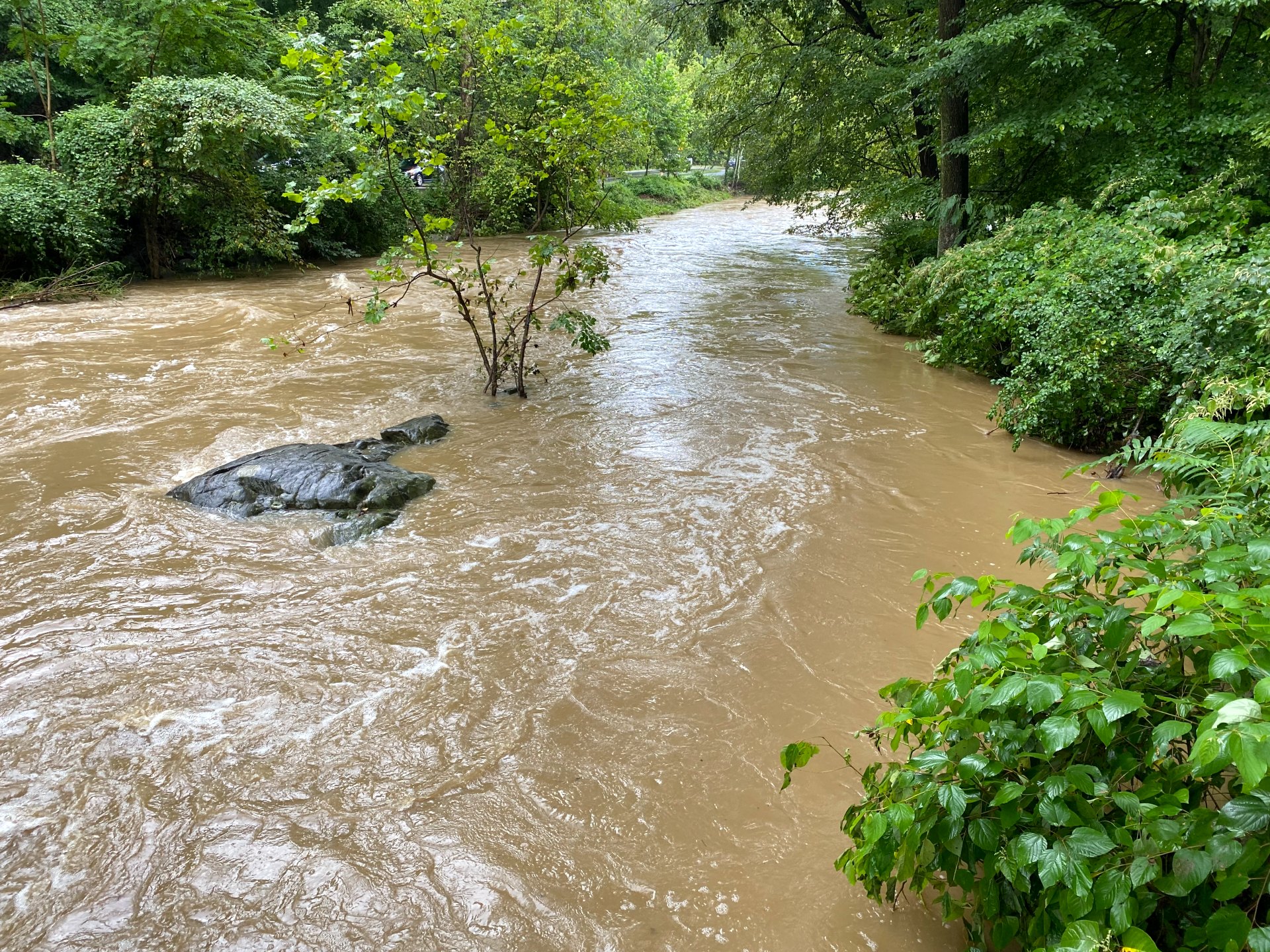
Storms in D.C. pollute the rivers in two different ways: stormwater runoff and combined sewer overflows. In a natural, forested setting, stormwater is not a problem — roughly 90% of rain evaporates or infiltrates into the ground, filtering through the earth to slowly feed creeks with clean water. In highly urbanized landscapes, rainfall hits impervious surfaces, like roads and roofs, and more than 50% becomes runoff, rushing toward the nearest drain, taking with it whatever pollution it encounters along the way.
"When you get rains this significant, you just have a total flushing effect," Naujoks says. "Everything that's on the land like pet waste, any sources of bacteria, are going to be flushed from stormwater into the river."
In old cities, including D.C. and Alexandria, antiquated combined sewers also overflow raw sewage directly into waterways during large storms. These sewer systems carry stormwater and sewage in the same pipes, and can quickly fill up with rain, bypassing sewage treatment plants and dumping through dozens of outfalls along the Potomac, Anacostia and Rock Creek.
The good news is that a massive new tunnel system built by DC Water is capturing and treating much of the sewage that would otherwise overflow into the Anacostia, and new tunnels are planned for the Potomac and Rock Creek in the next few years. On Sept. 1, as Ida's remnants battered the region, the Anacostia tunnel captured 88 million gallons of sewage and stormwater, which would have otherwise poured directly into the river. There were no sewer overflows on the Anacostia, according to preliminary DC Water data.
Naujoks says people planning to hit the water over the holiday weekend should be careful, and check local conditions.