Elliot C. Williams
The lions and tigers at the Smithsonian’s National Zoo have tested positive for coronavirus, according to a Friday announcement from the zoo. Initial results from fecal samples have come back positive, but the zoo is waiting on final results to be confirmed with a national lab.
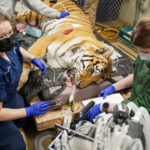
Six African lions, a Sumatran tiger, and two Amur tigers — all the great cats at the Northwest D.C. facility — were included in the test results. Over the weekend, zookeepers observed multiple cats showing decreased appetites, coughing, sneezing, and lethargy. The lions and tigers are undergoing treatment with antibiotics to help with their discomfort and decreased appetite.
The cats are showing varying degrees of symptoms, as the tigers’ symptoms appear less severe, according to National Zoo spokesperson Pamela Baker-Masson. “Because the test results are presumptive positive and we are observing symptoms in the animals, we are treating all animals as positive,” Baker-Masson told DCist in an email.
No other zoo animals are showing COVID-19 symptoms. The great cats can still access their outdoor habitats, and their distance from visitors won’t put people at risk, per the zoo.
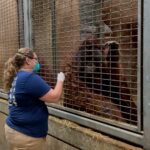
The zoo has conducted an investigation of all staff that have been in close contact with the big cats. While the zoo said it’s possible the cats were infected by an asymptomatic human, so far, it has found “no evidence to pinpoint the source of the infection.” The zoo has kept the vaccination status of its staff members confidential.
Researchers have found great cats and apes to be more susceptible to contracting coronavirus. A COVID-19 vaccine for animals has been used on a case-by-case basis at zoos across the country, as the U.S. Department of Agriculture has approved a vaccine by Pfizer subsidiary Zoetis.
Earlier this summer, the company donated over 11,000 doses of its vaccine to nearly 70 zoos across the U.S. The National Zoo and its Conservation Biology Institute in Virginia plan to use the vaccine on its most susceptible species in the coming months, the zoo’s statement said.
The zoo currently requires free timed-entry passes, face coverings in indoor areas for all guests and zookeepers, and has closed certain areas for COVID-19 safety since it opened to guests in May.