Rachel Kurzius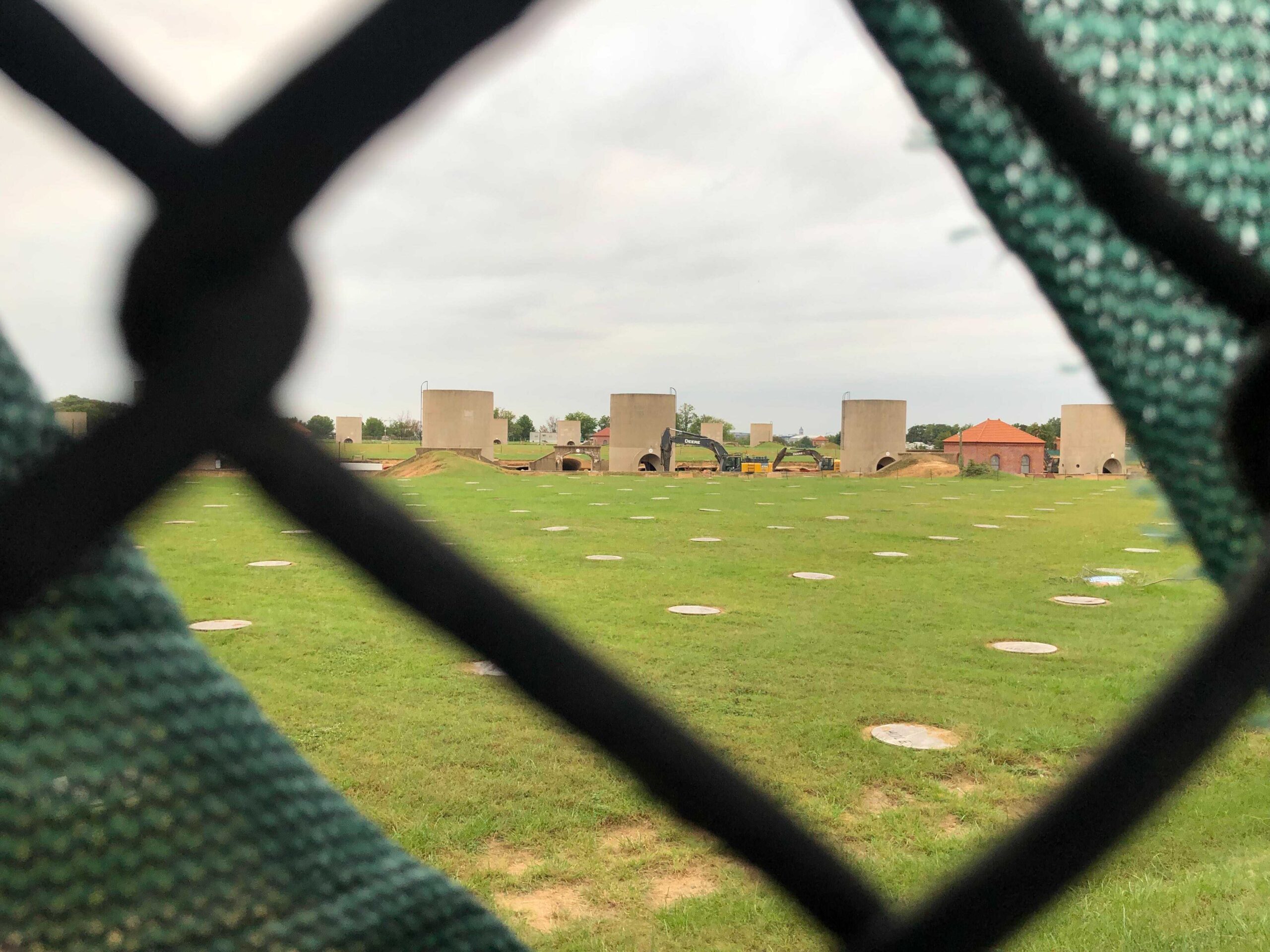
The start of the construction process at a D.C. development is generally too common to merit a news story. But the beginning of demolition at this particular site, known as McMillan, comes after years of legal limbo and marks a new stage in the protracted saga. And even as heavy equipment rolls in, a small but passionate opposition continues to fight the project in the courts; one group is even calling on Congress to intervene.
The effort to build on McMillan, a 25-acre plot of land on the edge of D.C.’s Northwest quadrant alongside North Capitol Street, has been ongoing since the city acquired it from the federal government in 1987. The massive century-old brick cisterns that dot the property are a reminder of its history as D.C.’s first large-scale water purification system, which used sand in underground catacombs to filter the city’s drinking water. The plant was decommissioned in 1986, and while the city allowed tours until 2012, the land has largely sat gated and unused for decades.
To opponents, McMillan represents everything that’s wrong with the District’s attitude towards development. They see the project as destroying an eye-catching historic property to add soulless buildings, and they say it’s being done without proper community input. But there’s also an avowedly pro-development crowd, who believe the amenities offered in the plan will serve the community better than fallow, fenced-off land, and who worry a small band of litigious activists is preventing the construction of more housing as D.C. faces an affordable housing crisis.
The current plan for the property is a 2.1 million-square-foot-project that includes a range of housing, retail and other facilities. Plans call for 146 townhouses, more than 500 apartments, a Harris Teeter supermarket, a community center with a pool, a healthcare facility, restaurants, and retail, alongside an 8-acre park. About 20 percent of the housing units are slated to be affordable for low- and moderately-low income residents. The design incorporates the two dozen historic buildings, including all of the cisterns, along with two of the underground catacomb cells.
Heading up the project is Vision McMillan Partners, a group comprised of three well-known local construction companies: EYA, Trammell Crow, and Jair Lynch. While D.C. chose the group to determine a master plan for the site through a competitive bidding process, Vision McMillan also became the de facto developer, in a process that the city auditor said was flawed.
The complicated chain of events regarding the development at McMillan is perhaps best exemplified by city officials holding a ceremonial groundbreaking on the site in December 2016, only to face a serious setback the very next day: The D.C. Court of Appeals vacated orders from the Zoning Commission and the Mayor’s Agent for Historic Preservation that had cleared the path for work to begin, meaning the city had to go through the bureaucratic process once again.
In addition to the lawsuits making their way through local and federal courts, the D.C. Council has been far more involved than is typical when it comes to development projects. First, Chairman Phil Mendelson introduced emergency legislation in 2016 that would effectively keep Vision McMillan on board, rather than reopen the bidding process. While the move kept the project moving along, it also added to opponents’ ongoing perception that the development was the product of backroom political dealings or even out-and-out corruption.
Over the summer, as litigation continued to stymie the development, the council stepped in again. Mendelson introduced an amendment to the Budget Support Act that called for the McMillan project to “proceed expeditiously and without further delay through all phases of demolition and construction of the foundation of the community center.” The measure passed, despite concern among some councilmembers that it set a bad precedent for council intervention in court disputes.
And it appears that amendment did indeed have an impact on a case in the D.C. Court of Appeals challenging the city’s demolition permit. Late last month, a three-judge panel lifted a stay on demolition activity, as first reported by the Washington Business Journal. (The underlying case against the demolition permits, however, was not dismissed — the next hearing is Oct. 26.)
A day after that ruling, on September 30, the city began demolition. Passersby at the site can expect to see construction activity, including backhoes and other equipment moving the soil, and dump trucks hauling it off.
But the concentrated assembly of opponents is far from throwing in the towel. Composed mostly of two overlapping groups — Save McMillan and Friends of McMillan Park — they’re notorious among local newshounds for trying to turn every conversation into one about the development. Many have been vocal opponents of other development in the city, including Chris Otten, the leader of Save McMillan, who regularly files lawsuits in an effort to delay and stop projects. Otten disputes the characterization of his work as delay tactics. He says that, while delays may be the result, the purpose is to prevent displacement of residents.
Greater Greater Washington policy manager Alex Baca says arguments that cite developments like McMillan as the drivers of gentrification in the city are overly simplistic: “It’s comforting to think that, ‘Oh, we stop the development with the luxury condos and the people who live in the luxury condos won’t come.’ But they will come. They’ll just buy your row house for $1.2 million.”
Opponents began staging protests last week, and they’re planning more. One over the weekend at the site saw a counterprotest from a neighborhood group advocating in favor of the development.
Members of that group, Develop McMillan, want the amenities, housing, and green space the project will bring. Some of the neighborhoods that surround McMillan are food deserts, which would change when the Harris Teeter opens.
“We have been the silent majority supporting the development for many years, but only in the past year have organized as a cohesive group,” says Develop McMillan leader Thomas Boeke over email. “We are tired of the FOMP and Save McMillan setting the narrative and giving the impression that the community is opposed to this project. Many residents in the local communities are no longer willing to sit back and allow this site to wallow in disrepair and squalor.”
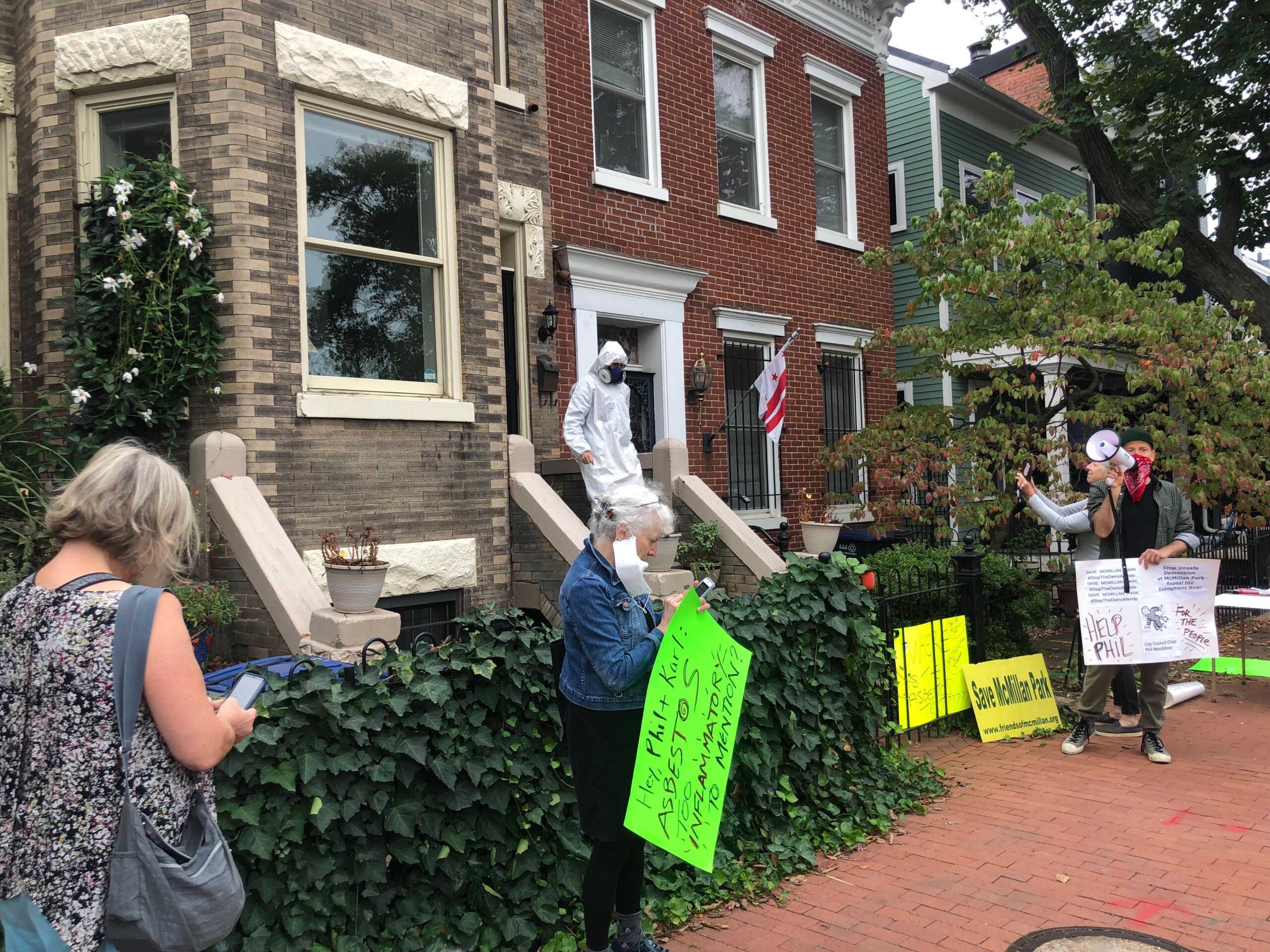
The opponents’ latest argument against to the development of McMillan was apparent at their Monday protest in front of Mendelson’s house, which had about a dozen participants. Attendee Jim Schulman wore a respirator and a hazmat suit, to demonstrate that the city and the developers have not released a report of the hazardous materials that could emerge during demolition.
“We citizens who’ve been involved for the whole run have no faith and have no confidence that the city has done its due diligence in terms of hazardous materials,” he says, adding that advocates have found experts who believe there is a likelihood that there is asbestos in the concrete.
The city contests this claim, contending that the demolition is safe. A 2016 letter from former D.C. Department of Consumer and Regulatory Affairs director Melinda Bolling says that a slew of reviewing agencies determined that demolition “is not likely to have a substantial negative impact on the environment,” meaning the submission of an environmental impact statement wasn’t required.
But the asbestos claim is the latest in a litany of arguments presented by opponents, which Baca describes as “Whack-A-Mole arguments where it’s like, ‘Oh, it’s the process.’ ‘Oh, this should be a hydroponic farm.’ And things just keep coming, and it’s like, this is not a coherent ideology because there isn’t a coherent ideology. The only thing coherent is that they don’t want it.”
But Otten says the legal arguments aren’t frivolous, and the proof is in the 2016 D.C. Court of Appeals ruling that waylaid the city for years. “We’ve had to use the levers of law and logic,” he says. “We relied on the law to win those cases.”
And opponents continue to seek relief in the courts. Daniel Wolkoff, a plaintiff in a federal court case that alleges D.C. has violated the historic preservation covenants associated with McMillan, filed a temporary restraining order on Tuesday to stop demolition.
And Friends of McMillan Park wrote in an email that the group was trying to rally members of Congress to intervene.
“We started the week calling ‘minority’ (Republican) members of the Oversight Committee, presuming that the ‘majority’ (Democrat) members likely would side with Congresswoman Norton and be against anything that could be linked with a perceived statehood challenge,” the email states.
The approach hinges on the fact that Congress can intervene in D.C. policy and affairs, a primary gripe of statehood advocates.
“I’m rethinking statehood,” said Carole Lewis Anderson, an opponent of development at McMillan, at Monday’s protest. “If we don’t have a council that works legally, it’s very hard for me to argue for statehood.”
Previously:
McMillan, D.C.’s Most Cursed Development Project, Explained
This story has been updated to include Chris Otten’s disagreement over the characterization of his work and a quote from Thomas Boeke of Develop McMillan.