Jacob Fenston
If you think about eating chestnuts, there’s probably a certain song that pops into your head. Sing along now: “Chestnuts roasting on an open fire…”
The song was popularized by Nat King Cole in the late 1940s. Ironically, this was the very moment when the last mature American chestnut trees on the continent were succumbing to a fatal blight.
The blight was first noted in the D.C. area around 1905. “Some blight has affected the chestnut trees, and many of them are dying near the city,” wrote the Washington Post at the time, lamenting the lackluster autumn foliage.
In the first half of the 20th century, an estimated 4 billion chestnut trees were wiped out as chestnut blight swept across the eastern United States. By 1950, there were virtually no survivors, except scraggly sprouts from dead stumps (which can still be found in D.C.-area parks).
Along with the trees, a food staple with deep roots in North America disappeared from the menu. Chestnuts were prized by Native Americans, and likely on the table during the first Thanksgiving in 1691; chestnuts were likely an ingredient used by James Hemings, Thomas Jefferson’s enslaved chef, in the room where it happened, when Jefferson, James Madison, and Alexander Hamilton agreed on a location for the new nation’s capital in 1790. In the mountains of Appalachia, chestnuts enabled a rural way of life that was no longer possible when they were gone.
But chestnuts are slowly making a comeback, with a burgeoning chestnut-growing industry in the Mid-Atlantic. This could be good news for your palette, and also for the environment.
‘An Extreme Blessing From Nature’
“This was one of the most bountiful foods that America has ever known,” says culinary historian Michael Twitty, author of the James Beard Award-winning book “The Cooking Gene,” which explores the history of race and food in the South. Twitty, who was born and raised in D.C. and now lives in Northern Virginia, says his ancestors in the South undoubtedly incorporated the American chestnut in their diets.
The nuts were an especially important source of nutrition for enslaved people and free people of color, he says.
“In a culture where you have very limited means, foods like this are an extreme blessing from nature. We can’t even imagine how many chestnuts were available,” says Twitty.
Chestnuts were tasty, nutritious, and free. Enslaved people, Twitty says, would use chestnuts in soups, sauces, stuffings, and sweets. The nuts were often collected by children, who couldn’t do as much work in the field, he says.
Collecting chestnuts and other foraged nuts and fruits, as well as trapping game, provided an accessible source of nutrition for people who were forced to spend most of each day laboring for others without pay.
“It really does take you into the heart of the different strategies that enslaved people used, and free people of color at the time used, to extract a living despite all of the oppressive and marginalizing forces used against them,” Twitty says.
Native Americans were also well aware of the nutritional value of the chestnut.
Author Charles Mann, who wrote the book “1491,” about the Americas before Columbus, says Native American agricultural practices are part of the reason the American chestnut was so widespread.
“They would burn areas and then plant chestnuts — they would manage succession — until enormous parts of the eastern United States were covered with chestnuts,” Mann says.
Later on, poor farmers relied on chestnuts as a backstop, in a bad year when crops failed.
“The common claim back then was that a single large chestnut tree provided enough calories — I mean, people didn’t talk about it in terms of calories but that was the idea — for a family for a year. So that if you had a chestnut tree, you weren’t going to go hungry,” Mann says.
In fact, one historian has argued that the demise of the American chestnut led to the end of a way of life. Subsistence farming in Appalachia was no longer tenable without the chestnut’s bounty.
Farming Chestnuts, Again
These days, it’s possible to find chestnuts for sale locally and online. They can be found at farmers markets in the fall sometimes, or through local food purveyors like Number 1 Sons.
The nuts are versatile — they can be roasted with a little butter, or used in savory dishes, or desserts. They can be processed into flour, which is gluten free, and used in baked treats or to make pasta. Chestnuts are still popular in Asia and Europe.
Mann has been on a personal crusade to bring back chestnuts as an American food staple, hosting a chestnut feast at his house and penning an opinion piece titled “Let’s Farm Chestnuts Again.” Mann says chestnuts should be an everyday ingredient, not a pricey gourmet item.
“An analogous situation would be if wheat were suddenly a specialty food that you had to go online and hunt around, and get some expensive package from Amazon sent to you,” Mann says. “If that were to be the case 100 years from now, we would think that was extremely strange, and that’s more or less what’s happened with the American chestnut.”
While native chestnut trees can no longer thrive due to the blight, which still lingers in the environment, there are available hybrid chestnuts trees that are blight-resistant and produce nuts indistinguishable from pure American ones. The hybrid trees can’t grow in the wild — they are too short and bushy to compete with the tall oaks, tulip poplars, and other trees that now dominate eastern deciduous forests. But the hybrids are perfectly suited for growing in orchards.
Growing chestnuts on a large scale could come with a host of environmental benefits — top among them, cutting greenhouse gas emissions and fighting climate change. Agriculture accounts for about 10% of emissions in the U.S.
Mann notes that chestnut trees produce as much food per acre as crops like corn and wheat, but don’t need irrigation or fertilizer. The trees sequester lots of carbon, much more than shallow-rooted row crops. Tree roots also help prevent erosion, as does the tree canopy, retaining soil nutrients and preventing runoff pollution of nearby waterways. And, Mann says, it doesn’t matter if people have lost the taste for chestnuts; they can be used for animal feed or for other industrial uses (nearly 40% of U.S. corn — the country’s top crop — is used to feed animals).
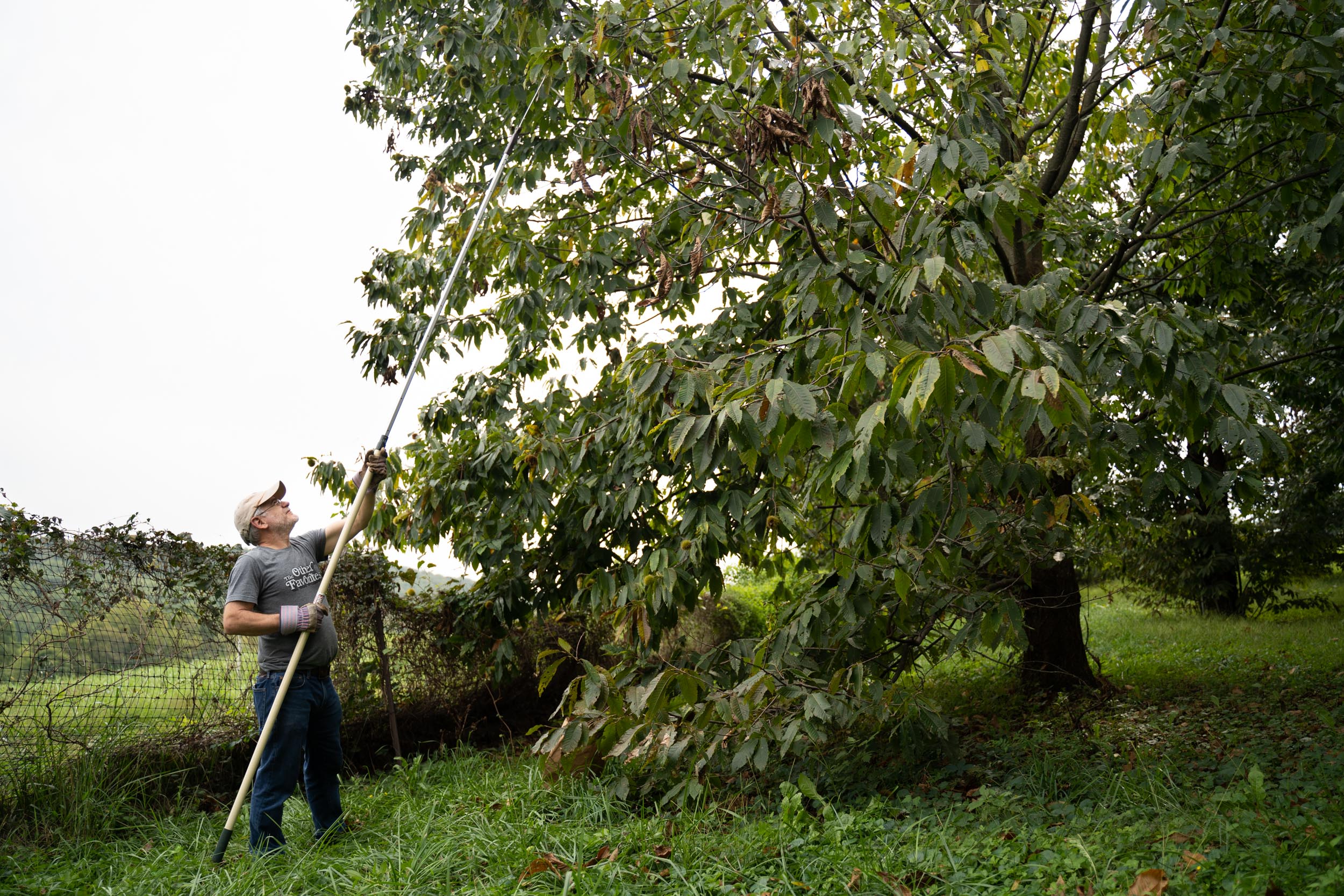
In recent years, some farmers in the region have started planting chestnuts again.
“You have to love the sustainability, because you’re going to plant that tree and it’s going to be here long after I leave this Earth,” says Kim Bryant, who along with her husband, grows chestnuts in Virginia on 46 acres they purchased in 2003.
At Bryant Farm, they have 1,600 trees, producing as many as 10,000 pounds of chestnuts a year, which they sell online and in local markets. The couple also have a nursery, selling young trees to other would-be chestnut farmers, and have helped four other chestnut farms in Virginia get started.
“We are crazy busy right now,” Bryant says.
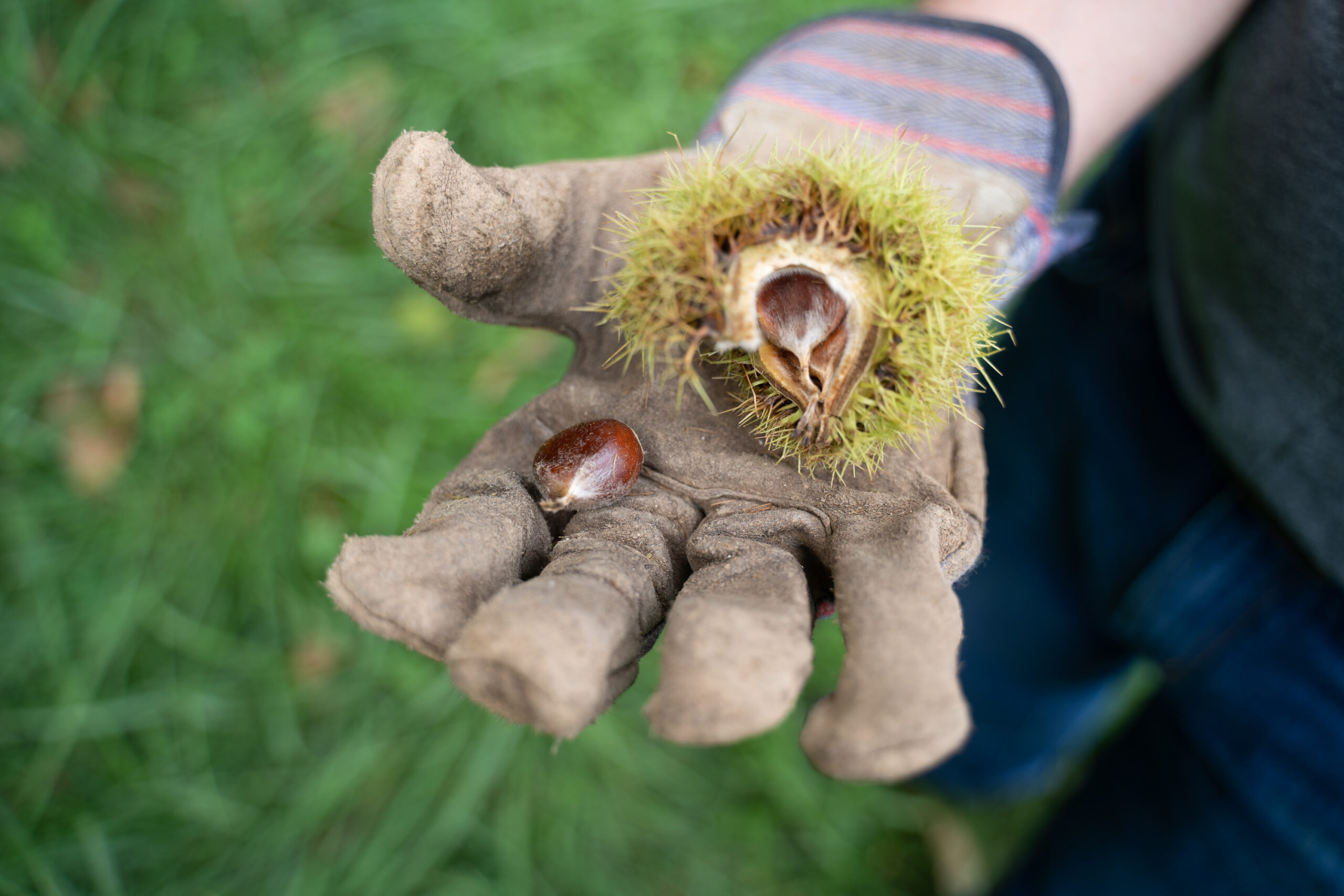
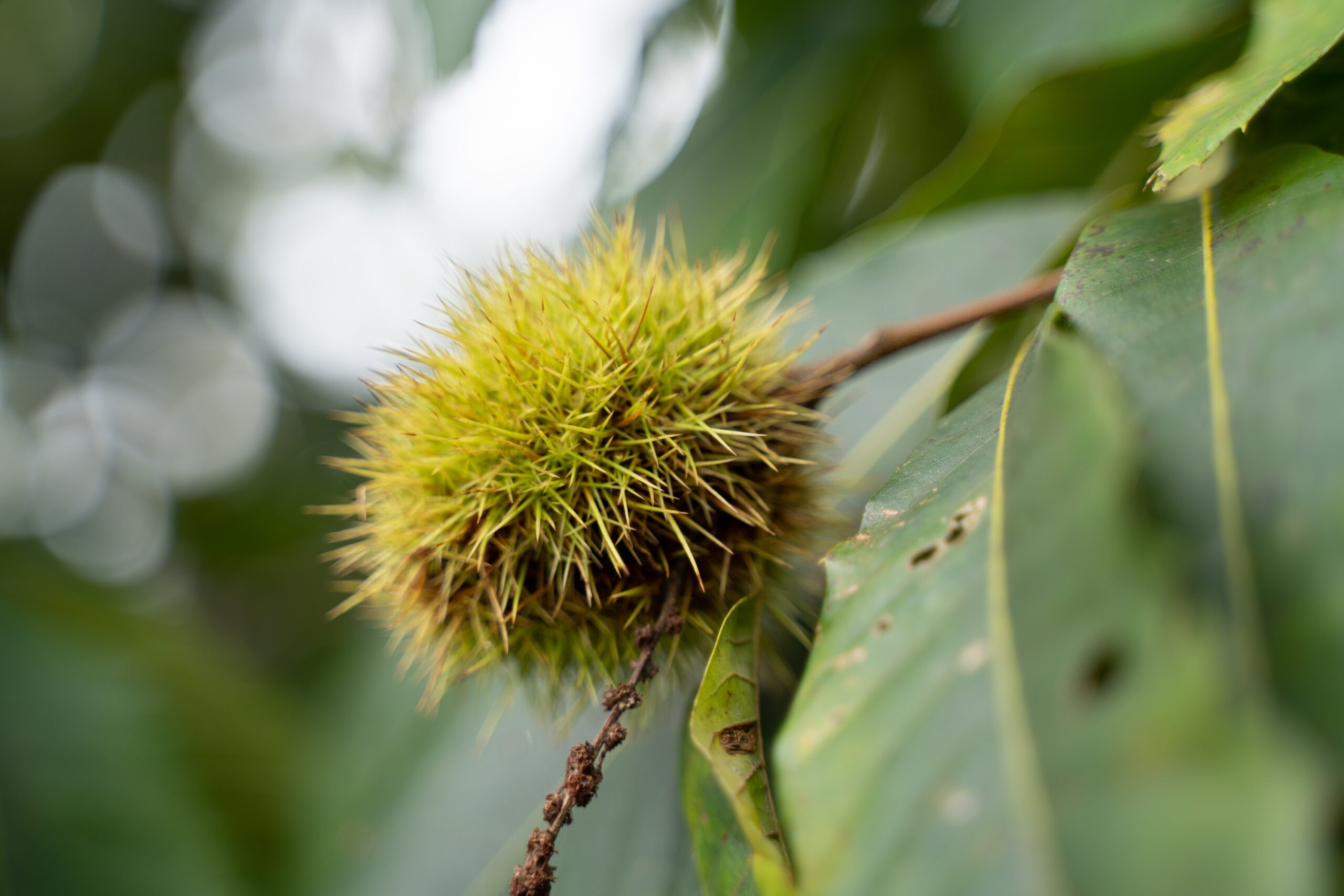
It’s still a niche market. But Bryant hopes chestnuts will go more mainstream. This fall, the farm has a “pick your own” option for the first time. Though people are asked to bring some protective gear — chestnut husks are spiky.
“We ask them to wear closed-toed shoes and we ask them to bring gloves,” Bryant says.
So far, it’s been a hit, she says. She hopes chestnut-picking could one day — again — be an autumn ritual.
Culinary historian Michael Twitty sees a lesson in the demise, and possible revival, of the chestnut in North America.
“In losing the American chestnut, I think we’ve all lost a sense of the majesty of nature — these humongous, beautiful trees with an enormous bounty of food,” Twitty says. “It’s a magic that is irreplaceable.”
Bringing back the chestnut, he says, “gives us back a little piece of the narrative of the sheer wonder of the North American continent.”