Margaret Barthel
Virginians head to the polls to vote for candidates for governor, lieutenant governor, attorney general and all 100 seats in the House of Delegates on Nov. 2 (and more than half a million Virginians have already voted early). Virginia is one of just two states — the other is New Jersey — holding a governor’s race this year. Many see this off-year contest as an indicator for the 2022 midterms — and a proving ground for national political messaging.
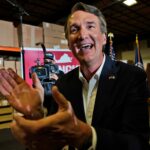
The polls are close in the governor’s race at the top of the ticket, with Democrat Terry McAuliffe and Republican Glenn Youngkin essentially neck-and-neck. Youngkin, a former private equity executive who has never before held political office, is attempting to become the first Republican elected to statewide office in Virginia in a decade, and some experts say he’s being helped by high enthusiasm among the Republican base. Meanwhile, McAuliffe, who previously served as governor of Virginia from 2014-2018, is trying to boost excitement among Democrats, who for the first time in years don’t have the spectre of President Donald Trump to run against. And there’s a third-party progressive candidate in the race, too: Princess Blanding, a Richmond-based criminal justice activist, who is running on a platform of justice reform, reversing systemic racism, and pandemic recovery. Some Democrats are concerned Blanding could be a spoiler in a close race.
In Virginia, the governor and lieutenant governor run on separate tickets, which could lead to a split executive branch. Two boundary-breaking candidates are running in that race: Del. Winsome Sears (R-Norfolk), an ex-Marine and the first Black Republican woman to hold a seat in the Virginia General Assembly, is facing off with Del. Hala Ayala (D-Fairfax), who rose to Democratic leadership in Richmond from hardship as a single mother reliant on government safety net programs. The two are vying not just for the lieutenant governor post, but also to make history as the first woman of color elected to statewide office in Virginia. Polls are very close in this race as well, surprising to some given the recent turmoil inside the Sears’ campaign.
Further down the ballot, Republicans hope to undo the Democratic majority in the House of Delegates, won in 2019 and giving them a 55-45 advantage. Democrats also had control of the three top statewide offices, giving them the power to push forward priorities like voting rights legislation, marijuana legalization, Medicaid expansion and pandemic protections like eviction moratoriums and vaccine mandates. In the 2021 election cycle, House Democrats have significantly outraised their Republican counterparts, $27.5 million to $12.9 million — but even flush with cash, there are multiple competitive races to watch.
Delegates are normally elected for two-year terms, but this year’s winners may need to ramp campaigns up again next year. Because of the delays surrounding the 2020 U.S. Census, new districts weren’t in place in time for this election. The Virginia redistricting commission is in the process of re-drawing district maps to account for the population changes in the state in the last decade — and there’s a chance a federal court will order a new election next year with the new boundaries.
Issues
As the race enters the final few weeks, candidates up and down the ballot are focusing on turning out their bases — and, in many cases, focusing on negative attacks rather than positive visions for Virginia’s future. In the gubernatorial race, Democrats have tried to tie Glenn Youngkin to former President Donald Trump, who called in to a Republican rally in Richmond hosted by former Trump advisor Steve Bannon. They have also attacked Youngkin on abortion rights, which 60% of Virginia voters support, in the aftermath of the passage of the Texas abortion ban (Youngkin has said he doesn’t support a Texas-style ban, but he does identify as “pro-life”).
Meanwhile, Youngkin has also been on the offensive, emphasizing President Biden and national Democrats’ falling popularity, stoking parent concerns about the teaching of race in public schools, and calling for an audit of Virginia’s voting machines (though these audits already happen routinely).
But what are the candidates’ policies, behind the political back-and-forth? Here’s some background.
Pandemic Response
Several polls show that the coronavirus pandemic is one of the top issues for Virginia voters in this election, and it’s a significant area of disagreement between candidates at the top of the ticket. McAuliffe has called for broad vaccine mandates across the state, which he sees as a way to accelerate the state’s pandemic recovery. He’s also released a COVID response plan that focuses on access to PPE, testing, and vaccines, as well as support for the workforce in the form of sick days, unemployment benefits, childcare, hazard pay, housing, and healthy food.
Meanwhile, Youngkin says he’s vaccinated and encourages others to be, but doesn’t believe COVID-19 vaccines should be required (though he has previously said he doesn’t object to routine childhood vaccinations currently required by schools for diseases like measles and mumps). Youngkin’s “Day One” list of priorities mentions responding to the coronavirus pandemic only in the context of restoring the economy and job creation.
Schools
Youngkin has spent several weeks on the campaign trail highlighting concerns about parents’ ability to weigh in on how schools in Virginia are teaching race, even creating a “Parents Matter” tab on his campaign website. Youngkin has promised to ban critical race theory (CRT) in public schools; although CRT is not part of state learning standards in Virginia, it’s become a cultural flashpoint for many. Asked about teaching about the history of race in Virginia in the second gubernatorial debate, Youngkin suggested such content is overly divisive. “We don’t need to teach our children to view everything through a lens of race and then pit them against one another so that their dreams are, in fact, stolen from them,” he said. Youngkin is also supportive of bringing more charter schools to the commonwealth.
Youngkin’s “Parents Matter” focus developed after the second gubernatorial debate, when McAuliffe said he didn’t believe parents should tell schools what to teach, referring to a bill he’d vetoed in 2017 that would have allowed parents to prevent their children from reading sexually explicit material in class (at the time, the legislation was nicknamed the “Beloved bill,” because it stemmed from a Fairfax County mother’s objections to her child reading the novel Beloved and other works by award-winning Black writer Toni Morrison in school).
McAuliffe has mostly steered clear of the culture-wars debates over critical race theory in schools, though he has advocated for teaching “the full history of who we are as a commonwealth,” including Virginia’s checkered history of racism, and he has called the CRT controversy “a racist dog whistle.” McAuliffe instead focuses on his plan to make teacher pay in Virginia competitive, expand pre-K, address what he describes as “modern-day segregation in schools,” and extend technological access to students in rural parts of the state — all priorities he would fund in part with the state’s $2.6 billion budget surplus.
Economy and Jobs
McAuliffe’s jobs plan focuses on helping women and people of color recoup their disproportionate losses from the pandemic by supporting child care options, pushing for sick days and family medical leave, increasing wages for home health aides and other low-paid care workers, pushing forward the timeline for the $15 minimum wage, and more. Bolstering career and technical education, training other pathways into good-paying jobs and supporting community colleges are also on McAuliffe’s agenda.
Youngkin’s economic proposals have focused on big tax cuts. He’s in favor of lowering the state’s income tax, getting rid of the grocery tax, pausing the recent gas tax increase, handing out a one-time income tax rebate, and giving small business owners a temporary tax holiday, among other things. All that would cost Virginia about $3.2 billion; Youngkin wants to put the state’s $2.6 billion surplus towards covering those cuts.
Public Safety
In non-stop television ads, both Youngkin and McAuliffe have touted law enforcement endorsements and support for police funding. That’s in contrast to Princess Blanding, a Richmond-based community activist and independent candidate in the race. Blanding lost her brother when a police officer shot him in 2018, and she is running for governor on a progressive platform of police and criminal justice reform.
McAuliffe stepped back from his previous support for ending qualified immunity — which protects police officers from civil lawsuits — in the second debate. He focuses instead on moderate police reforms — like funding for community policing and increasing diversity in officer hiring. McAuliffe has been endorsed for governor by New Virginia Majority, a progressive advocacy group which has previously called for defunding the police (a position which McAuliffe has clarified that he does not support).
McAuliffe’s incremental stance toward police reform comes as many vote-rich Northern Virginia localities have sought to significantly re-envision the role of law enforcement in communities and schools.
Youngkin has painted a rhetorical picture of a crime-ridden, unsafe Virginia, criticizing McAuliffe for rising murder rates during his first term as governor (a claim that does not account for the state’s good overall safety ranking over the same span, as The Washington Post notes). Youngkin’s Day One agenda includes items like protecting law enforcement funding, getting rid of members on Virginia’s parole board, fixing the state’s struggling mental health system, and implementing a program to move charging illegal gun possession to federal courts.
Expanded voter access in Virginia
Virginia has broadened access to the ballot dramatically in the last year. The General Assembly made many of the emergency pandemic regulations put in place during the 2020 presidential election permanent, including allowing localities to offer early voting on Sundays; creating designated drop boxes and requiring pre-paid postage on absentee ballots; and permitting voters with a disability or an injury to vote outside of a polling place. The Virginia Voting Rights act, which requires new voting policies to be scrutinized for discriminatory effects, is also now in place.
The last day to register to vote was Oct. 12. Requests for absentee ballots, which can be submitted by mail, fax, or email, are due Oct. 22 to your local elections office. Completed absentee ballots must arrive by Nov. 2, Election Day. Some localities may also have drop boxes for ballots; check with your local election office for details.
Virginians can also vote in-person before Election Day at various locations set up by local elections offices, which you can find here. In-person early voting has been ongoing during weekdays since September, and will expand to Saturdays on Oct. 23 and Oct. 30, which is also the last day to early vote in-person. Some local elections authorities may also have early voting locations operating on Sundays.
On Election Day, polls open at 6 am and close at 7 pm. Voters who are in line by 7 pm will be allowed to vote.
You can search your voter registration and find your polling place on the Virginia Department of Elections website.
Who’s on my ballot?
We’ve highlighted a few competitive races to watch below. You can find out what House of Delegates District you live in here. And you can find out what local elections and candidates might be on your ballot by checking the Virginia Department of Elections website or your local elections page for more information (for example, in Northern Virginia, voters will choose a mayor and City Council members in Alexandria and a County Board member in Arlington).
If you’re interested in finding out more about specific candidates and their campaigns, you can search the Virginia Public Access Project, where you can find out how much money campaigns have raised and recent relevant press coverage.
Races to watch
Loudoun County
House District 10: Wendy Gooditis (D, Incumbent) vs. Nick Clemente (R)
Incumbent Democrat Wendy Gooditis is defending her seat from Republican Nick Clemente, who has served on the Leesburg Planning Commission and works in the building industry trade association. The race is one of several highlighted by the Virginia Public Access Project as competitive. Gooditis has outraised Clemente, $1.2 million to $935,000, and her platform focuses on pandemic recovery, healthcare access and Medicaid expansion, support for education and educators in the pandemic, minimum wage increases, voting rights, and infrastructure and agriculture improvements.
Clemente’s top issue is fixing Virginia’s mental health system, along with COVID recovery, reopening schools, funding for law enforcement, better representation for Northern Virginia on the Metro Board, and protecting the state’s right-to-work law, which weakens unions by preventing them from requiring dues from members.
Fairfax County
House District 40: Dan Helmer (D, Incumbent) vs. Harold Pyon (R)
Incumbent Democrat Dan Helmer, a small business owner and a veteran, is defending his seat against Republican Harold Pyon, a Korean American civic leader who works at the U.S. Patent and Trade Office and who is also a veteran. Helmer has raised double the amount of cash that Pyon has, $1 million to just shy of $500,000. Helmer’s platform highlights his work expanding access to healthcare and reducing its cost, passing gun safety measures, protecting women’s reproductive healthcare, and expanding voting rights and access to early voting.
Pyon’s top issue is improving education standards. He opposes changing admissions at top magnet school Thomas Jefferson High School from an admissions test to a lottery. He also opposes raising highway tolls, and supports funding and training for law enforcement, creating workforce incentives for people getting back to work, and helping small businesses recovering from the pandemic.
Prince William County
House District 51: Briana Sewell (D) vs. Tim Cox (R)
This is the seat Democratic lieutenant governor hopeful Hala Ayala is vacating, so there is no incumbent in the race. Republican Tim Cox, a contractor and navy veteran, is facing off against Democrat Briana Sewell, a former staff leader for U.S. Congressman Gerry Connolly and the current chief of staff to County Chair Ann Wheeler. Sewell has significantly outraised Cox, $655,000 to $46,000.
Cox’s top issues are protecting First Amendment rights to freedom of religion, support for adoption and foster care and opposition to abortion, claims that Virginia elections are not secure (there has been no evidence of fraud or problems in recent elections), business-friendly policies, including opposition to a $15 per hour minimum wage; transparency in healthcare costs, support for renewable energy, transportation construction investment, and law enforcement funding. Like Republicans further up the ticket, Cox has focused on parent choice in education as a key issue.
Sewell’s campaign has focused on her role in Prince William County’s vaccine distribution efforts and her desire to create a county-run health department, instead of the current state outpost located in the county. She wants to promote business growth, family and medical leave policies, Medicaid expansion, reproductive health access, increases in teacher pay, and green jobs.
House District 50: Michelle Maldonado (D) vs. Steve Pleickhardt (R)
Current District 50 Del. Lee Carter, a democratic socialist, is leaving this seat, so there is no incumbent in the race. Democrat Michelle Maldonado, a lawyer and leadership training business owner, is running against Steve Pleickhardt, a dentist. Maldonado has significantly outraised Pleickhardt, $386,000 to $20,000. She’s running on a platform of pandemic recovery support for small businesses, ensuring family and medical leave, paying a living wage, adding more train service on the Virginia Railway Express, expanding access to healthcare, creating universal pre-K and free community college programs, and developing an affordable housing strategy for Northern Virginia.
Pleickhardt wants to cut taxes and eliminate tolls. He supports school reopening and law enforcement, and opposes the Green New Deal in favor of an “all of the above” energy policy for Virginia. He has also called into question the security of Virginia elections (a claim for which there is no evidence), and supports stricter voter ID laws and absentee voting requirements.
This story was informed by the ideas and perspectives shared by readers in our voters survey. If you’re a Northern Virginia resident, consider taking five minutes to tell us what’s important to you in the upcoming election here.