Colleen Grablick
Metro is proposing a budget for next year that includes a slew of fare perks, continuing the transit agency’s attempts to draw in riders during a slow pandemic recovery process.
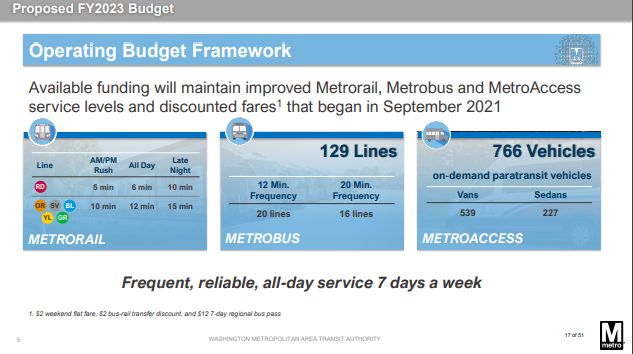
Starting with the next fiscal year in July 2022, Metro could add late-night fare discounts, reduced-rate monthly passes, and a bonus for frequent riders, while maintaining the same service levels as this past year (before the 7000-series trains were pulled from service.)
WMATA General Manager Paul Wiedefeld will present the budget to the board this Thursday. The board will deliberate, make tweaks, and accept public comment on the budget in January and February of next year before adopting a budget in March. The budget will then go into effect in July.
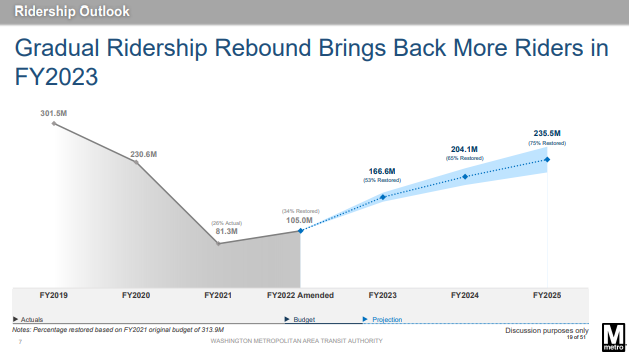
Total ridership is expected to reach 53% of its pre-pandemic level through the next fiscal year, increasing to about 65% of pre-pandemic ridership by fiscal year 2024, according to Metro’s projections.
To boost that recovery, next year’s budget includes a $2 flat fare for one-way rail trips taken after 9:30 p.m., and an 11% discount for monthly passes. It also proposes reducing the cost of weekly passes, and it introduces a $5 bonus on a SmarTrip card for every $25 spent. Metro is also planning to make permanent the discounts implemented this past September: the flat $2 weekend fare and the $12 seven-day regional bus pass.
The fare benefits are pitched in Metro’s budget as a benefit to workers and the region’s economy, but Benjy Cannon, a spokesperson for Unite Local 25, a union that represents local hotel, restaurant, and casino workers in the D.C. area, says the proposed changes still don’t make the transit agency’s operations sufficient for the region’s hospitality workers.
“That’s a good start, but if it’s not addressing the hours that the system is running, it’s not addressing the thing that our members need the most,” Cannon says. “Unless we’re talking about dramatically expanding hours and further reducing fares, it’s not going to have a meaningful impact on hospitality workers’ ability to do their jobs.”
Noticeably absent from the drafted budget is a discount for low-income residents, something WMATA’s board previously expressed interest in. However, Metro proposed adding $20 million for “future transit equity initiatives,” and plans to provide details later in the development process, according to the agency.
Last budget season, Metro’s picture looked much darker. Staring down a nearly $500 million pandemic-induced deficit, the agency originally proposed closing 19 stations, completely eliminating weekend service, slashing bus service, and laying off nearly a third of its workforce — reducing the system to a “bare-bones service network to sustain essential travel.” Thanks to $2.5 billion in federal aid, Metro avoided that doomsday scenario. But the agency isn’t out of the woods.
The proposed budget notes factors like a new COVID-19 variant, waning vaccine efficacy, and remote work trends that could pose a threat to the agency’s revenue over the following year. And while federal funding saved Metro in the short term, it’s set to run out by 2024 — leaving a $519.3 million deficit. If ridership doesn’t return, the agency may need to revisit fare increases, service cuts, or layoffs.
Meanwhile, as Metro looks to 2022, the agency is simultaneously managing a more immediate crisis: the drastic service reductions stemming from a 7000-series train derailment last month, which prompted WMATA to pull all of its 7000-series trains. Delays are expected through at least mid-November, as officials investigate the safety of the fleet and ramp up service again.
The 2023 budget includes $12 billion on “safety and state of good repair” including $303 million for acquiring, repairing, and rehabilitating rails and railcars. Capital investments include money for the stalled Potomac Yard station project, replacing and upgrading Metrorail’s faregates, and the tunnel ventilation project, among others.