Martin Austermuhle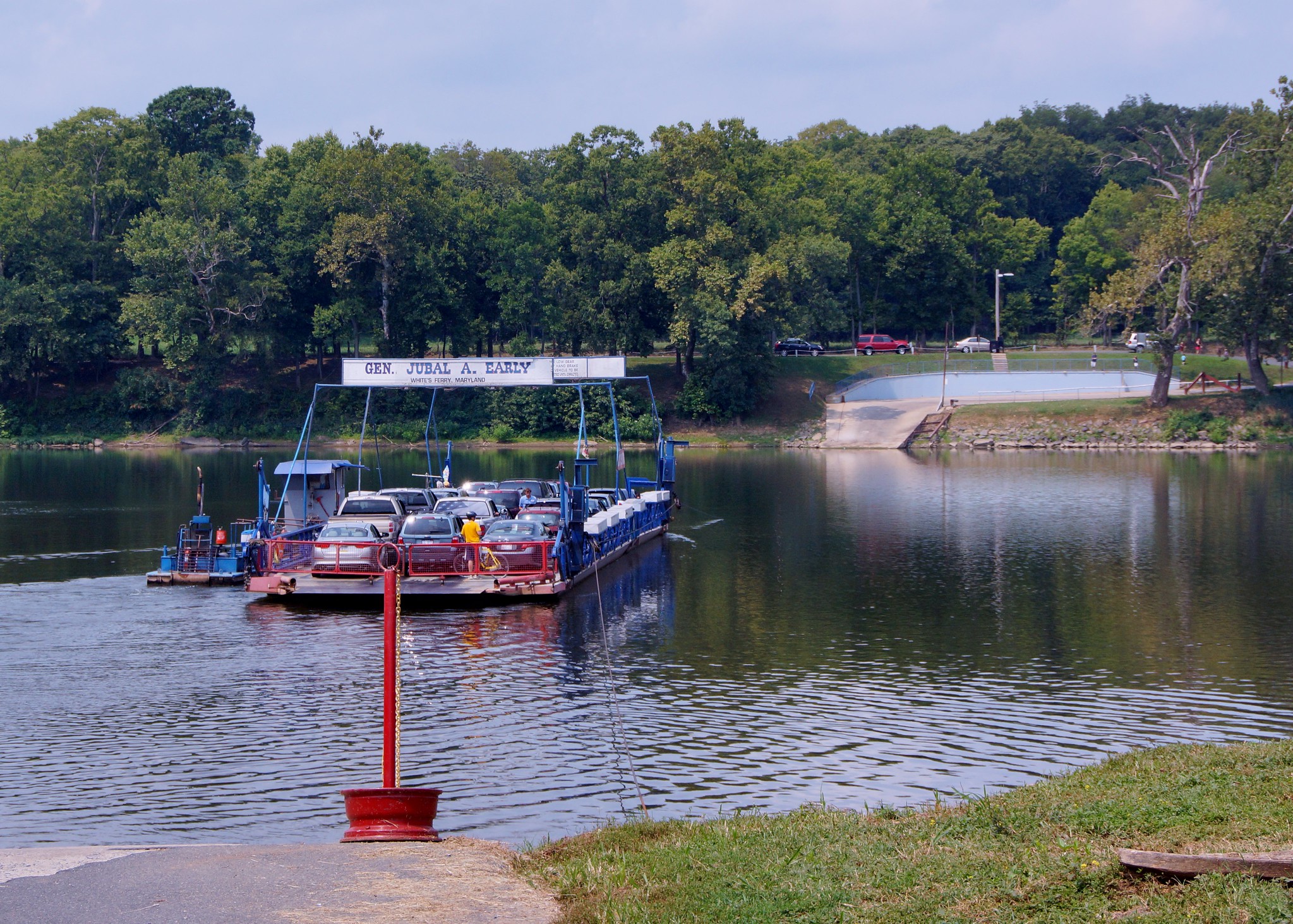
When White’s Ferry suddenly ceased operating last December, officials in both Montgomery and Loudoun counties pledged to work as quickly as possible to restart service on the sole remaining ferry across the Potomac River — the only place to cross the river between the American Legion Bridge and Point of Rocks some 40 miles to the north.
But almost a year later that quick solution has eluded local officials in both Maryland and Virginia. Debates continue over the importance of the ferry, what role local governments should play in resolving a dispute between a private ferry operator and a private landowner, and whether the two states should instead focus on building another bridge across the river.
The complexity of the issue — and the differences in how people on either side of the river see it — became evident this week, when elected officials in Loudoun County said they were hesitant to use eminent domain to take the private landing on the Virginia side in order to allow ferry service to resume. It was a long-running legal conflict between the ferry’s former operator and the landing’s owner that prompted the ferry to shut down last year, leaving the 600 to 800 drivers who used the ferry on a daily basis looking for alternate means to cross the river.
“This is a dispute between private parties, a dispute we don’t want to get involved in unless we absolutely have to,” said Supervisor Caleb Kershner (Catoctin) at a meeting of the Loudoun County Board of Supervisors on Wednesday night.
“We have not been the ones who have talked about eminent domain… in my opinion, we should get a professional mediator and get everyone in the room. We will offer our room upstairs as neutral ground. That’s what needs to happen,” added Chair At-Large Phyllis Randall.
The dispute involves Rockland Farm, which owns the landing on the Virginia side of the river, and Chuck Kuhn, the Loudoun County businessman who purchased the ferry — which has been in operation since 1786 — from its longtime owners earlier this year, pledging to restart and improve operations. The owners of the farm say the ferry’s former owner violated a longstanding agreement on use of the landing, and late last year a Virginia judge sided with the farm on the question over whether the landing was public land or not.
The issue has been of particular interest to officials on the Maryland side of the river, who spoke to supervisors on Wednesday about the importance of the ferry.
“Historic significance and emotional attachments aside, the closure of the ferry has shown how reliant our residents and businesses are on this transportation connection. The importance of this ferry is not on its business model or as a pleasure cruise, rather it provides a vital link between communities and its closure has had a significant negative impact on our communities,” said Montgomery County Executive Marc Elrich.
Kerri Cook, president of the Poolesville Town Commission, said the ferry’s closure had impacted commuting decision and local businesses alike.
“Some neighbors have had to fight increased traffic on highways while others have made the decision to change jobs and some even to move out of town because of the reality of not having that vital transportation link is not a sustainable option,” she said.
A study on the ferry jointly commissioned by Loudoun and Montgomery counties and released earlier this week found that there were an estimated 1,092 daily trips on the ferry in 2019, split evenly between both sides of the river but leaning more heavily towards “social-recreational” trips than commuting. (The ferry passes by the C&O Canal, and connects Montgomery County Agricultural Reserve to Loudoun County’s wine country.) Without the ferry in operation, the trip from Poolesville to Leesburg has increased by 17 miles and 11 minutes, with Route 15 at Point of Rocks taking up a portion of that additional traffic.
The study also found that bringing back the ferry would have an economic impact of $9 million in 2023 and increasing to between $13 and $24 million by 2040, depending on whether ferry service remains the same or is expanded. Once the dispute over the Virginia landing is resolved, the study said ferry service could resume in as little as 12 weeks.
But resolving that dispute remains the sticking point. Over the summer Kuhn said that negotiations with the farm had gone nowhere and that eminent domain may have to be used to take the landing. Libby Devlin, one of the farm’s owners, has disputed that, saying she offered Kuhn multiple options, from a per-car payment to an annual licensing fee to the option of outright buying the landing.
“We believe there is an opportunity for Rockland and White’s Ferry to come to the table and work out a solution that gets the ferry open,” she told the supervisors on Wednesday. “Unfortunately the prospect of the county condemning Rockland’s landing for the new owner’s use creates a disincentive for him to negotiate with us. The prospect of the board taking our land for use by another private property is also very unfair to us.”
Thomas Stokes, a Loudoun County resident, sided with Devlin during the meeting, saying the use of eminent domain would be “wildly inappropriate” since “the threat here is the county will condemn the property of one of its constituents so a privately owned Maryland LLC can operate a for-profit business.”
Some supervisors said that even if eminent domain were considered, they would question whether it should be used for the ferry. Supervisor Matt Letourneau connected that concern to a longstanding point of contention between Maryland and Virginia: a proposal to build a new bridge across the Potomac.
“White’s Ferry is a wonderful feature, but it is a Band-Aid for what the ultimate problem is and what the solution is,” he said. “The reality is our friends in Maryland have something they could do, and that’s work with us on an actual river crossing, not a piece of technology from 100 years ago, but a bridge.”
Earlier this year Randall said she proposed the idea of a new bridge to her counterparts in Montgomery County — only to be shot down. County leaders have long argued against a new bridge, saying it would increase traffic and development in the agricultural reserve and not address actual traffic issues in the region.
Debates over the bridge aside, Supervisor Tony Buffington (Blue Ridge) said he would support the use of eminent domain to get the ferry running as quickly as possible. “We need to reopen this regionally important pathway for the public,” he said.
Any move towards eminent domain won’t come for a few weeks at least; county staff first have to propose the idea and let supervisors vote on it. In the meantime, Devlin said she remains open to negotiate with Kuhn. But in written statement, Kuhn said he didn’t think any negotiations would occur.
“During this process, we have been cussed at, screamed at, and insulted by the owners of Rockland Farm… as recently as Tuesday night in front of the Loudoun County Government Center, which was witnessed by a local reporter,” he said. “Given the difficulty in dealing with the Rockland Farm ownership, I don’t think further negotiations will help us reach this goal.”
This post has been updated with a comment from Chuck Kuhn.