Martin Austermuhle
The battle lines are being drawn over proposed new ward lines.
Neighborhood groups, civic organizations, and some elected officials are raising concerns about a proposed new ward map unveiled last month as part of the decennial redistricting process. The plan will be debated and voted on by the D.C. Council this month. The lion’s share of the complaints revolve around changes in and around Ward 6, the city’s largest ward — and the one that has to shift thousands of residents to another ward in order to more closely approach the city’s average ward population of 86,193.
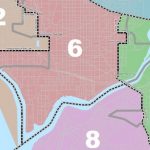
The map proposed by the council’s three-person redistricting subcommittee would transfer a large portion of fast-growing Navy Yard from Ward 6 to Ward 8, expanding the latter across the Anacostia River for the first time. Ward 7 would expand further westward into the eastern end of Capitol Hill, while the Kingman Park neighborhood — which was transferred from Ward 6 to Ward 7 in the 2001 redistricting — would move back into Ward 6.
In a report accompanying the map, the subcommittee’s three members — At-Large Councilmembers Elissa Silverman, Christina Henderson, and Anita Bonds — said the proposed changes would accomplish the goal of growing both Wards 7 and 8 while respecting as many established neighborhoods as possible and not excessively diluting Black voting majorities in the two wards.
But some residents and elected officials are pushing back on those changes to Wards 6 and 7. On the eastern end of Capitol Hill — often referred to as Hill East — some Advisory Neighborhood Commissioners say moving the Ward 7 boundary west from 19th Street to 15th Street would unnaturally split the area off of the broader Capitol Hill neighborhood, which they say has historically stretched all the way from the U.S. Capitol to the Anacostia River.
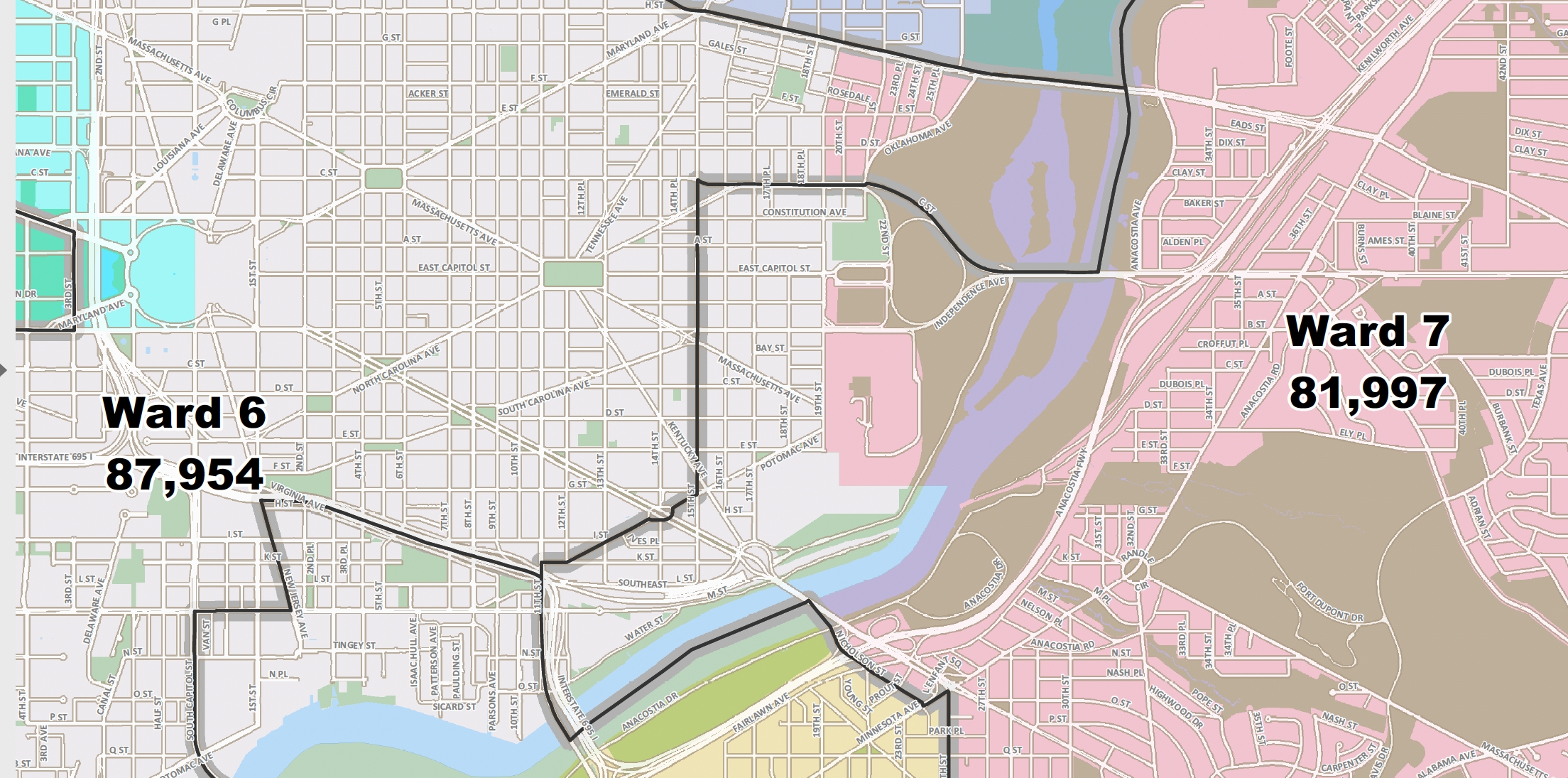
They worry the new dividing line would create what they decry as a “Hill East Island,” and fear it will impact their ability to weigh in on planned development at the nearby Reservation 13 campus next to RFK Stadium. (The campus was transferred to Ward 7 in 2011, but long-planned development projects have only started coming to fruition in recent years.) Similar concerns about portions of Hill East going to Ward 7 were expressed during the 2011 redistricting process; “Hell no we won’t go to Ward 7” read one sign during a protest at the time.
“I have nothing against Ward 7. I’m not ‘displeased’ to move to Ward 7; we have nothing against Ward 7. We are ‘displeased’ not to stay within Ward 6; it is simply that my constituents and I are more a part of the Capitol Hill community than Ward 7, and should therefore stay within Ward 6 and part of the Capitol Hill community of interest,” wrote Ward 6 ANC Commissioner Brian Alcorn in an email to lawmakers before Thanksgiving.
In the committee report, the three councilmembers (Silverman, Henderson and Bonds) aren’t all on board with the argument that Capitol Hill is a single, unified neighborhood that should not be broken up. “The District has long recognized that within the larger Capitol Hill area, there are identifiable neighborhoods, including Hill East, Kingman Park, and H Street NE,” they wrote.
Three other Ward 6 ANC commissioners say they welcome being moved into Ward 7, though they have raised separate concerns about the proposed map. In a letter drafted by Corey Holman, Alison Horn, and Edward Ryder, the three commissioners say the current proposal would leave Ward 7 only narrowly above the smallest legal population it could have. They also note it splits an existing commercial corridor around the Potomac Avenue Metro station, and could eliminate an existing ANC commissioner for the D.C. Jail. They’ve proposed three possible alternatives that would grow Ward 7, one that would extend the ward’s boundary all the way to 11th Street south of Independence Avenue SE.
“Change is hard and even more so when it’s not asked for nearly two years into a global pandemic. While acknowledging the difficulties in changing political representation and structure, we would welcome the new opportunities if our neighborhood, constituents, and friends and families are redistricted to Ward 7,” they wrote.
Two Ward 6 ANCs are holding public meetings this week to discuss the proposed maps, and various lawmakers are expected to be in attendance to address concerns and hear alternative proposals.
Another issue at play involves the Kingman Park neighborhood, which under the proposed map would be transferred from Ward 7 to Ward 6. (In 2001, the opposite happened: the neighborhood went from being in Ward 6 to Ward 7.) The subcommittee said such a move would reunify portions of the neighborhood that were split during past redistricting processes, and would help maintain racial diversity in Ward 6 — which has grown whiter over the last decade.
But that proposed move has drawn opposition from some residents and elected officials in Kingman Park, as well as a coalition of political organizations and Councilmember Vincent Gray (D-Ward 7). In a letter to Council Chairman Phil Mendelson this week, Gray said the proposed map would leave his ward “unnecessarily and ill-advisedly undersized.” Gray and the Ward 7 Redistricting Equity Coalition are calling on the boundary of Ward 7 to continue expanding westward beyond where it is now.
“Expansion west of the river is necessary and has been set on a path since the 2000 Census. The time is here and now to see that growth,” said Ward 7 ANC Commissioner Tamara Blair.
Outside of Wards 6 and 7, some concerns have been raised about changes to Ward 5. In a press release before Thanksgiving, Councilmember Kenyan McDuffie (D-Ward 5) said he opposes moving the Armed Forces Retirement Home campus to Ward 1, as well as the New York Avenue Playground south of Dunbar High School to Ward 2. “This is simply an unnecessary disruption,” he said of the latter change, adding that his office had worked with neighborhood groups for years to improve the playground.
The council will cast a first vote on the new ward lines on Dec. 7, and a second and final vote on Dec. 21. Even as ward lines will change, school boundaries and police district lines will not. The subcommittee also decided to freeze current residential parking privileges, so even if a person’s ward changes, their parking zone won’t.