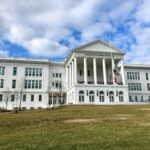
There’s nothing funny about the controversy comedian and alum Dave Chappelle has stirred for the Duke Ellington School of the Arts in Georgetown. Chappelle’s recent queerphobic and transphobic remarks sparked a major backlash, including making national headlines and creating a social media frenzy; there was even a “Saturday Night Live” joke. The issue has divided the school community, with many criticizing the administration’s response in the wake of a “surprise” visit from Chappelle during an assembly last Tuesday that led to a contentious clash with students.
The school had been poised to name its theater after Chappelle, but delayed the ceremony until April 2022 from its originally planned date last week. Now, a number of students and parents at Ellington say the swarm of media attention is focused too narrowly on Chappelle and the debate over whether to name the school’s theater after him. They point to a bigger disconnect between administrators and students over a number of other issues, including student fees for arts programs and the handling of sexual assault on campus.
These Ellington community members say they feel betrayed by the school’s chaotic handling of Chappelle’s recent visit. And they feel burned out contending with national media scrutiny that is leaving out students’ diverse perspectives.
“A lot of students are honestly tired of talking about it,” says one student, who asked to be identified by her first initial, L., because of concerns the school will retaliate against her for speaking to a reporter. “It’s gone from this thing that was most people’s peripheral experience to this huge defining part of our school experience this year.”
Meanwhile, administrators are standing firm on the pledge to rename the school’s theater after Chappelle — even after Chappelle himself proposed canceling the naming if enough donors to the school oppose it.
Chappelle announced on Instagram last Friday that he’s launching a fundraising drive for the school and asked donors to note whether they support renaming Ellington’s theater after him. If “no” outweighs “yes,” Chappelle said, he would accept the result.
“While we appreciate Dave’s impromptu and spirited fundraising initiative, we stand behind our decision to honor the wishes of our co-founder, the late Peggy Cooper Cafritz, to name the theatre after Chappelle,” the school announced Sunday in an email newsletter to parents. The ceremony is now slated for April 2022.
The school’s statement says “it appears that the clear majority of students at Ellington favor naming the theater for Dave Chappelle.” It goes on to state that “our purpose is not to form a uniformity of viewpoints, but to help instill genuine, respectful curiosity in perspectives that challenge one’s own.”
Students say they never got a survey that would have helped the school determine what the majority of students support. Asked how Ellington administrators reached its understanding, school spokesperson Savannah Overton Williams replied, “Principal Logan and the administrators are very involved with the student body and make it their job to understand the currents that are pulsing through the school. However, we believe it is important to state that this question is not a majority rule decision.”
Ninety percent of donors to Chappelle’s fundraising drive who expressed a viewpoint about the theater said they support renaming it after Chappelle, according to Mark Irion, a spokesperson for the school.
Williams says administrators are meeting with leaders of the school’s Gender and Sexuality Alliance, which includes students and staff.
Some in the Ellington community say they believe this episode represents the latest instance of the school failing to listen to students’ many concerns, as well as a failure to communicate with transparency.
“Most kids just want funding for their education,” L says. “They’re willing to put up with things they don’t necessarily agree with if Dave Chappelle continues to give us funding to be able to do what we came to the school for.”
One parent tells DCist the school’s handling of the Chappelle controversy has her wondering whether her child might be better off at a different school.
“The message for my kid has been, ‘Dissent will not be tolerated. We will pretend to give it a hearing and we will not ultimately tolerate it,’” says Alina Baciu, whose child is a freshman at Ellington. “I think that’s incredibly destructive.”
Baciu said she’s not opposed to renaming the theater after Chappelle, but wishes the school would state clearly that it doesn’t endorse everything Chappelle says.
Chappelle is ‘unofficial mascot’
Ellington leaders first announced the decision to honor Chappelle in October, during the in-person premiere of his latest stand-up special “The Closer,” for which Netflix reportedly paid him $24 million. The stand-up comedy special written by Chappelle and shot in Detroit in August debuted on Netflix on Oct. 5, hours after Ellington administrators announced their decision to name the school’s theater after the comedian.
L. says she and some fellow students weren’t surprised by the decision. “Dave Chappelle is basically the unofficial mascot for our school,” she said. “When you walk in, his face is everywhere.”
Chappelle gained a reputation in the early 2000s for his biting satire and pointed commentary on issues of race. But in the last few years, Chappelle has repeatedly targeted the LGBTQ community, and transgender people in particular.
During the special, Chappelle declares himself a member of “Team TERF,” a group of anti-trans activists; repeatedly mixes up the order of the letters in the widely acknowledged acronym “LGBTQ”; expresses frustration with having to think or talk about people’s chosen gender pronouns; and appears to equate the discrimination trans people face in America with the suffering of comedian Kevin Hart and rapper DaBaby, wealthy celebrities who lost professional opportunities after making homophobic comments in public.
L. said she hadn’t seen “The Closer” before the controversy sprung up at Ellington. Once she did, she wasn’t impressed.
“A lot of the things he had to say about gender and sex and sexuality just weren’t that accurate. But it’s not something he felt the need to educate himself on, it wasn’t really something that affected him in his day-to-day life,” L. says. “Making a full comedy special on something you don’t really know anything about is kind of a dumb move.”
Chappelle’s comments drew sharp criticism from LGBTQ advocates and sparked a walkout among trans employees at Netflix. Asked by DCist whether the school is concerned about Chappelle’s rhetoric, school spokesperson Williams replied: “We are naming the theatre after Chappelle because of his excellence, over a long career, as a comedian and satirist; his status as a distinguished and caring alumnus, and his generous, long-standing support (financial and non-financial) for the school. We are no more required to endorse or reject statements made by him in the context of a comedy routine than any other institution, including the Kennedy Center and Saturday Night Live, that has previously bestowed honors on him.”
Toward the end of the special, Chappelle says he’s retiring from mocking the LGBTQ community. But in New York City last Monday, the night before his visit to Ellington, he reneged on his promise, using a homophobic slur as a punchline, and joking that if he ever went to prison he would dress as a woman to get better treatment, the Daily Beast reported.
Another student, a senior who asked to be identified by her first initial, K., over concerns about retribution from the school, said she was initially torn on whether she agreed with naming the theater after Chappelle. Some students were hurt and offended by Chappelle’s comments, while other students, K. says, were more frustrated by how they found out.
“I was hearing a lot of, ‘Why didn’t they tell us sooner?’ People were kind of annoyed but not really surprised. Admin has always had a problem communicating clearly and properly with their students,” K. says.
An Ellington parent who asked to be identified only by his first name, Michael, over concerns of retribution from the school community, tells DCist he’s frustrated that the city’s funding model for Ellington forces the school to perpetually rely on private donors like Chappelle to fill gaps. His child benefits from the arts school environment, which he feels is generally more hospitable to queer students than a typical public school.
“Don’t create a situation where the school is so dependent on one person that no matter how controversial their views are, the school feels beholden to them,” Michael says. “That’s not good for education.”
Threatening message from fans
On Nov. 12, Ellington administrators announced that they would delay the renaming event from Nov. 23 until April of next year. Moving forward, they wrote, “without first addressing questions and concerns from members of the Ellington community, would be a missed opportunity for a teachable moment.”
This news happened to coincide with an effort some students were planning to walk out over a $200 arts fee Ellington students pay each year, according to a school spokesperson and interviews with students. The walkout never took place.
L. says the planned walkout was also connected to concerns among students about sexual assaults on campus. Since March 2020, two former Ellington teachers were arrested on charges of sexual abuse with a minor.
In October 2020, the school held an assembly with staffers from the nonprofit DC Rape Crisis Center, and students aired grievances at that gathering.
“A lot of girls were talking about how male teachers and male students made us feel unsafe on campus, and it wasn’t addressed,” L. says. “I haven’t seen any changes since the assembly.”
The nonprofit held additional focus groups with students in the last few weeks, says Indira Henard, the organization’s executive director.
“Addressing and disrupting sexual violence is no quick fix,” Henard says. “Our whole purpose was to make sure we heard directly from the students around some of what their concerns were.”
Despite these ongoing issues, news of the theater renaming quickly dominated headlines. Administrators announced a few days after the decision to delay the renaming that students had recently received “alarming communications from Ellington and non-Ellington members” related to the Chappelle controversy. As a result, the school temporarily paused off-campus and after-school activities, and increased security during arrival and dismissal.
According to K., LGBTQ students who voiced concerns about the contents of this special received threatening messages from Dave Chappelle’s fans on Instagram. “I was worried for those students’ mental health,” K. says.
Just as the tensions over Chappelle appeared to be dying down, they revved back up again when Chappelle visited the school for an hour-long assembly last Tuesday afternoon, the last school day before the Thanksgiving holiday break. Williams, the school’s spokesperson, told DCist in an email that the school contacted Chappelle a few weeks ago to let him know some students wanted to ask him questions, and Chappelle contacted the school later to express concerns about online comments attacking Ellington students.
On Nov. 19, Chappelle invited the Ellington community to attend a Nov. 23 screening of his new documentary at Capital One Arena. “The response was so favorable, his team inquired about stopping by before the screening and they were able to confirm a few hours before,” Williams wrote.
News of the surprise visit first surfaced two days later in Politico Playbook.
Students found out about the assembly only half an hour before it happened, and L. says administrators never confirmed that Chappelle would be attending until he showed up onstage nearly an hour after the assembly had started. Camera crews were filming, students who attended were required to leave their phones in sealed magnetic pouches at the door, and the assembly extended beyond regular school hours.
Some parents found out about the assembly from their children. Others only heard about it from a message the school sent after the assembly had already begun. The message to parents did not mention that the assembly was a town hall with Chappelle, that camera crews were present, or that students weren’t allowed to bring their phones to the event.
Several parents tell DCist they were frustrated by the lack of notice, given the charged nature of the subject matter.
“This was an incredible betrayal on the part of the school,” Baciu says. “I just felt it was really weird they would do something like this without asking if it was okay.”
“Alerting parents to programming activities is a courtesy that the school extends whenever possible but is not policy,” Williams, the school’s spokesperson, wrote in an email to DCist.
Students told DCist and other news outlets that Chappelle was dismissive and antagonistic towards the students at times, declining to apologize for his remarks and boasting of his superior talent. He did, however, forcefully denounce threats students had received for criticizing him.
Some students were excited to see Chappelle, L. says, while others were even more incensed with him after the assembly than they were before. Still, their main frustrations lie with the administrators who facilitated the event in the first place.
“My safety and well-being was never his responsibility,” L. says. “But my safety and my well-being and my comfort is the responsibility of the administration. To cater to him they put a lot of children’s feelings of safety and well-being on the line.”
Parents and students say their main priority is for students to feel safe and thrive in the rarefied arts school environment that makes Ellington a draw in the first place.
“Some of the kids that went through this and are salty, at some point in the future, they’re going to be in a position to give Duke Ellington money,” Michael says. “What are they going to remember? All the great things you did, or this one time when you put them in a bad situation?”
This story was updated to reflect that K. is a senior, not a freshman.