Amanda Michelle Gomez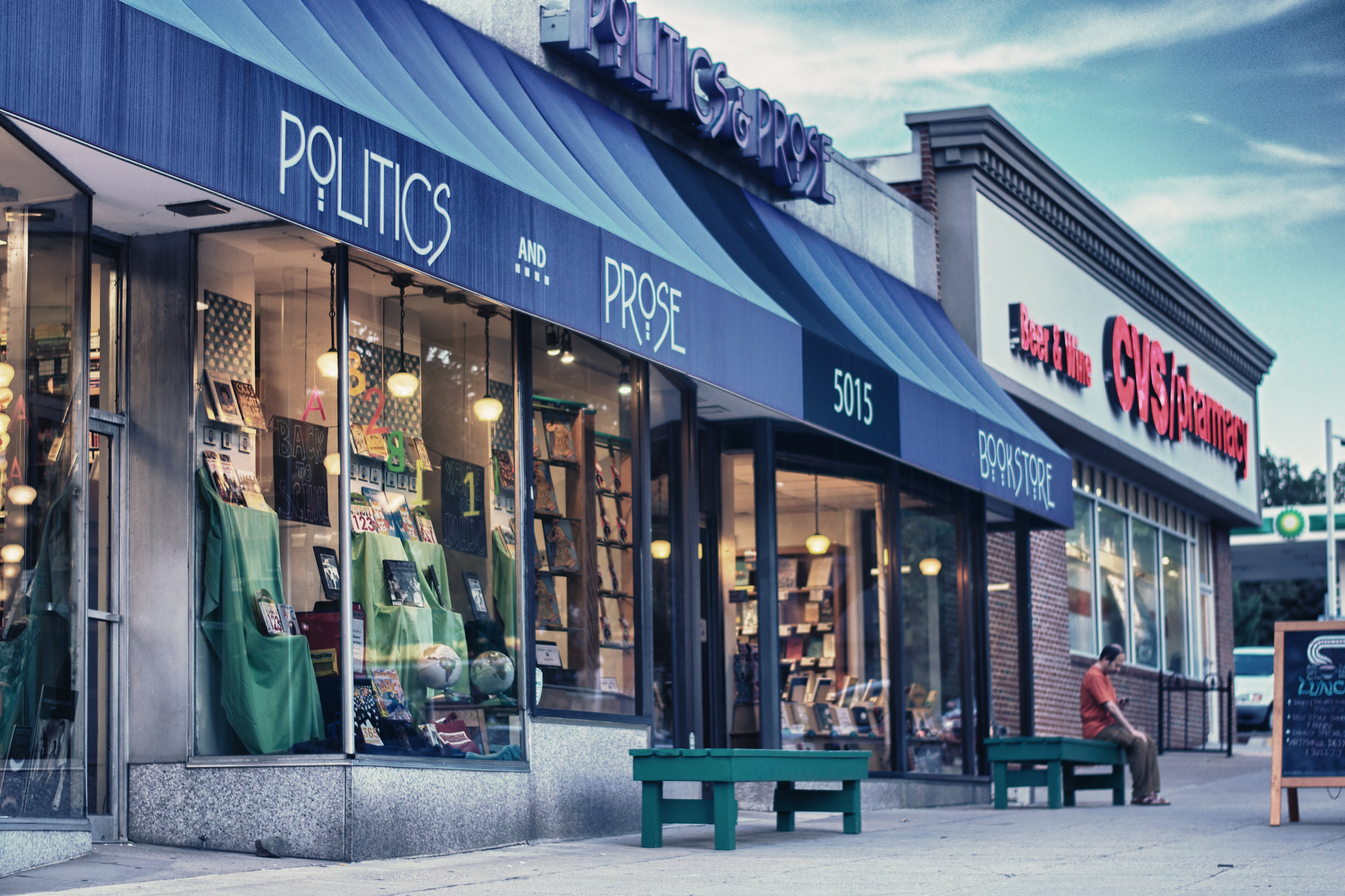
Update 12/16: Politics and Prose owners Bradley Graham and Lissa Muscatine have hired a law firm known for its aggressive anti-union tactics, shortly after employees filed a petition for an election through the National Labor Relations Board.
The owners hired Jones Day, one of the largest law firms in the nation, after declining to voluntarily recognize their workers’ union.
“When a union files a petition, the NLRB process moves swiftly,” Graham tells DCist/WAMU via email. “We had worked with Jones Day before on a number of employment and labor matters. They knew us, and we knew them. They were available right away. That’s why we retained them.”
Politics and Prose workers who are organizing expressed disappointment in their employer’s decision on Twitter, noting the law firm’s ties to former President Donald Trump. According to the New York Times, Jones Day was involved in roughly 20 lawsuits involving Trump, his campaign, or the Republican Party and received $18.8 million collectively. The Times also reported that the firm represented Trump and the Republican Party as they tried to contest the results of the 2020 election, but Jones Day denies participating in “any litigation alleging voter fraud.”
Jones Day lawyers have been known to employ hardline tactics during negotiations with unions, including pushing for bare-bones contracts for employees. “Negotiations are always hard, but they’re not always ugly. Jones Day makes the process ugly,” Washington-Baltimore News Guild President Robert Struckman told Columbia Journalism Review.
“These are not the actions we have come to expect from Politics & Prose, nor do they reflect the values of our mission statement,” Politics & Prose Workers Union said in a statement on Twitter. “However, we are undeterred. We are forming our union.”
Original:
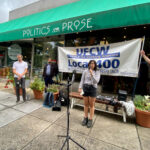
Workers at Politics and Prose, the longtime independent bookstore with three locations around D.C., have decided to unionize, joining a growing labor movement of retail workers across the country.
If successful, Politics and Prose would become what appears to be the only bookstore in the District with a unionized workforce. Of more than 100 total employees at the brand’s three locations, organizers believe that 55 will be eligible for the union. Last week, owners said they wouldn’t recognize the union until a majority of staff voted in a formal election, which some believe buys management time to disparage unionizing.
Two employees who are a part of the organizing committee, supported by UFCW Local 400, informed Politics and Prose co-owner Bradley Graham on Wednesday of workers’ intent to unionize. Bookseller and shift supervisor Ayesha Shibli tells DCist/WAMU that she and her colleague walked into Graham’s office and told him a “super majority” of full- and part-time employees across departments and stores decided to form a union. They offered him the cards employees signed to authorize a union but Graham declined to take them, according to Shibli.
Workers decided to unionize for a variety of reasons, including to negotiate a contract that secures a living wage instead of a minimum one, as well as pay transparency and a standardized pay scale. Shibli says there’s no public scale of wages or salaries, making her current raise negotiations difficult to navigate. Another employee, Sarah Valencia, says there’s only a dollar difference in hourly pay between an experienced bookseller and supervisor, and prior bookstore experience has not always been honored in compensation.
Workers also hope to improve scheduling through collective bargaining. The company struggles with chronic understaffing, so employees are often overloaded with work, says Adam Wescott, who’s worked at Politics and Prose since 2015, currently in web orders. The staffing shortage is not unique to the COVID-19 pandemic but can feel worse now — three employees left within the last six months, multiple workers say, including one who lasted a week because of the commute and because they were uncomfortable with how many customers were in the store.
“People have done the work to improve the conditions of the workplace without the structural benefits of a union, and it’s been [of] some help in the past,” Wescott says. “The problem is it doesn’t stick around. Inevitably, people leave.”
Workers also want to use contract negotiations to shape health and safety policies, and ensure diversity, equity, and inclusion training.
“Politics & Prose has long been considered a progressive and inclusive bookstore,” said workers in a joint statement, “and our decision to unionize is a natural next step in the company’s ongoing effort to put our shared values into practice.”
Graham and co-owner Lissa Muscatine tell DCist/WAMU via email that pay rates are standard, with variations based on a number of factors including job performance and amount of relevant experience. Management is also developing a set of pay ranges for various positions to share with staff.
“P&P has as many staff members now as before the pandemic,” they say in response to the staffing concerns, “reflecting our commitment throughout the crisis to avoid layoffs, even as revenues have remained considerably below pre-pandemic levels.”
In an email to staff on Friday shared with DCist/WAMU, Graham announced he and Muscatine would not voluntarily recognize their union. Relying on the union authorization cards that Shibli and her colleague delivered, rather than waiting for a full vote through the National Labor Relations Board, would “disenfranchise those employees who didn’t sign cards, who still would like more information about the pros and cons of a union, or who may have changed their minds,” he wrote. Graham added that they “fully recognize the rights of employees to seek union representation” and will abide by the results of an NLRB election.
Graham also said in the email that he and Muscatine were both in unions before assuming ownership of the local chain, so understand how “unions alter workplaces—sometimes for better, sometimes for worse.” (The married couple were both journalists at The Washington Post.)
“We’ve always valued the opportunity to work directly and collaboratively with you to solve problems and address your needs, from the professional to the personal,” said Graham in the email. “We believe a union at P&P would make our workplace more transactional, less personal, and less flexible.”
Employees say over 70 percent of the union-eligible workforce signed union-authorization cards. They hoped this proved that enough workers want to be represented by a union.
“It felt like [Graham] was saying we had pressured our staff to join the union when I feel very strongly that it’s going to be pressure from them not to join,” says Valencia, a bookseller and shift supervisor. “We’re doing this for each other — for all of us to be respected, for all of us to be valued, for all of us to be in a safe environment.”
In their email to DCist/WAMU, Graham and Muscatine say they believe not all employees “favor” unionizing or have made up their minds. “We expect to be having conversations with employees in multiple forums,” they write.
Wescott says employees had made several attempts to unionize the last six years he’s worked at Politics and Prose, and even organized around similar problems. “There’s always been this pretty consistent feeling … that things could be better,” he says.
Workers form unions either through voluntary recognition — which typically includes a neutral third party reviewing cards — or NLRB elections. Some labor experts argue that the NLRB election process does not resemble true democratic choice. For example, employers are able to present employees with anti-union materials during mandatory “captive audience meetings” or one-on-one meetings ahead of election.
Politics and Prose employees filed an election petition with the NLRB, said Alan Hanson of Local 400. He also said it’s been a long time since Local 400 helped organize any retail employer — more than a decade, at least.
“I’ve been doing this work for 22 years,” said Hanson. “I’ve never seen the level of worker organizing that I’ve seen right now,” he said, broadly speaking.
Just under 5 percent of retail workers belonged to a union last year, according to the U.S. Bureau of Labor Statistics.
However, since the pandemic set in, organizing has been on the rise across industries, and unionizing among bookstore workers is especially up. Workers across industries have become emboldened to organize, experts say, as more people have spoken out about COVID layoffs and wage disparity. Employers are also struggling to fill jobs, giving employees some leverage.
Politics and Prose is arguably the city’s most high-profile bookstore. Since the first location opened on Connecticut Avenue NW in 1984, it has become a requisite stop for top-shelf authors, including former first lady Michelle Obama, with its book talks featured on C-SPAN. Graham and Muscatine took ownership of the store in 2011, following the death of one of the original owners. In the past few years, Politics and Prose has expanded with locations at The Wharf and Union Market.
Employees feel the weight of the bookstore’s significance. This is why Wescott can’t just leave for another job. He feels a special affinity towards Politics and Prose, having grown up in the area.
“I picked up a copy of [graphic novel series] Bone by Jeff Smith at Politics and Prose. I picked up a copy of [graphic novel series] Tekkonkinkreet by Taiyou Matsumoto at Politics and Prose. These are all things that set me down the path of the kind of person I was later,” said Wescott. “Everyone I know cares a lot about the store’s continued survival. And that’s one reason, I think, why we’re all participating in this effort.”