Colleen Grablick
Tuesday marked one year since the first dose of a COVID-19 vaccine was administered in the D.C. region. Two days later, the District recorded the highest number of cases in a single day during the pandemic — and shattered that record again the next day.
The recent spike in cases locally is prompting schools to close, restaurants to temporarily stop service, and hospitals to activate surge plans – all as the new, highly transmissible omicron variant emerges, and experts warn of a worsening winter surge that will most severely impact the unvaccinated.
“We knew that we were going to have a surge, we all expected it,” says Dr. Amira Roess, an epidemiologist with George Mason University.
Before this week, the daily case count peaked at 397, during the devastating January surge earlier this year. On Thursday, D.C. set a new record of 508 new coronavirus cases. On Friday, D.C. reported 844 new infections, immediately shattering the record again.
Hospitalizations are not spiking at the same rate, but they have increased by more than 50% in the past two weeks. According to the city’s data (which lags by a few days), on average, 4.6% of recent positive infections have resulted in hospitalization — although this doesn’t include the latest record-breaking surge in cases. The number of people dying from COVID in the city, meanwhile, has stayed stable. In the past month, nine residents died of the virus.
Across the region, huge increases in cases – predominantly among the unvaccinated – are forcing hospitals to activate surge plans. On Friday, Maryland Gov. Larry Hogan announced that 1,200 people were currently hospitalized statewide with COVID, triggering the health department’s directive for hospitals to maximize bed capacity and reduce non-emergency surgeries. In Virginia, hospitalizations increased by roughly 45% from the beginning of December.
Roess says she’s hopeful that even as cases are likely to continue to surge in the region through January, vaccines and boosters will prevent hospitalizations and deaths from spiking as dramatically as they did last winter. Individually, that’s good news, but it doesn’t mean that transmission – and the business closures, new masking mandates, and confusion that accompany large case increases – will stop.
“If you’re vaccinated and boosted, the chances of you having a severe illness is very low,” Roess says. “That’s good news for you, as an individual for your health. What I worry about is if you are coming into close contact with individuals who are not adequately vaccinated or are not vaccinated at all, or if you’re coming into contact with individuals who have underlying conditions or older, you might be putting them at real risk.”
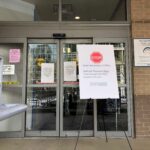
Across the region this week, the surging case counts quickly disrupted public life, as schools began changing operations and the entertainment industry went into retreat. The Kennedy Center postponed its production of Ain’t Too Proud for two weeks, after fully vaccinated company members tested positive. Multiple restaurants and bars, including Maketto, Slash Run, Bar Charley, Lucky Buns, and Lost and Found announced temporary closures after staff members tested positive. (Lucky Buns announced it would open Friday night after all staff members tested negative.) Meanwhile, The Washington Football team made several roster changes on Friday after the team’s quarterback Taylor Heinicke tested positive for COVID-19, and the backup quarterback was already sidelined for COVID precautions.
In one local pandemic first, a D.C. lawmaker revealed they’d recently tested positive. Ward 8 Councilmember Trayon White shared the news on his social media accounts.
“We are getting too many calls about COVID outbreaks … Our kids and families are not safe,” White wrote on Instagram. “We need to shut it back down and should not be unmasking. It’s flu season and the holiday season.”
In a first since schools returned to in-person learning this fall, an entire D.C. elementary school shut down earlier this week. Students at Whittier Elementary School in Manor Park won’t be returning to classrooms until Jan. 3, after multiple positive cases sent students into quarantine and left the school short staffed. On Friday afternoon, Prince George’s County Public Schools announced that all school would operate virtually starting Dec. 20, and students will continue learning virtually after winter break, until Jan. 18. Earlier this week, three county public schools closed and moved to virtual learning amid a rise in cases.
“Now that we’re in the midst of the surge that we expected, it feels or it is causing, at least for some organizations, a lot of extra work to handle the surge in cases and handle what this means for capacity when a large number of your workers are testing positive and unable to come in,” Roess says.
The spiking and at times record-breaking numbers this week follow the recent identification of omicron – a new variant that early data suggests may be more transmissible than the already highly contagious delta variant – across the region. Last weekend, D.C. announced the first four cases of omicron in the city, all in fully vaccinated individuals who had recently traveled domestically. Virginia and Maryland had detected the variant earlier in December. Roess says our current case surge is still likely driven by delta, as we’re on the early end of the omicron curve. She says experts are watching the U.K. – where omicron is already rapidly spreading, and officials are racing to administer boosters – to forecast what happens in the coming weeks in the U.S.
“It’s just a matter of time before it outpaces delta,” she says.
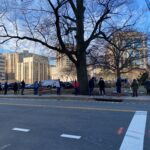
A panic reminiscent of March 2020 seemed to set in throughout the week, as locals questioned whether they should visit a bar unmasked, or take extra precautions before holiday travel. Lines at D.C.’s COVID testing sites snaked through streets for the first time in months, and lawmakers put in requests for D.C. officials to make free rapid tests available ahead of holiday travel, like Montgomery County and surrounding jurisdictions in Virginia have done.
Experts have repeatedly stressed the importance of regular testing as a way to mitigate spread, but DC Health officials had little to share about making tests more available during a call with councilmembers on Friday. When asked if the city planned to beef up the public testing offered at firehouses for the holidays, Patrick Ashley with DC Health said no, but that they are “looking at our overall testing infrastructure.”
The city currently has 20,000 rapid antigen tests (which can go for up to $24 for two at a pharmacy), but they’re reserved for high-risk settings like nursing homes and jails. Ashley told councilmembers that the city is hoping to provide an update in the coming weeks on making these rapid tests available in schools as students head back into classrooms in January.
During the call, At-Large Councilmember Elissa Silverman asked if DC Health was “rethinking its strategy” given the rise in cases and the threat of the omicron variant. When Mayor Muriel Bowser lifted D.C.’s indoor mask mandate last month – a move widely criticized by lawmakers – she and DC Health director LaQuandra Nesbitt laid out a new plan for mitigating COVID, one that emphasized individual risk mitigation over government interventions.
“It’s really about amplifying messages about the importance of testing … of contact tracing and isolation and quarantine when we’re sick,” Ashley said, in response to Silverman. “It’s really time for us to really make sure that we’re embracing that message of the importance of being fully vaccinated. And that also includes that as you’re eligible for it, we want individuals to get that booster.”
According to the Centers for Disease Control and Prevention, about 63% of D.C.’s population is fully vaccinated. In Maryland, nearly 70% of the population is fully vaccinated, and in Virginia, nearly 67% of the population is fully vaccinated.
Only about 21% of D.C.’s vaccinated population has received a booster, according to the city’s data, and despite roughly 82% of seniors 65 and over having two doses, about 41% of fully vaccinated individuals in that age range have received a booster. All individuals 16 and older are eligible for a booster shot six months out from their original vaccination series – a step that could provide added protection against omicron, which early studies show may have a greater ability to evade antibodies than previous variants.
When DCist/WAMU reached out DC Health for comment on Thursday’s record-breaking case increase, asking if DC Health officials had any guidance for individuals as winter continues, a spokesperson directed DCist/WAMU to DC Health’s statement on Dec. 12, which announced four cases of the omicron variant.
“The recent emergence of the omicron variant further emphasizes the importance of vaccination, boosters, and prevention strategies (e.g. masking, washing your hands frequently, choosing activities wisely, and physically distancing from others) needed to protect against COVID-19,” reads the statement.
According to Roess, getting a booster is a crucial step in protecting an individual from falling seriously ill with the virus – but people will still likely have to adjust their behavior this winter to prevent transmission. A mild or asymptomatic case for a young, vaccinated, boosted individual could be a severe case for a non-boosted, or immunocompromised person.
“What is still challenging is figuring out how to break the cycle of transmission,” Roess says. “I think that’s partly why some individuals feel very stressed about what they [should] do if they are infected, have a mild case, or are asymptomatic. We absolutely should consider protecting each other, limiting our movement … keeping the masks on, avoiding being in close contact or visiting our friends and family who have immunocompromising conditions. I think that’s our duty.”
This post was updated to reflect Friday’s daily case count in D.C., Prince George’s County shift to virtual learning through Jan. 18, and the reopening of one restaurant.