Amanda Michelle Gomez
 Colleen Grablick
 Margaret Barthel
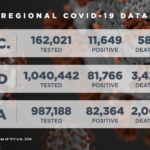
D.C., Maryland, and Virginia all reported record-breaking numbers of new COVID-19 infections on Tuesday as the U.S. grapples with a nationwide case surge.
Federal health officials expect the remarkably contagious omicron variant to lead to unprecedented positive cases but are unsure how many of those people will get seriously sick. Public health experts suspect the vaccines offer a significant degree of protection against serious illness caused by omicron, particularly for those who are boosted. However, even if a small proportion of cases develop into severe illness, a small proportion of a large number is still going to be a large number, warned DC Health officials on Monday.
Here’s what to know about the numbers across the region and how health authorities are preparing for a continuing surge through the holidays.
D.C.
DC Health this morning reported 3,763 new positive cases between Dec. 17 and 19, averaging 1,254 per day — by far the highest number documented in a single day in the District since the pandemic began. The District reached that grim milestone two separate times last week, too, with a record 508 cases on Thursday and then another record 844 on Friday. But the District’s data, which lags days behind, does not fully capture the spike the city is currently seeing.
According to the Washington Post tracker, D.C. reported the highest daily case rate per 100,000 residents in the country, as of Dec. 21. (DC Health’s daily case rate is behind several days, so does not account for all the weekend cases.)
DC Health also reported the death of a 56-year-old woman from the virus between Dec. 17 and Dec. 19. Altogether, D.C. has lost 1,207 residents to COVID-19.
By the afternoon, the city posted the data for Monday, Dec. 20 — adding 1,155 new cases and no additional deaths.
Tuesday’s numbers arrived after a lag in the city’s COVID reporting this week. At a press conference on Tuesday, DC Health senior deputy Patrick Ashley said the data was delayed to ensure there were no duplicates in the numbers.
“Everyday we have seen an increase in cases and so we expect that to continue — that’s the way that COVID-19 spreads,” Ashley said. He encouraged residents to get tested.
While increased testing in part accounts for the drastic rise, DC health officials believe the new variant plays a bigger role. The Centers for Disease Control and Prevention announced Monday that the highly contagious omicron variant accounts for 73% of new infections across the country last week, rapidly overtaking delta’s share of cases in just one week. While DC Health reports that omicron makes up less than one percent of cases regionally, sequencing of D.C. cases takes up to 10 days and the agency is sequencing a minimum of 10% of new cases.
It’s too soon to say what the impact will be on the D.C. region’s health care system, as hospitalization and death numbers lag behind cases. DC Health’s key metrics for measuring the wave of the pandemic lag by several days. So far, vaccination has proven effective against serious illness and death.
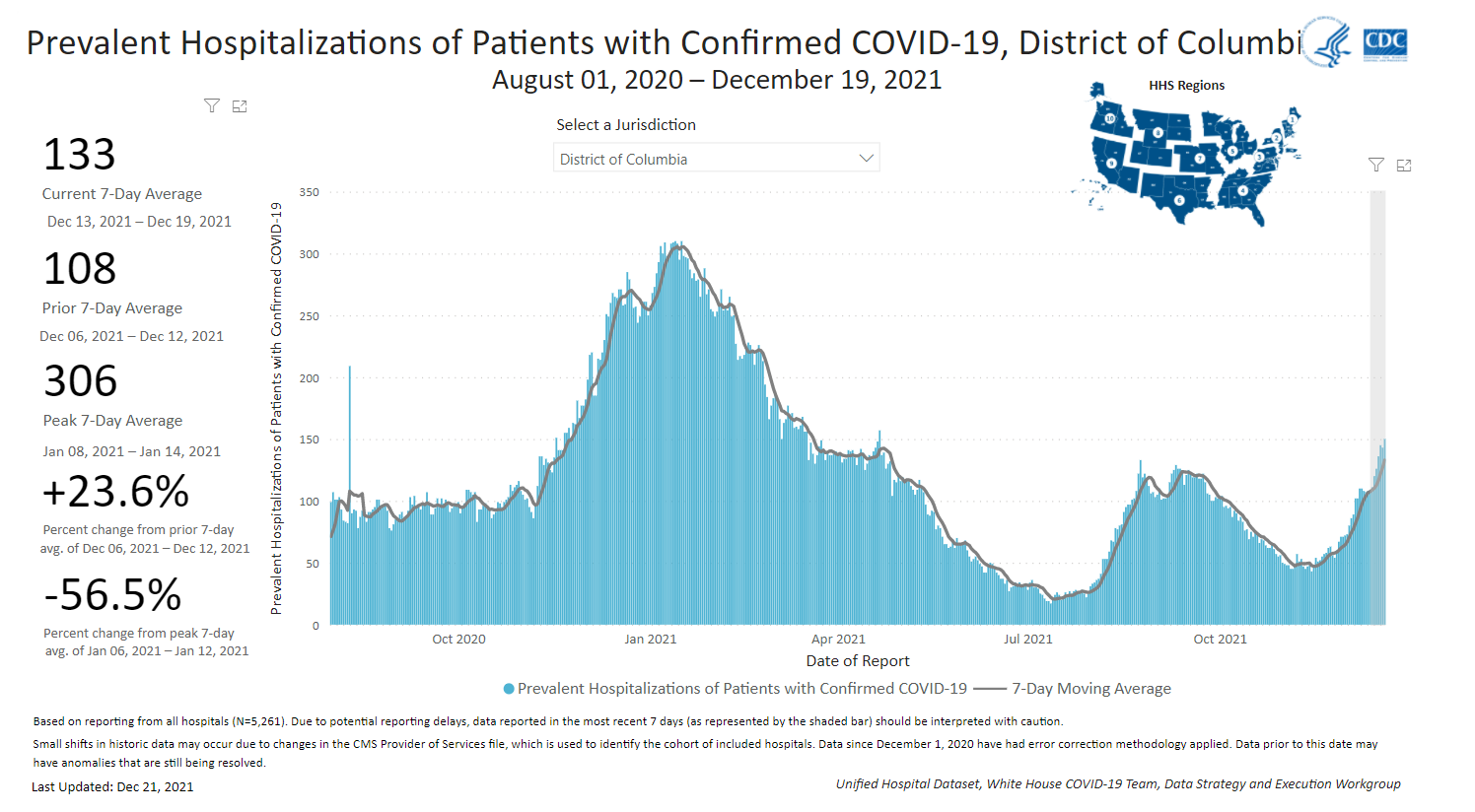
“We have to wait and see, unfortunately,” says Neil J. Sehgal, a public health professor at University of Maryland. “We’ll know the real impact from the cases that we saw between Friday and now, between Christmas and New Year’s … and certainly for fully vaccinated and boosted people, hospitalization and death are not the likely outcome of a breakthrough infection. But our vaccination rates in the District aren’t as high as we want them to be, so there are certainly a lot of vulnerable people in the District.”
Maryland
Meanwhile, Maryland added 6,218 new cases on Tuesday – nearly doubling the state’s previous record for the most recorded cases in a single day (roughly 3,800 cases during the January 2021 surge). The state’s online COVID-19 data tracking system only came back online on Monday, after a cyberattack shut it down for nearly two weeks.
Hospitalizations from the virus are also continuing to rise in Maryland. As of Tuesday, nearly 1,400 people were hospitalized with the virus. During the January 2021 surge, that number peaked at roughly 2,000, but Gov. Larry Hogan (who tested positive for the virus on Monday) has directed hospitals to revert back to their pandemic-era surge plans when the state recorded 1,500 hospitalized patients with COVID.
On Tuesday afternoon, Hogan addressed residents from home via a livestream, seated in front of a giant Christmas tree, speaking with a slightly hoarse voice. Hogan said he was quarantining and experiencing only mild cold-like symptoms.
“I attribute that to the fact that I have been fully vaccinated and that I got a booster shot as soon as I was eligible, and I can’t stress this enough. Getting vaccinated and getting your booster is your strongest possible defense against this virus and its variants.”
Hogan said state health officials project hospitalizations could be higher this winter than during last winter’s COVID surge, reaching more than 2,000 and peaking in mid-January. In addition, Maryland officials said, because of health care staff attrition during the pandemic, hospitals have about 5% fewer beds available heading into this wave of infections.
Virginia
In Virginia, where officials have yet to reimpose any pandemic precautions, COVID cases are also climbing at a record-breaking pace. The entire state is about to surpass its 7-day rolling average peak of 3,689 new cases during the delta surge. The average currently stands at 3,575. Meanwhile, hospitalizations in the commonwealth are also climbing, from a low in November of 846 to more than 1,500 today.
In Northern Virginia, several jurisdictions have already far surpassed their 7-day rolling average records from earlier in the pandemic. At the height of the winter 2020 surge, Arlington’s new case average stood at 122 per day. During the delta surge this fall, it was just under 50 per day. That figure is now almost 200. Case numbers in Alexandria have similarly skyrocketed past all previous levels, and the city reported its highest-ever number of diagnostic tests on Tuesday.
Fairfax, Loudoun, and Prince William counties have not yet surpassed their winter 2020 surge case highs, but they are well past their delta surge numbers.
“We’re definitely at the highest case counts that we have seen, but even even higher than folks like me would’ve reasonably imagined,” says Sehgal.
The regional response
Government officials have emphasized the importance of vaccination, testing, and masking in response to the latest surge.
On Monday, Mayor Muriel Bowser announced the return of the city’s indoor mask mandate, effective Tuesday morning, as well as increased access to testing, and a vaccine mandate — booster included — for D.C. government employees. Bowser did not go into detail about how the city is going to increase boosters.
The total population of people fully vaccinated in D.C. is 67%, with 45% of those 65 and older boosted, according to the CDC. In Maryland, 70% are fully vaccinated, with 63% of seniors boosted. In Virginia, 68% of the total population are fully vaccinated, with 62% of seniors boosted.
Regionally, the surge has disrupted lives in a way many locals had hoped was a part of their pandemic past: Prince George’s County Public Schools are fully virtual until mid-January, after officials recorded nearly 1,000 cases among students in one week. In D.C., more and more public schools keep closing – currently, 11 are moved fully remote due to infections on campus. Restaurants – either due to a COVID-19 infection among staff members or out of an abundance of caution – are closing their dining rooms temporarily. The Kennedy Center postponed a show last Wednesday, and the 14th Street venue Black Cat announced that two staff members for a recent performer have tested positive, and will not be hosting any shows until the new year. Regional sports teams – including the Washington Football Team to the Washington Capitals – have had their rosters shuffled and games postponed as the virus sidelines multiple players.
And it all comes ahead of a holiday weekend – one that many locals had hoped would look a bit more normal than 2020. Personally, Sehgal says he has changed his holiday plans, and will no longer be seeing his fully vaccinated and boosted, but immunocompromised, parents. He says, however, that there are ways to gather with others in the coming weeks safely, so long as individuals calculate their risk and the risk of those they’re seeing.
“If everyone that I was socializing with were vaccinated, I would certainly feel much more comfortable about keeping holiday plans and that’s been my recommendation to other people – if you can say with confidence that the people you’re going to be around are fully vaccinated, boosted, and that at low risk of serious disease, certainly keeping your holiday plans is reasonable,” Sehgal says.
But as the D.C. area waits to see the impact the massive caseloads have on hospital capacity and deaths, Sehgal says the mental and emotional impacts of the surge will have already been felt across the region.
“It’s going to put a lot of strain on the population of the DMV, even before it puts a strain on the healthcare system,” he says. “Nobody’s happy, nobody’s feeling well. There’s a lot of anxiety right now, and the mental health toll that this phase of the pandemic will take will likely be very significant, and we can’t discount that even as we prepare for the toll that it takes on people’s lives and the healthcare system as well.”