Martin Austermuhle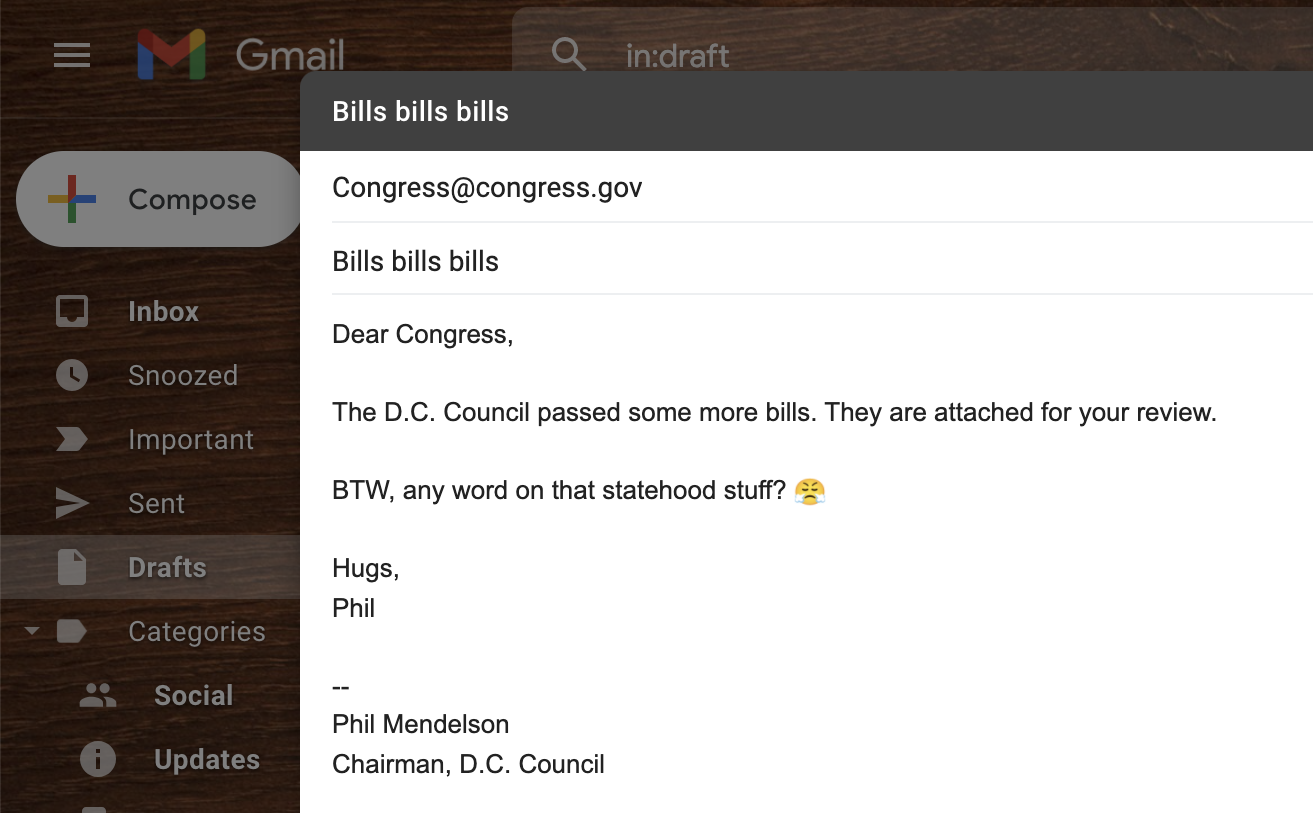
D.C. Del. Eleanor Holmes Norton usually spends her time in Congress fighting for the city’s right to govern itself free from Republican intrusions, but this week she’s focusing on a slightly more pedestrian concern: email.
A new bill Norton introduced Monday would allow the D.C. Council to send legislation to Congress electronically, instead of the current — and, some argue, technologically antiquated — requirement that it be hand-delivered to Capitol Hill.
Under the city’s Home Rule Act, all legislation passed by the council and signed by the mayor must undergo a 30-day congressional review period, or 60 days for changes to the criminal code. That period begins once the legislation actually reaches Capitol Hill, giving members of Congress the opportunity to review and lodge objections to measures passed by the city’s duly elected legislators. The bills can only become law once the congressional review period ends.
Beyond the mere annoyance of printing and hand-delivering paper copies of legislation to Congress, the system has worked fairly well since it was adopted in the mid-1970s. That changed last year, when dozens of D.C. bills were held in legislative limbo because council staff were physically blocked from delivering copies because of the fencing that encircled Capitol Hill after the Jan. 6 insurrection.
That fencing is no longer there, but Norton says the 48-year-old process remains unnecessarily burdensome, requiring that council staff schedule times to drop bills for the Speaker of the House and Senate president, drive to the Capitol — which requires two employees, a driver and delivery person — hand-deliver the bills and accompanying legislative reports that can be hundreds of pages long, get signed receipts, and return to the Wilson Building.
“Today, when we live in the era of email, there is no reason to continue to require an increasingly ancient process when these documents can be transmitted electronically, saving a tremendous amount of time and effort for all involved,” Norton said in a statement accompanying her bill.
There are currently 35 bills passed by the council undergoing congressional review. The congressional review period can drag on for months, because the 30- or 60-day timeframes only include the days that either wing of Congress is actually in session.
Norton has fought for a bill in recent years that would make D.C. the 51st state (it passed twice in the House and stalled in the Senate) but has also taken on some of the smaller challenges and indignities faced by the city in its status as a federal entity without a vote in Congress. The nonvoting delegate has pushed to end the congressional review of D.C. legislation and budgets, require that flags be flown at half-staff upon the death of a D.C. mayor (a privilege extended to governors), grant D.C. control over its own court system, and give the mayor authority over the D.C. National Guard.