Jacob Fenston
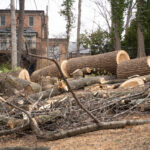
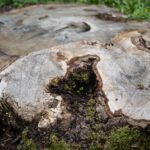
Police, neighbors, and city officials stood on the sidewalk snapping photos and filming, as a tree crew cut down a towering oak tree in D.C.’s Takoma neighborhood last week. The removal was illegal and will carry a hefty fine, according to District officials, but due to a loophole in the law, nobody was able to step in to prevent it.
In D.C. it’s against the law to cut down what are known as “heritage trees.” But these trees – many 100 years old or more – are sometimes removed anyway by developers willing to pay a hefty fine, if doing so boosts their property value.
When Alice Giancola woke up on a recent Friday morning at her home in Takoma, her husband told her there was a tree crew setting up in the lot across the street. “I got dressed hurriedly and I called a couple neighbors and ran over there,” says Giancola, who has lived in the same house on Cedar Street NW since the 1980s.
Takoma is a leafy neighborhood of bungalows and old farmhouses, where the streets are named alphabetically for trees, starting with Aspen. Many of the trees in the neighborhood are older than the houses and some even predate the tree-named streets.

Giancola confronted the guys who were working on the oak. She dashed off an urgent note on the neighborhood listserv. She called the city’s urban forestry division and her local councilmember’s office. And she called the police. The oak tree across the street was a heritage tree, according to District foresters – larger than 100 inches around, and protected, in theory, by D.C.’s 2016 Tree Canopy Protection Act.
“But unfortunately, the way the city laws are written, there’s nothing you can do about it because the city — while they say it’s illegal to take down the tree — they do not give the forester the legal authority to issue a stop work order, which is really stupid, in my opinion,” says Giancola.
Hefty fine does not stop some owners
The police did show up on Cedar Street, but didn’t have the authority to stop the cutting. Then the property owner arrived, says Giancola, and started shouting at the crowd of neighbors.
“‘Get off my property, I’m going to cut this tree down,’’ Giancola recalls him saying. Neighbors told the owner that cutting the tree was illegal, Giancola says.
“He said, ‘I don’t care. Everybody does it, all developers do it. We pay the fines, nobody cares,'” Giancola says.
The property on Cedar Street is owned Sicarii Development, LLC, according to District property records. Meagan Allen, a lawyer for the owners, said in a statement to DCist, “My client appreciates and supports efforts to preserve and improve the city’s urban forest canopy and has acted in good faith.”

But Earl Eutsler, who heads the District’s Urban Forestry Division, says the owner was advised in “no uncertain terms” that removing the oak tree would be illegal. In fact, he says the owners applied for a removal permit and were denied. Eutsler says the property owner is facing as much as $72,000 in fines for cutting down three protected trees — the heritage oak, and two smaller “special trees.” Special trees — with circumferences between 44 and 100 inches — can only be removed with a permit at a cost of $55 per inch of circumference. Heritage trees — larger 100 inches or more in circumference — cannot be removed unless dead, dying or otherwise hazardous. Fines for removing a heritage tree start at $30,000 — calculated at $300 per inch around.
To most people that probably sounds like a staggering amount of cash. But for some property owners it is not a real deterrent.
“If by removing a protected heritage tree, you can add substantial square footage to a building, you’re probably able to simply recover the cost that the fine imposes,” says Eutsler.
Despite the heavy fines, there were 24 illegal heritage tree removals reported in 2020 and 27 illegal removals in 2021, according to data from the Urban Forestry Division.
Fines the city collects for illegal tree cutting go into a special fund to pay for planting new trees around the District. But Eustler says you just can’t replace a 100-year-old oak.
“With trees, the older they become, the greater the services and benefits they provide to the people who live around them. And so while we and our partners are planting thousands of trees every year, it will take decades for the trees we’ll plant now to attain size and service delivery similar to the trees that were removed last Friday,” Eutsler says.
A legislative fix
Many tree-lovers in the District are backing legislation that would strengthen the heritage tree law. Known as the Urban Forest Preservation Authority Amendment Act, it would allow urban forestry to issue a stop-work order before a tree is cut down.
Italia Peretti, a spokesperson with the nonprofit Casey Trees, says it’s a step in the right direction.
“Ultimately, this action would hopefully give them the tools to be more proactive in preventing the city’s heritage trees — all large trees — from being taken down, instead of the more kind of reactive issuing fines that are currently in place right now.”

D.C. Councilmember Janeese Lewis George said in an email to DCist that the tree removal on Cedar Street “highlighted a major loophole in our current laws.”
“I was taken aback that despite several D.C. agencies being present, no one had the authority to step in and prevent this from happening. The developer considered the fine as the cost of doing business, while the contractor didn’t care about the tree being protected or the lack of a permit,” wrote Lewis George, adding that she strongly supports the legislation to strengthen the heritage law, currently before the Council.
Eutsler says other protections, besides just the ability to write a stop work order, may be needed to protect trees. For example, there could be a provision limiting future construction on a site where a tree was illegally removed.
“Let me put it to you in terms of historic preservation: If this if this individual had a historic structure and they knocked it down, there likely would be implications for their ability to build something new on that site. And yet there are few things more historic than a heritage tree.” (The property on Cedar Street is located within the Takoma Park Historic District.)
A slow death
On Cedar Street, a couple dozen neighbors came by as the trees were being cut. Many stayed for hours as chainsaws buzzed, watching the big oak come down limb by limb. They say a magnolia and locust tree were also removed.
“There was crying. I mean, and very, very upset people,” says neighbor Marie Ringwald, whose windows look directly into the now-bare dirt lot where the trees once stood. The property was part of the land around an 1894 farmhouse. The farmhouse was recently sold and flipped, and the land around it broken into separate lots and sold off.
Giancola says the battle over the heritage tree has been going on for months; over the summer, she says, the owners attempted to kill the tree by cutting the roots and poisoning it. She says this was witnessed by a D.C. Urban Forestry employee, who happened to be in the area. Eutsler says he can’t comment on the alleged attempt to kill the tree because the city is still investigating the violations, in preparation to levy fines.
Attempts to kill trees to avoid removal fines are not unheard of. Karen Taylor, who lives in Colonial Village, testified in favor of the new tree protection bill earlier this year. She says a developer working on the property next to hers has blatantly ignored rules about protecting trees during construction, in what she says is an attempt to kill a large tuliptree. Tuliptrees are among the trees least tolerant to construction disturbance, and require extra protections under D.C. law.
“Besides cutting down the tree, you can kill it by suffocating the roots. This can be done by piling up dirt, by piling pieces of concrete, by driving over it with utility vehicles, and many other ways,” Taylor says.

“It’s the same thing as cutting down. It’s just kind of a slower approach,” Taylor says. The developer, she says, had originally planned a swimming pool where the tree stands, and is trying to get rid of it.
Taylor says there needs to be a more comprehensive approach to protecting large trees. “It has to cost you more to cut down the tree than you will gain by cutting down the tree,” she says.
There are some examples of the heritage tree law working as intended, with developers planning buildings around the trees – or even moving the trees. That’s what happened at the old Fannie Mae building on Wisconsin Avenue – in 2019 the developer relocated three heritage trees on the property. It cost more than six times what it would have to just cut them down and pay the fine.