 Ayan Sheikh
Stacy Bishop tried pole dancing and curling during her search for a new athletic activity a decade ago. The fact that pole dancing was an “epic failure,” she says, is why she’s a semi-competitive curler today.
“I saw it on TV, and I was like ‘wait, they don’t look so crazy athletic that I would die if I tried that,’” the 37-year-old said.
Every four years, when the Winter Olympics roll around, people wonder about the sport called curling. What is it, and who plays it? Is it really a sport?
Bishop can dispel one myth right off the bat: yes, it is a sport. And it’s a sport with local enthusiasts.
Today, Bishop is the coordinator for the recently-reformatted women’s league at the Potomac Curling Club in Laurel, Maryland, the first of its kind in the Washington region. The Chesapeake Curling Club located in Easton, Maryland, is the only other curling club located in Maryland and they also have a women’s league.
Aiming the rock at the house
On a cold Monday evening in January, a group of roughly 30 women, with Bishop at their helm, gathered for their first league game, some of them curling for the very first time. Before they got on the ice, Bishop went over a few housekeeping notes and reviewed the rules of the game. The women were divided into different teams–each group consisting of experienced and amateur curlers.
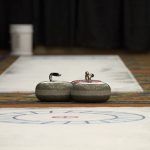
In curling, each game consists of a face-off between two teams of four players each. The goal is to slide a 40-pound granite stone, known as “the rock,” 140 feet over a sheet of ice toward the center of a single giant bullseye called “the house.”
Each member of the team plays a crucial role: one person propelling the stone, two sweepers following it and, when necessary, frantically scraping the ice in the stone’s path in order to reduce friction, melt the ice, and control the curl of the stone. Waiting at the house is the team captain, who helps determine the trajectory of the stone and tells the others where to aim.

The team with the closest stone to the middle of the house scores a point. Each team can score multiple points if they have more stones closer to the center than their opponent. Each game is broken into 10 innings, also known as “ends” and both teams take turns to throw eight rocks per end. Once the rocks collide, they make a very distinctive sound, almost like a gunshot going off in the distance. The team with the closest stone in the center of the house wins the inning.
A fun fact about the granite stones used in curling: They all come from the same factory, located in Ayrshire Scotland. A company called Kays Curling has had the exclusive rights to mining and harvesting the granite for the stones since it was created in 1851. The sport is called “curling” because of how the rock can curve as it moves along the ice, influenced by how it’s pushed, or by the surface of the ice itself.
Like Bishop, every woman in the room had a story about what brought them to curling.
“I wanted to curl since I was little but it wasn’t really accessible, and when the opportunity came up to curl, I took it,” said 27-year-old Jackie Sharp.
Sharp is a Pittsburgh native who moved to the Washington region two years ago. She’s an engineer by day and a hockey player who is now “addicted” to curling.
Liz Brown on the other hand was a latecomer to the game. She took up the sport 12 years ago, at the age of 54, thanks to her husband.
“My husband said ‘let’s go for a ride, I’m going to surprise you where.’ He never does this,” she explains. Brown grew up in the suburbs of Detroit and used to watch curling on TV. “He had heard about the curling center, so we came here,” she added. Brown took to it quickly but, unlike Bishop, who plays semi-competitively, Brown describes herself as a social curler.
‘It allows all sorts of people to play’
Brown and Bishop enjoy curling because it is a game of immense precision and strategy — it’s like playing chess on ice, they say. Curling also requires a lot of teamwork. It’s also a sport they say anyone can play, because you don’t need to be a top notch athlete to succeed.
“There is no advantage to being big and strong versus flexible, versus a lot of other things,” said Bishop. “It allows all sorts of different people to play, and play together.”
In spite of the even playing field as far as physical skills, it’s still a male dominated sport, with women making up about thirty percent of 260 members at the Potomac Curling club, according to Bishop. The teams at the Potomac club are co-ed, except during the women’s league, though to compete, they have had to rely on recruiting their male counterparts to complete the required 32 slots needed to fill the teams. Bishop shared that the club now has a full women’s league in 2022 for the first time since 2017.
The gender imbalance is something she and her teammates are trying to change, including through a series of classes taught by experienced female curlers aimed at recruiting more beginners to the sport. Bishop said that since introducing these clinics last year, the number of female members at the club has doubled.
Curling has been slowly growing in popularity, gaining traction in particular during the winter Olympic games in recent years, and with it, the club has seen a jump in membership. Bishop said the club saw a roughly 25% increase in membership around the 2018 winter Olympics.
“We will see over a thousand people come to try curling in the next few weeks, in a variety of public events,” she said. “In other years, we see maybe a few hundred across the whole season.”
The Potomac Curling Club was originally founded by six Canadian citizens in 1961. (While many believe curling originated in Canada, the World Curling Federation reports the first evidence of the sport was recorded in Scotland and the Netherlands in the 16th Century.) The club’s original members first skated on rented ice in College Park, Maryland, using stones borrowed from the American Curling Foundation. The club has been in its current location in Laurel since 2002.
“We’re not preparing them for the Olympics, so to speak, but we’re preparing them to play a pretty competitive game,” said Bishop.

Some people compare curling to shuffle board, but to professional curlers like Dominique Banville, that’s an insult. For starters, she said, curling is far more physical.
“You have to run on ice and you have to sweep at the same time, and pace yourself so that you are next to the stone,” she said. “The stone will sometimes travel very fast, sometimes not. And when it’s not traveling fast and it needs to travel more than what we think it’s going to travel, then it’s like you have to sweep hard, and you are not just like a Swiffer on the ice. It’s like scrubbing.”
Mindy Carlson is the last person in her family to start curling. Her husband and both of her children play the game.
“I just decided I really admired the camaraderie that my kids were getting with their peers and that my husband had, he developed some close friendships with the people he curled with and I just sort of felt like now it’s my turn,” said Carlson.
Diversity is still an issue
While the Potomac Curling Club has made strides in attracting more women to the game, they still have a diversity problem. Of the 30 women in attendance on league night, all were white. Bishop said they recognize the boundaries that keep certain groups of people from curling, including that many curling centers are in suburban areas not accessible by public transportation. Because it requires ice and special equipment, it’s also an expensive sport. Membership at the Potomac Curling Club costs $500 a year. Curling shoes range anywhere between $100-200, and the brooms players use can cost anywhere from $70-300.
Bishop says that even though they have work to do in attracting people of color and making the sport more accessible, she is proud of the strides they’ve made to engage members of the LGBTQ community.
“Our club proudly hosted the first, and I think still only, LGBTQ-plus and allies tournament in the United States,” she said, adding that the club has hosted at least three or four transgender women.
Another important element of the game is what’s known as the “spirit of curling,” a code of conduct that dictates how players should act on the ice. One thing frowned upon is excessive celebration. While this is forbidden during play, the women at the Potomac Curling Club have a lot to celebrate as the popularity of their sport continues to grow.