Elliot C. Williams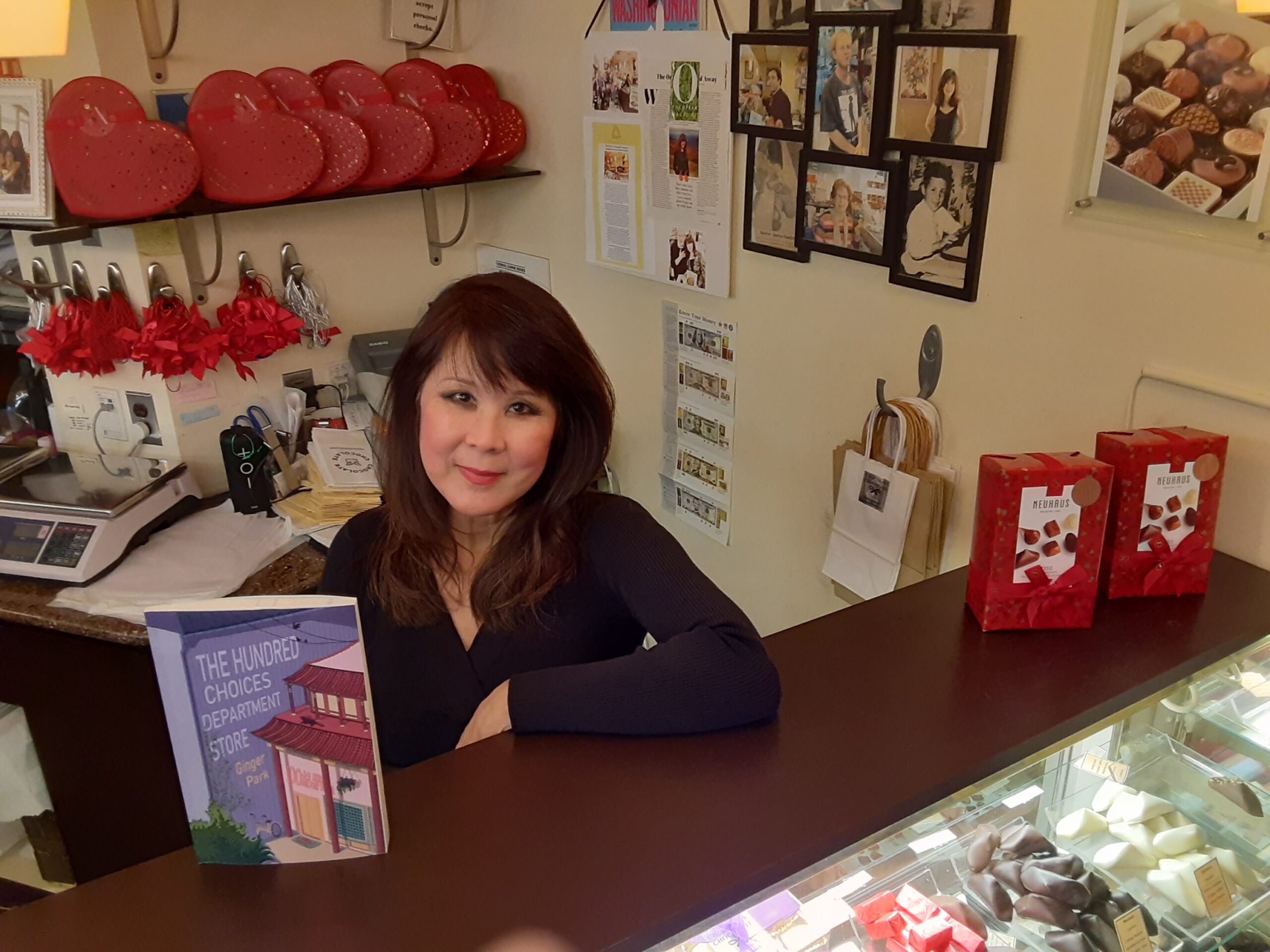
Ginger Park has a saying: Chocolate can put you in a good mood, no matter the circumstances. Park, a small business owner and author, says that chocolate — and writing — has sustained her through the pandemic.
Since 1984, Park and her sister, Frances, have owned and operated Chocolate Chocolate, D.C.’s oldest independent chocolate store, while writing and publishing children’s books that explore the history of Korea through first-person narratives. The store is only big enough for a few customers to fit without bumping elbows, but regulars are treated like family and — with the shopkeepers’ help — pick out their favorite sweets from around the globe.
The Park sisters have written a number of award-winning titles — together and separately — including memoirs, short story collections, recipe books, and illustrated children’s books.
“The pandemic has really brought us to our knees, and it’s been really, really tough,” Park says about their chocolate shop, located at 1130 Connecticut Ave NW. “But throughout it all, you know, I’ve been writing.”
Park, 59, found inspiration from her mother’s story. Heisook Park, Park’s mother, grew up in Sinuiju, a village in northern Korea (before it was North Korea).
“My mom had a whole other life before this life in America, and it was a life that she could never let go of, as much as she loved this country,” Park says. “I grew up always thinking it was this dark, miserable place, but my mom said, ‘No, it was beautiful.’”
Park’s latest book, The Hundred Choices Department Store, tells the story of 13-year-old Miyook Pang in 1944 Korea, during the Japanese occupation and Russian invasion of the country.
The 100-page novel follows the Pangs, who own the “Hundred Choices Department Store,” a loose translation of a store her mother’s family actually owned in Korea. In the story, the shop caters to wealthy Japanese men and women who “easily dropped one hundred yen without batting an eye,” the book reads. “Luxury choices included expensive jewelry encrusted with sapphires, emeralds, rubies, and diamonds, and glittering with every color of the rainbow.”
In her Japanese-controlled school, Miyook must navigate two worlds. She’s taught the Japanese language and history, and must bow to a portrait of Emperor Hirohito, all while trying to remain loyal to her Korean family and traditions. “We were assigned Japanese names,” Miyook narrates. “Mine was Himeko, a meaningless label for a girl christened Miyook, which means beautiful pearl.”
Exhausted and sick, Miyook is sent to work in a dye factory her older brother dubbed “Hell’s Chamber.” As World War II comes to an end, Miyook’s encounter with an orphan named Song-ho proves more pivotal than she anticipated. The book plays with the idea that “small gestures are never forgotten,” and asks, “What would you risk for freedom?”
The Park sisters grew up in Northern Virginia listening to their mother tell stories about her escape from northern Korea to the south in 1947. After their father’s sudden death from a stroke in 1979, Park says she and Frances started listening more intently to those stories, hoping to write them down before it was too late. Eventually, in 2010, they published their first picture book, My Freedom Trip, about their mother’s escape from North Korea at age 16 and her separation from her own mother.
“I feel that this is a piece of history that kind of … I don’t want to say it was swept under the carpet … but it just isn’t a part of history that we talk about a lot in this country,” Park says. “And now that North Korea is North Korea, it’s not like you can go into the country and explore what a lot of people like my mother experienced growing up.”
Before Park’s mother passed away in 2019, she read the manuscript for The Hundred Choices Department Store. Her opinion, of course, mattered to Park the most.
“Normally, whenever I’ve written something, she would always be like, ‘Wow, you could have done this, you could have done that.’ But when she read this, she was crying, and her tears told me I had done my job,” says Park.
In the span of two years, Park watched her mother die of cancer, along with a close friend and employee at the chocolate shop, Steven Koumanelis. The onset of the coronavirus pandemic then forced the Park sisters to temporarily close up shop right before one of their busiest times of the year — Easter. The Chocolate Chocolate owners have considered selling the shop at times, but loyal customers convinced them otherwise. Patrons continue to buy their favorite chocolates through the store’s website and in person when they’re able. “You can’t sell your baby,” Park says. “So, we’re in it for the long haul.”
Still, with COVID-19 variants in the picture, nothing is certain. Park’s world has shrunk — she only leaves her home in Springfield, Virginia to visit the shop. She has the company of her son and husband at home, but admits that they’ve all grown a bit batty while sticking to health protocols. “My writing has really saved me,” she says.
Park’s book will be released on March 25 — her mother’s birthday — and is available for pre-order. In addition, the Park sisters will give an author talk with Politics & Prose on March 23. The event is free and currently scheduled to take place virtually.
“It’s my mama’s story, you know?” says Park. “And she would be really happy to know that it was published.”
P&P Live! An Evening with Frances Park and Ginger Park. FREE; March 23.