Margaret Barthel
Update:
Alexandria City Council unanimously passed a resolution to begin collecting fees from businesses using on-street parking spaces for outdoor dining, fitness classes or retail, the first jurisdiction in the region to charge for so-called “parklets.”
The Council, concerned about the impacts on businesses still recovering from the pandemic, decided to delay the beginning of fee collection until October 1, instead of July 1 as originally proposed. Beyond the fees, permanent parklets will come with an additional up-front cost to businesses: building a platform that makes the space flush with the curb, instead of requiring a step down to access.
Alexandria Mayor Justin Wilson said setting the fee was a step to ensure that businesses actually use their parklets, and to recognize that the areas were public space being put to a commercial purpose.
“I think it’s important from a principal perspective that this is public space,” he said. “We are giving public space to a private business to make money off of.”
Members of the council also requested information on whether the city would be able to dedicate some federal pandemic relief money to help businesses with the cost of constructing platforms.
Delaying the implementation of parklet fees to October could have a small fiscal impact. City staff had assumed the program would bring in $50,000 in revenue if fee collection were to start on July 1.
Original story:
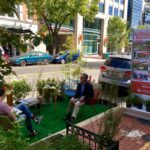
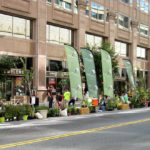
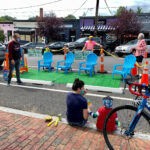
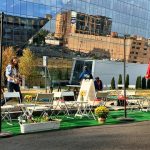
Small businesses in Alexandria that have temporarily been using parking spaces for dining, fitness, or outdoor shopping could soon be required to pay fees to the city, according to a proposal being considered by the city council.
Under the proposal, which will be discussed at the council’s meeting on Tuesday night, the city would begin charging fees for use of these “parklets,” with the amount depending on the location of the space, whether it is for public or commercial use, and whether it is temporary or long-term.
There are 32 businesses in Alexandria that received a permit for a parklet and are still using the spaces — down from a high of 50 applicants for parking spaces during the city’s temporary pandemic parklet program, excluding the businesses on the 100 block of King Street. City staff also say there are two new businesses interested in participating in the program now that it is permanent.
If the Council passes the proposed fee structure, businesses using parking spaces for dining or other outdoor commercial activities would pay $3,000 per year for a parklet in the King Street corridor, $2,000 per year for parklets in other commercial areas, and $1,000 per year in areas defined by the Metropolitan Washington Council of Governments as ‘Equity Emphasis’ areas.
The fees would take effect in July, and they would be halved for the first year. Businesses would also be required to build removable platforms for the parklets that would raise the space to the level of the sidewalk, in order to prevent the space from spilling over into the existing street and to comply with accessibility standards set out in the Americans With Disabilities Act. The cost of constructing such a platform could range between $5,000 and $10,000, according to a report from council staff.
The city receives an average of $4,000 per year in parking revenue from a single parking space along King Street, and an average of $2,000 per spot elsewhere, per the report.
The proposal would also set up a fee structure for public-use parklets, at $300 per parking space per year.
At the start of the pandemic, Alexandria approved a temporary parklet program, part of a push to help restaurants add outdoor dining spaces to keep them afloat financially. No fees were collected during the temporary program, which ends in March, and may be extended into June. (Prior to the pandemic, the Council had been considering a public-use parklet pilot; a modified version of those original guidelines was used in the temporary program).
The Council approved a permanent version of the parklet program in October 2021, with the expectation that the city would eventually charge fees to recoup lost revenue from turning in-demand parking spaces along King Street and in other busy areas into outdoor dining or other types of space for public use.
“The goal for a parklet program is to continue supporting local businesses with additional space for their operations, safely activating the public right of way, providing new open space for pedestrians, and enabling outdoor activities during and after the Pandemic,” reads the Council report from the permanent program’s passage.
In August 2021, city officials surveyed businesses about what they felt would be an “economically feasible” annual fee for using on-street parking spaces for their operations. The 51 responses are a mixed bag, ranging from more than $1,000 per year to zero or “unsure.” Some respondents suggested that the existing 5% meals tax should be regarded as payment for the spaces.
Overall, the broader 2021 survey — which received more than 2,700 responses — found that the parklet program was popular with businesses and residents alike. 74% of respondents — and 66% of business respondents — hoped to see outdoor dining in parklets continue permanently, past the pandemic emergency.
This story has been updated with the results of the City Council vote.