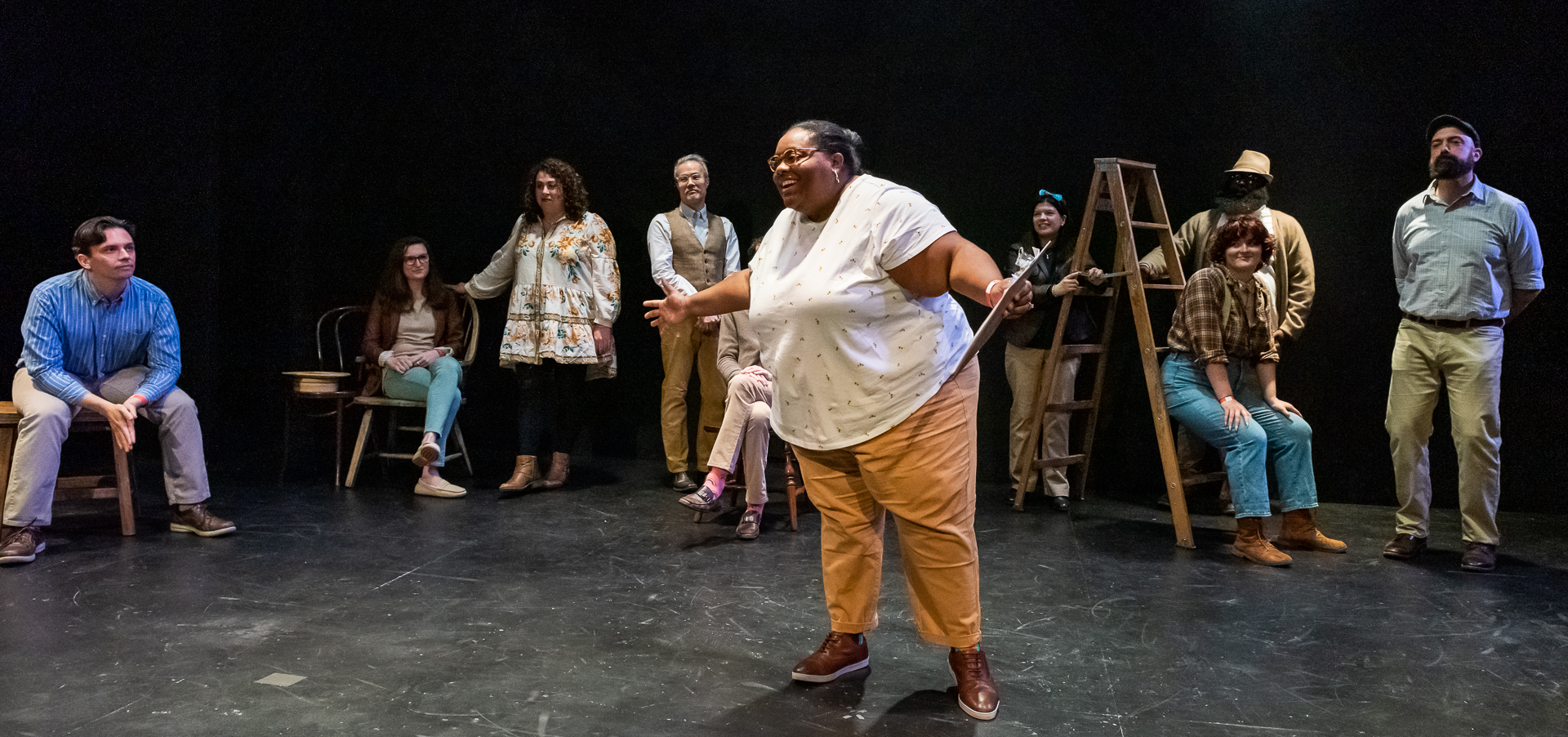
The stars of Washington Improv Theater’s new show are a camera, a newspaper, and a lock of hair. Or was it a potato, a pineapple, and a spatula?
The topics change nightly, but each performance of WIT’s (y)Our Town reaches the same conclusion: When it comes to healing from the trauma of a global pandemic, improv may just be the best medicine.
Each performance of (y)Our Town, now running through March 20 at the Source Theatre, is built around the small-town setting and three-act structure of Thornton Wilder’s Pulitzer Prize-winning 1938 play Our Town. As in the original, we see the life arc of residents of a small American town, but in WIT’s version, the performers create new characters each night, inspired by the three items chosen by the audience. It “has more heart and feels more grounded in reality than improv shows typically do,” Bill Nelson, the show’s co-director, says.
A narrator starts the show by asking audience members to name three objects they would put into a time capsule for the future. These objects then inform the plot of that night’s performance, which is created onstage by an ensemble of 10 performers over 45 unscripted minutes.
At a recent performance, the audience chose a camera, a newspaper, and a lock of hair. The actors ran with it, creating a series of vignettes centered around the objects. A majority of the show was comedy: a daughter with two gay dads keeps a lock of hair from their drag wigs; a husband leaves his 12-year-old daughter in charge of the family newspaper business so he can intern at the New York Post; and a group of teenagers uses a camera to record sleepover shenanigans. But at the end of the show, the actors reflect on the objects, conjuring up moments of equally unscripted tenderness.
Co-directors Nelson and Matt Strote had planned to stage (y)Our Town prior to the pandemic. “In our initial concept, the show would have been more Leave-It-To-Beaveresque,” Strote says. But after living through two years of a pandemic and the social justice protests that rocked D.C. in the summer of 2020, embracing improv’s traditional headlong rush into comedy felt wrong.
“When we picked the show up again after COVID, we knew we had to reconceptualize,” Nelson says. While Our Town, and its examination of community, still sits at the heart of (y)Our Town, “The show now embraces the possibility of happiness and joy but also sadness and despair, which is how things have gone for a lot of us over the course of the pandemic.”
During rehearsals, Nelson, Strote, and the show’s ensemble cast discussed the role that trauma plays in society. “One of the goals of our show is to remind people that we all walk around with generations of inherited trauma,” Nelson says. “But we have inherited goodness too. We hope this show will be a communal moment of joy for everyone who is there and that maybe that joy can shift the balance from bad to good.”
While improv shows frequently rely on audience participation to determine what happens onstage, Strote confesses to feeling nervous before the first performance of (y)Our Town. “I had a panic that people would suggest some of the usual silly items you play with in improv,” he says. “Things like potato or pineapple or spatula because it’s just fun to say spatula. But the audience really played along and came up with juicy items.”
“And even if we were to get two really heartfelt, introspective items to pass down to the future and the third one ends up being a potato, I know our cast would do the work to make that potato important,” Nelson adds. “Like we just went on a journey with this potato, right? Now let’s contemplate what that journey meant like a lot of us did during the pandemic.”
Strote and Nelson have both been involved with WIT since 2015. For Nelson, who works as a pattern maker at the Washington National Opera’s costume shop by day, joining the improv group was “an outlet and a pressure valve” at a time when he was experiencing personal trauma. For Strote, a member of the education staff at Signature Theatre, improv seemed like a great way to connect with a diverse group of people.
As COVID lingers, that sense of connection is even more important for Strote. “There are so many people who are hungry for connection right now,” he says. “It’s exciting to use the Our Town lens of community, identity, and grace to connect with new people who have also lived through this weird couple of years.”
Washington Improv Theater’s (y)Our Town plays Friday, Saturday, and Sunday evenings through March 20 at the Source Theatre. The run time is 45 minutes with no intermission. Tickets $15-$20.