Jacob Fenston
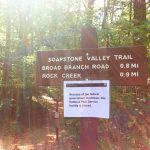
After more than a decade of planning, discussing with neighbors, and replanning, DC Water has finally begun work on a project to rehabilitate a mile of aging, leaky sewer pipes in Rock Creek Park’s Soapstone Valley. Trails in Soapstone Valley, from Connecticut Ave. NW to Broad Branch Rd. NW, will be closed until Oct. 2023.
Soapstone Creek is one of the most polluted tributaries in the Rock Creek watershed, regularly testing with dangerously high levels of bacteria. The sanitary sewer pipes that run alongside the creek are 100 years old and, according to DC Water, at risk of failure due to erosion along the stream bed. DC Water found cracks, fractures, holes, leaks or roots growing into the pipe in every section of sewer inspected in a report from 2011, when the planning process began.
DC Water also provided an update on the number of trees that will be removed to make way for the project. Previously, officials said as many as 370 trees would have to be cut down. After a closer survey of the site, they’ve identified 245 trees that will be removed, mostly oak and beech. This includes 5 large “special trees,” measuring between 44 inches and 99.9 inches circumference. No heritage trees (larger than 100 inches circumference) will be removed.
Tree removal is currently in progress. Later this spring, workers construct access paths for trucks to be able to reach sewer pipes in the park. Work repairing the pipes will begin this summer.
After all the work is completed, 270 trees will be planted, along with 300 shrubs and 500 forbs (a.k.a. herbaceous native plants), according to DC Water.
The project is moving forward despite the concerns and objections of some nearby residents, who worry about the impact to human health of air pollution and water pollution caused by the project. The project will use a process called cured in place pipe, or CIPP, to reline the old pipes with new plastic, giving them decades more service life.
CIPP can cause toxic chemicals to be released into the environment, especially if steam is used to cure the plastic pipes. There have been numerous cases of workers and bystanders being sickened from exposure to steam CIPP emissions. After pushback from neighbors, DC Water announced in January it would switch from using steam CIPP to using hot water to cure the pipes; the agency says this method produces little air pollution and any water pollution will be handled at the sewage treatment plant.
Neighbors, and the local Advisory Neighborhood Commission wanted DC Water to fully consider using a type of CIPP that uses ultraviolet light to cure pipes, but DC Water said it wasn’t practical for this project.
In January and again in February the ANC passed resolutions calling for the project to be postponed pending further study.
But at a recent ANC meeting, on March 15, commissioners appeared to have accepted that the project was moving ahead, and thanked community members for pushing DC Water to lessen the project’s negative impact.
“Going into this project, it is not perfect — I’m not suggesting that it’s perfect, but I am suggesting that we are in a much better place than we were six or seven months ago,” said Commissioner Dipa Mehta. “I am convinced — and I think my fellow commissioners agree — that it is a very necessary project. Otherwise, we are facing serious risk of infrastructure — the pipes and the sewers and the outfalls — failing, which could end up being a bigger problem for the community well beyond this project.”