Martin Austermuhle
A plaza in the heart of Adams Morgan was fenced off early Monday morning, even as a longstanding legal dispute continues over a proposal to build a condominium building there.
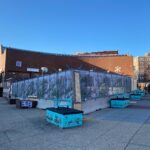
Fencing and concrete jersey barriers were placed around the old SunTrust Plaza, named for the bank that once occupied the back end of the concrete lot at the intersection of 18th Street and Columbia Road NW. (SunTrust is now known as Truist.) In an email, a spokesman for Truist said the fencing was put up so the bank could “conduct maintenance and to help address some of the issues raised by local residents and businesses.”
The fate of the 4,000-square-foot plaza – which has a bank building on site that would be part of the demolition — has long been owned by a string of banks and has been the focus of a pitched legal and political battle stretching over the last six years. It was in 2016 that SunTrust said it would sell the plaza to developer Hoffman & Associates, which planned to build a six-story condominium building on the site.

Some neighborhood activists and residents rallied to stop the project, arguing that an easement exists on the land — which they liken to a “town square” — dating back to the 1970s that would preclude any private development at all. They say the easement was granted by Perpetual Bank, which then owned the land, as a means to settle complaints about discriminatory lending practices.
Those activists and residents sued in 2017 to stop any development, and a D.C. judge temporarily put a halt on any work until he could consider the merits of their claims. The case was dismissed in early 2021, and the long-running farmers’ market that occupied the plaza every Saturday was forced to find a new location at another plaza a block away. The D.C. Court of Appeals heard the case last week, addressing questions if the groups even had standing to sue and whether Perpetual Bank had agreed to a formal easement on the land — and whether that easement would last in perpetuity.
“They built the bank in this amphitheater design, and that’s evidence to some degree of permanency,” said Paul Zuckerberg, an attorney for the groups, during oral arguments. “They created something which has permanence for however long that structure is going to last.”
“That’s the nub of it: they built the bank and they didn’t promise that structure would be there forever. And here we are, they would like to tear down that structure and build something else. Where’s the evidence that they promised up front that they would allow this land to be used, not just now while they owned the property but by future owners?” asked Judge Catharine F. Easterly.
The three-judge panel also pushed an attorney for Truist to address historic records showing some type of agreement by Perpetual Bank to allow the public to use the plaza in front of the bank building.
Plans for fencing the plaza had been in the works for months, but were delayed various times to address a small number of people experiencing homelessness who had set up an encampment there. (Activists used the delay to paint the plaza and add benches for seating.) According to D.C. Councilmember Brianne Nadeau (D-Ward 1), housing was found for those residents.
In an email, Peter Wood, the Advisory Neighborhood Commissioner who represents the area, says that the bank was also concerned about possible crime on the plaza.
“From what I’ve been told and observed, multiple nearby small businesses on Columbia Road NW and 18th Street NW had seen an increase in hostile confrontations during the past several months. While my personal experience has been that those episodes were unrelated to the individuals staying in the encampment, I believe Truist felt the general atmosphere of their property was facilitating criminal activity. Thankfully, they were fairly cooperative regarding that encampment and delayed their plans for fencing multiple times following conversations we had,” he wrote.
“We’ve worked closely with D.C. government and groups like Miriam’s Kitchen to provide respectful, safe and compassionate assistance for the transition of unhoused persons from the former SunTrust property,” wrote the spokesman for Truist.
The Court of Appeals is expected to issue a ruling later this year, and Wood says the fencing is likely to stay up until then. Should the court rule for the bank, the land is expected to be sold to Hoffman & Associates for construction to eventually begin on the building. Some residents have cheered the idea of more housing in Adams Morgan, a popular and centrally located neighborhood where housing has grown more expensive.