Amanda Michelle Gomez
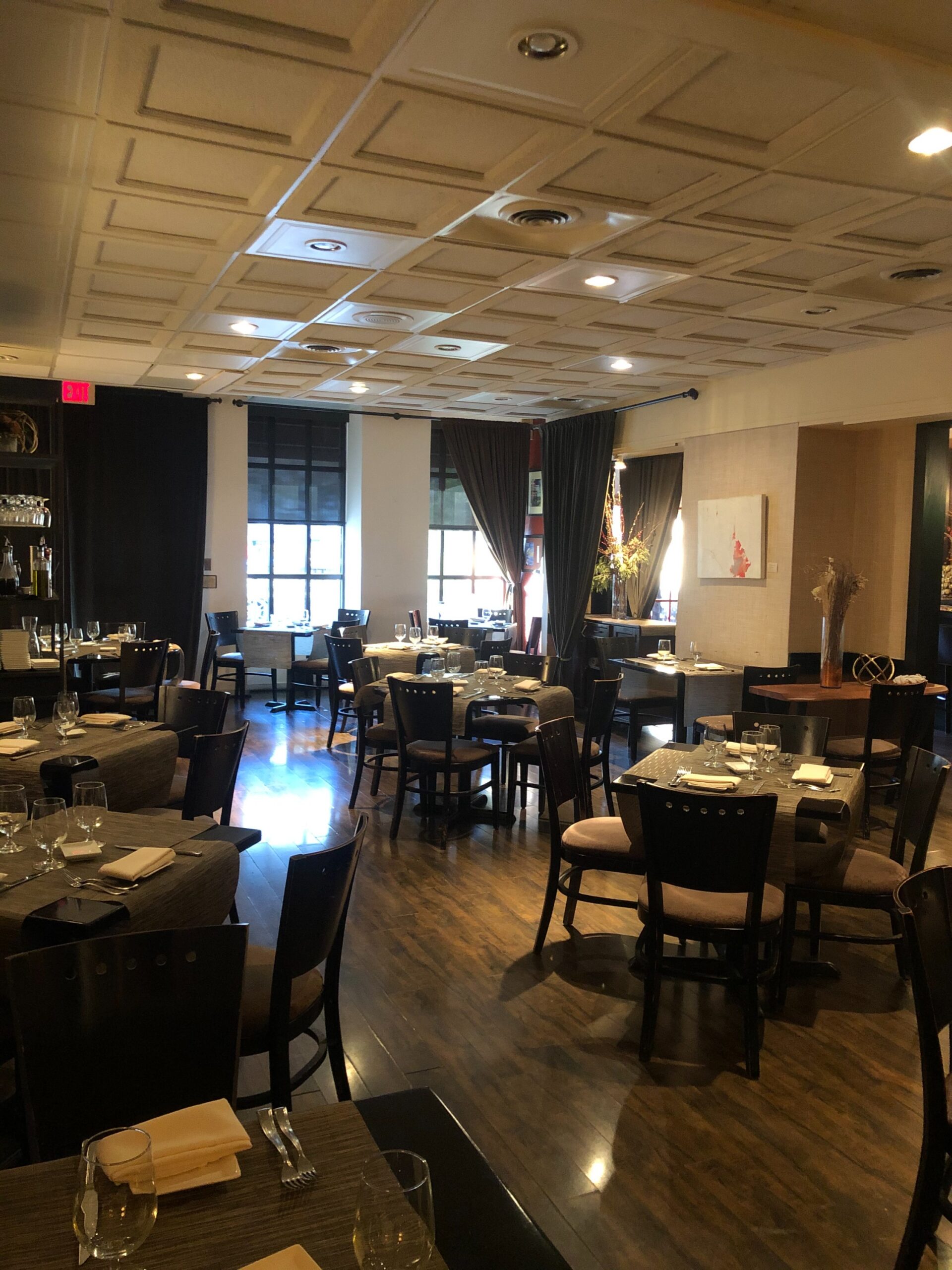
Siroc Restaurant, an Italian place near McPherson Square in downtown D.C., used to have anywhere between 60 to 80 patrons for lunch on Fridays before COVID-19 hit. Despite the weather being unseasonably warm on this particular Friday in March, Siroc had around just 30 patrons.
“Today was really busy for us,” says co-owner Mehdi Dris from one of the many tables set with the hope that someone would show up for homemade pasta and focaccia. Most other recent days, he says his restaurant has only had about 5 to 10 patrons.
While many neighborhood restaurants have enjoyed a return to packed dining rooms since COVID-19 vaccines became available and restrictions eased, many of those downtown continue to struggle as tourists and office workers have yet to return in pre-pandemic numbers. According to the DowntownDC Business Improvement District, its restaurants were at 80% of pre-pandemic sales in late February, while the city’s were at 97% overall. Restaurants in the Maryland and Virginia suburbs were at 99.7%.
While various grants and loans were available in the early months of the pandemic, funding opportunities have since withered. These difficult conditions have already caused many downtown businesses to close — a DowntownDC Business Improvement District spokesperson says 18 of its restaurants shuttered between March 2020 and March 2022. For comparison, the executive director of Adams Morgan BID Kristen Barden says 8 of its restaurants closed during the same time period.
Now, Dris worries that Siroc will be next.
Unable to keep up with rent, Siroc is facing eviction over failure to pay about $284,300 between July 2020 and January 2022. Unpaid rent accounts for about $176,900 of that and the rest is from other costs, including ultilities, taxes, late fees, and legal fees. The eviction is particularly notable, Dris and his lawyer say, because their landlord is the progressive nonprofit, the American Civil Liberties Union, which filed the eviction notice in DC Superior Court on Jan. 31 under the limited liability company 915 15th Street LLC.
“Not only was I surprised, I was shocked,” Dris tells DCist/WAMU. “It feels like they don’t even want to work with us.”
“It seems sort of contrary to their core beliefs,” says Richard Bianco, a prominent attorney for local small businesses who’s representing Siroc, noting the progressive powerhouse’s advocacy around eviction and debt. “The ACLU is running essentially every other landlords’ playbook, and they’re not acting like the ACLU.”
Neither the ACLU nor their lawyer responded to repeated requests via email and phone for comment.
To stave off eviction, Dris and his lawyer say the restaurant hopes to enter a payment plan where remaining back rent from before September 2021 is fully forgiven and rent after that will be paid based on its business performance. He says the restaurant paid as much back rent as the owners could afford from business, grants, and loans. The ACLU, they say, wants the restaurant to pay off all its debt in 12 monthly installments on top of rent moving forward.
“[For] 12 years, we paid our rent on time and in full. We’ve never missed a payment ever, ever, ever until the pandemic hit. Even [in] March 2020 — that payment was made,” Dris says.
D.C. law requires commercial landlords to offer payment plans over back rent to eligible tenants during the public health emergency and one year thereafter. The law doesn’t dictate the terms of these agreements, except to say landlords cannot request a lump sum but equal monthly installments, unless something else is agreed to. Bianco says that while the ACLU did comply with these terms, they only met the “bare legal minimum,” unlike some landlords he’s worked with who determine rent based on a business’s income rather than the lease. Instead of negotiating a plan, he says the ACLU and the nonprofit’s attorney are effectively “ignoring us.”
“It’s hard to say in commercial leasing that there’s an industry standard, but I can tell you that in my business, a very large percentage of landlords have offered some type of proportional or percentage rent type of deal,” says Bianco. “It’s disappointing that not only did they not get that here, but the ACLU wasn’t even willing to entertain a discussion about it.”
The DowntownDC BID spokesperson confirms that landlords have taken different approaches, from insisting on full payment, to forgiving rent for periods of time, to having tenants pay a percentage of rent outlined in the lease. The spokesperson could not, however, say how common each approach is for downtown landlords.
Dan Koffman, an attorney whose law firm represents both local commercial landlords and tenants, says that deals offering rent forgiveness or rent based on income have become more common throughout the pandemic. But restaurants continue facing evictions because landlords are rarely compelled to abate rent if they have a better option, he says.
“While this situation isn’t an outlier,” he says of the ACLU-Siroc eviction lawsuit, “my hope is that throughout the city, landlords are doing their best to work with tenants on a structure that can be mutually beneficial for both. In most situations, such a mutually beneficial solution exists.”
Several blocks away from Siroc is a business with a more generous rent deal. Timgad Café owner, Miloud Benzerga, says his landlord, the federal government, has waived rent during the pandemic. His business has remained closed since March 2020, he says. He relies on federal workers, who are still mostly working remotely. But beginning in April, Benzerga says his landlord will begin requesting rent, not according to the lease but 10% of gross sales. He believes he’ll be able to make rent because some of his patrons have told him they’ll be working in-person then.
“A lot of people like him just gave up,” Benzerga says of Dris. He says he feels for his friend, whom he’s known since Dris was in college waiting tables.
Siroc was awarded two federally-backed loans under the Paycheck Protection Program, which was designed to help businesses during the pandemic. The first loan amounted to $179,200 and the second, $263,873. The restaurant also received assistance from the D.C. government, receiving $24,500. Dris says the restaurant sent the ACLU all the funding he’s legally able to, even if more money could have gone to his workers’ salaries (he employs 11 people). The owners/partners have only paid themselves once during the pandemic, $21,000 each from the PPP loans, he adds — forcing them all to live off savings.
“All our books will be open for you,” Dris says he told the ACLU.
PPP loans were mostly meant to cover payroll, so it’s unsurprising that Siroc is unable to pay all of the back rent, says Koffman, who’s not affiliated with the lawsuit. The Restaurant Revitalization Fund would have been a great help, he says. “We’ve seen a huge discrepancy in outcomes between restaurants who received restaurant [revitalization funding] and those that didn’t,” Koffman continues. “It’s night and day.”
Dris says he was unsuccessful in his efforts to receive the Restaurant Revitalization Fund, a federal grant that offered no more than $10 million per business or $5 million per physical location.
Ben Gilmore, an attorney who represents both local commercial landlords and tenants, says several hundred thousand dollars is a lot of money for a business to owe. But he says a landlord could be in a position to forgive.“Context is really everything,” he says, “For a small landlord who maybe owns a couple properties here or there, that would be unrealistic … if they are a huge institutional landlord though, that might be a drop in the bucket.”
While Siroc’s landlord makes this a standout case, it’s a situation that many restaurants, particularly downtown, are grappling with — or may find themselves grappling with in coming months. Hundreds of brick-and-mortar businesses across D.C. already closed during the pandemic, a DCist/WAMU investigation found. While DowntownDC BID expects restaurant sales to increase in the spring and summer months, downtown will inevitably look different when people come back. Mayor Muriel Bowser’s administration, for example, is interested in turning some of the empty office and retail spaces downtown into residential housing.
Dris and his brother Keram — who’ve lived in the region for nearly three decades after immigrating to the United States from Algeria — opened Siroc with Chef Martin Lackovic during the Great Recession, in 2008. Since opening, the restaurant says it has earned several diners’ choice awards, and several local chefs have worked out of Siroc’s kitchen.
The pandemic forced Siroc to fully close for eight months. Since then, variants and limited business have required them to close partially or fully multiple times. These days, they’re only operating four days a week. When the owners and staff first learned of the eviction when a notice was plastered to Siroc’s door, one team member left. The eviction looms over, with a hearing scheduled for April.
But Keram describes promising signs of returning patrons. In 2021, Siroc’s revenue was $357,804, and the restaurant paid $90,000 in rent, per an email from restaurant ownership to ACLU executive director Anthony Romero. Both are huge increases from 2020, when revenue was $18,538 and the restaurant paid $33,280 in rent. Two large parties made a reservation on the same day for later this month, Keram says, though he couldn’t book them both due to staffing constraints.
“We still have hope,” he says. “But we don’t know, really, what’s going to happen. Now, it’s up to the landlord.”