Jacob Fenston
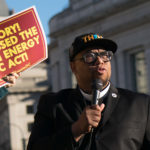
Maryland lawmakers passed a bill Thursday with some of the toughest greenhouse gas reduction targets in the nation. Under the bill, which now heads to Gov. Larry Hogan’s desk, Maryland would have to cut statewide carbon emissions by 60% by 2031, and be net-zero emissions by 2045.
“I’m very pleased,” said bill sponsor Sen. Paul Pinsky (D-Prince George’s County), in an interview with DCist/WAMU after the vote. “I think it moves Maryland forward, puts us in the top ranks of other states nationally in trying to address climate change.”
Under current law, Maryland has a target of cutting emissions by 40% by 2030.
The legislation, known as the Climate Solutions Now Act, was also proposed in the General Assembly last year. Different versions passed the Maryland House and Senate in 2021, but lawmakers were unable to compromise on the legislation before the end of the session. This year, delegates and senators were determined to work together to pass climate legislation. After the House passed the Senate bill on Tuesday, senators quickly voted adopt all the House amendments, rushing the bill through final passage on a party-line vote, 32 to 15.
In addition to the emissions reduction targets, the bill contains provisions to speed up the transition away from fossil fuels. The bill targets emissions from buildings, requiring large buildings to cut emissions by 20% by 2030. It also requires state agencies to begin transitioning car and light-duty vehicle fleets to electric vehicles, and requires school districts to transition bus fleets to electric. It also requires state officials to put forward climate plans to reach emissions targets by the new deadlines.
During debate over the legislation, Republicans and fossil fuel industry representatives said the bill would raise energy costs for residents, and have only a symbolic effect on climate change.
“Everyone knows that Maryland is too small and part of a much bigger world to make any measurable impact,” said Sen. Bryan Simonaire (R-Anne Arundel County). “If we want to address this issue in a meaningful way, we need to focus on solutions that are global, national or at a minimum, a regional level.”
“If they want to stay on the sidelines and watch history be rewritten, that’s fine,” said Pinsky of Republican lawmakers who voted against the bill. “But we’re here to try to shape history and improve the quality of life in our state and our planet.”
Pinsky said he expects a veto from Gov. Hogan, but is optimistic he’ll have the votes to override that veto.
Environmental groups applauded the bill’s passage, though they continued to call for further climate action.
Josh Tulkin, director of the Maryland Sierra Club, agreed with Pinsky that the bill would “make Maryland one of the national leaders in setting strong greenhouse gas goals.”
At least 16 states, plus D.C. and Puerto Rico, have set greenhouse gas reduction targets, according to the National Conference of State Legislatures. D.C.’s target, in line with a handful of other leading states, calls for a 50% emissions cut by 2030 and and carbon neutrality by 2050.
But, Tulkin said, it leaves a lot of open questions for future lawmakers to answer. “The bill has a lot of strong components, but we really see this as a down payment on Maryland’s commitment to come back and pass the policies that are necessary to get us to that 2031, 60% goal.”
Some measures to help reach that goal were stripped out of the legislation during this year’s session. For example, the bill originally included a provision to ban natural gas for heating and hot water in new construction. That provision was dropped, though, after intense opposition from utility companies and the building industry.
Natural gas is mostly methane, a potent greenhouse gas, and would need to be phased out eventually, in order to meet net-zero goals.
Tulkin said it was important to pass the climate bill, even if it doesn’t contain everything environmental groups were pushing for. “We’re fighting against time when it comes to climate change — we’ve got a limited window to make a big impact,” he said. “We’d rather get half a loaf than no loaf at all.”