Rachel Kurzius
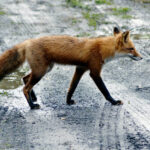
There’s a tragic twist to the story of the Capitol Hill fox accused of biting and nipping multiple people earlier this week — the adult female was euthanized after her capture on Tuesday afternoon. Her baby foxes, called kits, were discovered on Capitol Hill grounds on Wednesday morning, according to D.C. Health.
The D.C. Public Health Lab confirmed on Wednesday afternoon that the fox tested positive for rabies, according to Humane Rescue Alliance spokesperson Sam Miller. Non-vaccinated animals must be euthanized for a rabies test to occur, because it requires brain samples.
The three kits found on the grounds were also euthanized, per D.C. Health in a statement on Thursday. “Since the mother tested positive for the rabies virus and the kits could have been exposed during grooming or other means, they were no longer able to be safely rehabilitated,” the agency said.
D.C. Health says the fox was responsible for nine confirmed bites on Capitol Hill, and is urging anyone who came into physical contact with a fox to contact D.C. Health.
Among those attacked was Ximena Bustillo, who felt something nip at her left ankle as she left Capitol Hill on Tuesday afternoon. At first, the Politico agriculture policy reporter thought it was a squirrel or a rat.
“As I scream and whip around, a fox runs right in front of me,” she says. “I grabbed my backpack and swung at it, because that was the only thing I could think of doing.”
Other people were nearby, and they made noise to scare the fox away from her. Some trailed the animal at a distance to give its whereabouts to the Humane Rescue Alliance, which trapped the fox. The fox’s nip broke skin on Bustillo’s ankle, she says, so she was advised to get rabies and tetanus shots, which she did at an emergency room.
#BREAKING: Captured. pic.twitter.com/LJAn2ZjH9J
— U.S. Capitol Police (@CapitolPolice) April 5, 2022
One of the other people was Representative Ami Bera, a Democrat from California, who was “nipped on the leg by a fox” on Monday while walking into his office, according to his communications director. Out of an abundance of caution, Bera received shots of immunoglobulin, a tetanus shot, and a rabies shot, with more rabies shots forthcoming, per his office.
This isn’t the first sighting of a fox on Capitol Hill grounds. In 2014, what was also called Capitol Hill Fox was seen several times on or near the grounds over a few weeks’ time, lounging in the grass or eating a squirrel. (There are conflicting reports about whether that animal met its untimely demise at the hands of a driver — the remains of a fox were discovered on the 1-395 off ramp leading to the House office buildings, though.)
Indeed, foxes are common in D.C. and throughout the region.
“Foxes have been in the D.C. ecosystem for quite some time,” says Pete Marra, the director of Georgetown’s Institute for Environment and Sustainability, and a professor of biology and the environment. They’re mostly active at dawn and dusk, “times when people may not be quite as active, especially in the suburbs, so foxes can live a pretty good lifestyle in these places because we’ve got lots of food for them, like rats and other small mammals.”
Foxes aren’t the only carnivores in town, either. The region’s coyote population has been increasing, and the mid-sized predators are here to stay. Black bears are making a comeback in Maryland, according to the National Park Service. One proposed solution to the region’s deer overpopulation has been a reintroduction of wolves, but that would in all certainty create more problems than it would solve.
Kathy Woods is the director of Phoenix Wildlife Center, which rehabilitates wildlife in Maryland and returns them to their natural ecosystems.
“We rehabilitate a lot of foxes a year,” she says. “We’re able to rehabilitate healthy young foxes and release them back in the county they came from.” Many of the kits end up at the Phoenix Wildlife Center after something happens to their mother. “They have a remarkable capacity to bounce back,” she says.
Marra warns against approaching or feeding foxes, or any other wildlife.
“It’s a beautiful, wild animal that, observed at a distance, is a great way to experience nature, even in an urban ecosystem,” he says. “Respect them with distance, watch them with binoculars or through your window, and just appreciate the fact that we can have native species like foxes and coyotes living right among us, even in a place like Washington, D.C.”
This story has been updated with the results of the fox’s rabies test and the news about the kits’ euthanization.