Jacob Fenston
The U.S. Army is no longer pursuing a plan to restrict access to Washington Channel, after years of pushback from D.C. residents and local officials.
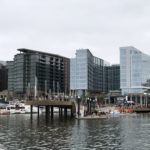
Some of the military’s biggest big-wigs are housed at Fort McNair, a historic waterfront base on Washington Channel. The channel, just downstream from the Tidal Basin, is also where the District’s newest river-side development, The Wharf, is located. When the Army decided to create a security zone, cutting off access to roughly one-third of the channel for security reasons, there was public outcry.
Now, the Army says, that plan is no longer on the table.
“After engaging with the D.C. government and the local boating community, we elected to pursue other potential technical options within our purview that achieve the same effect as the restricted area to better protect the people who live and work on Fort McNair,” said Lauren Mick, a spokesperson for the U.S. Army Military District of Washington, in an email to DCist/WAMU.
Rather than creating a restricted zone in the water, the Army instead plans on “leveraging technological solutions” along the waterfront, to rapidly detect and interdict any potential intruders trying to enter the base from the channel.
Potomac Riverkeeper Dean Naujoks applauded the decision to keep this section of the Potomac open to the public. “The Potomac River is a public waterway, it belongs to the people. The Army really had no right to come in and say they were going to restrict use of that waterway and take it away from the public,” Naujoks said.
“It was the the overall voice of the public that I think really put an end to this. They realized the opposition was too great, too,” added Naujoks.
The original plan, first put forward in 2019, would have created a 300 ft.-wide buffer zone along the waterfront of Fort McNair, marked off by buoys. At a public hearing on the proposal in Jan. 2021, Major General Omar Jones argued the security perimeter was needed due to recent “attempted breaches of the base from the channel.”
When pressed for details on those attempted breaches by D.C. Delegate Eleanor Holmes Norton (D), who convened the meeting, Jones could only provide one example: a swimmer who had climbed ashore on the base.
“He may very well have been lost,” conceded Jones after further questioning.
Elected officials at the meeting, including Norton and D.C. Councilmember Charles Allen (D-Ward 6), were highly skeptical of the plan and said there were other, more effective ways to keep the base safe.
“The answers that we got from from the Army around their rationales didn’t make any sense,” Allen said after the meeting. “They really kind of stretched believability.”
Following the meeting, Norton introduced a bill in Congress that would prohibit the Army from creating a security zone in the channel. The bill passed the House transportation and infrastructure committee last May.
In a recent press release, Norton said the security zone plan was “arbitrary, capricious, and unnecessarily restricts recreational and commercial access to the Channel without providing any benefits to Fort McNair.” She welcomed the news that the Army was dropping the proposal, but vowed to continue her work to pass the bill, in order to prevent any future efforts to restrict the waterway.
In recent years, particularly since the opening of the multi-billion-dollar Wharf development in 2017, there has been an explosion of activity in the channel. There is a water taxi service, a kayak and paddle board rental facility, as well as numerous private boats. There’s even the occasional lost swimmer, apparently, despite the fact that swimming is still officially illegal in D.C. waterways.