Morgan Baskin
When DeNisha and her boyfriend moved into the Park 7 apartments on Minnesota Ave NE, she was only days away from giving birth to her first child. It was March 2020, and the young family was scrambling to settle into their new home as COVID-19 swept through D.C.
She spent the first months of the pandemic juggling her day job and the demands of being a new mom. The now-26-year-old was working as a stylist for Amazon, curating monthly clothing boxes for subscribers, but says the company laid her off in November. Shortly afterward, her boyfriend lost his job, too. The dual job losses left the couple unable to afford the $1,532 monthly rent for their two-bedroom apartment.
“My boyfriend and I, we’re definitely two people who have always, always, always had a job, [no] matter what is going on. So it was just really a tough time,” DeNisha says. “We paid our rent up until the time we could not.” (At her request, DCist/WAMU is withholding DeNisha’s last name to protect her privacy.)
So they were grateful when, the next summer, STAY DC – D.C.’s pandemic-era eviction prevention program that disbursed money to property managers on behalf of renters who’d lost their income – approved the family for an initial $13,400 to pay their back rent. DeNisha got an email in August, obtained by DCist/WAMU, that the program cut a check to Park 7 Residential LP, the business entity that owns and operates Park 7. Yet employees in the leasing office continued to tell DeNisha and her family that the company never received that money.
They are now suing to evict her, her boyfriend, and their two-year-old son over about $18,000 in alleged unpaid back rent.
DeNisha and her family aren’t alone: The holding company that operates Park 7 also filed eviction lawsuits in early March against tenants in 50 of the building’s 377 apartments. The mass eviction attempt is a stunning climax to years of tension between Park 7 owner and developer Chris Donatelli and his tenants, which have seen protests, rent strikes, and an investigation by the D.C. attorney general.
The eviction filings are further complicated by the fact that several Park 7 tenants dispute the allegation that they owe thousands in back rent — three families tell DCist/WAMU that they paid rent to the company with the help of STAY DC and believed they were up to date on payments, or at the very least owe significantly less than the company is suing them for. Park 7 Residential LP received more than $1.3 million in eviction prevention funds from STAY DC last year, according to data obtained by DCist/WAMU’s Ally Schweitzer by FOIA.
It’s unclear, however, whether Park 7 received all of the payments tenants believed they did. Neither Donatelli nor representatives from Park 7 and STAY DC — which was administered by multiple city agencies and stopped accepting new applications last fall — responded to DCist/WAMU’s multiple requests for comment. But the evictions are a blow to the efficacy of STAY DC, which disbursed $352 million with the explicit purpose of keeping financially vulnerable residents housed in D.C.
DeNisha’s boyfriend says he spent weeks on the phone with STAY DC employees in the fall of 2021 to try and figure out where their check went, and tells DCist/WAMU that an employee from the Department of Housing and Community Development, which helped administer STAY DC, was able to confirm that the first check was cashed — just not by whom.
The program eventually cut them a second check for another $13,400 in February of 2022, DeNisha says, which they say property managers at Park 7 also denied receiving. DCist/WAMU reviewed documentation from STAY DC confirming they had disbursed the money.
At a loss about how to proceed, the family applied for funds from the Emergency Rental Assistance Program. But late one evening in early March, officers from the Metropolitan Police Department knocked on their door to serve the family with eviction papers.
In the meantime, they are living in conditions that DeNisha likens to squalor, with piles of dog feces sitting in the hallways, cockroaches crawling up walls in common spaces, and rats scampering inside the building’s trash rooms “staring into your soul.” “There’s no way that these people are expecting $1,500 a month when you’re living in a place that’s so dirty,” she says.
Stephanie Bastek, a tenant organizer affiliated with the housing advocacy group Stomp Out Slumlords, says she has spoken with more than a dozen Park 7 tenants facing eviction, including one woman who cashed out part of her 401K to put money toward her rental debt. Another couple of residents moved out of the building after they received STAY DC funds, but Park 7 filed eviction suits against them, too. “That follows you [around],” Bastek says. DeNisha is similarly worried about what the eviction might do to her credit score, and how difficult it could subsequently prove to find an apartment suitable for her family.
Bastek says she believes that STAY DC’s disbursement system contributed to confusion among tenants about what they owed their landlord, because the city made payments directly to property managers on the tenants’ behalf. Spokespeople for STAY DC did not respond to DCist/WAMU’s multiple requests for comment.
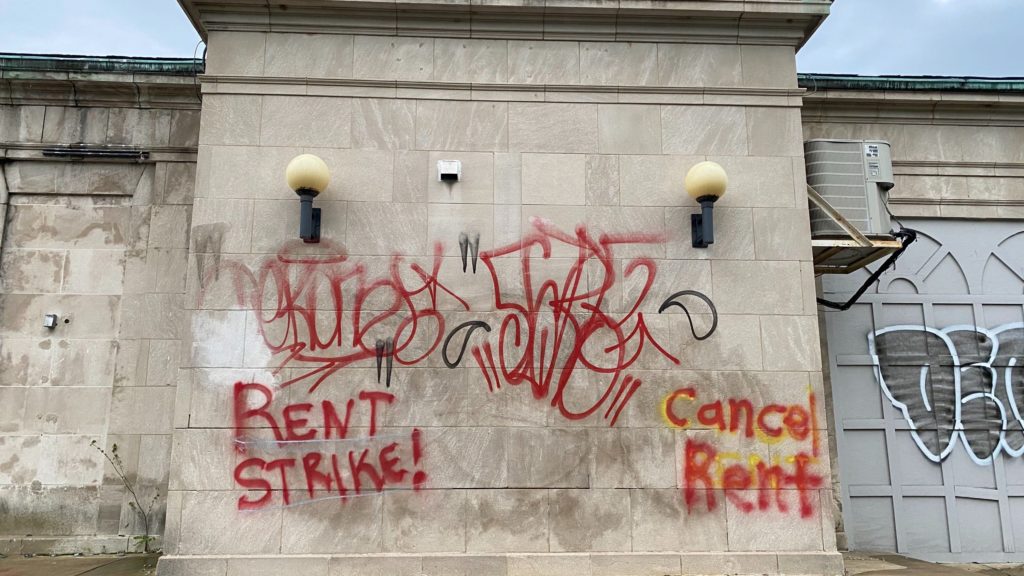
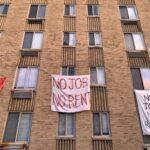
A baseline of distrust has already made the relationship between Donatelli and his tenants tempestuous: Renters in the building have long complained of shoddy construction that encouraged pest infestations, plumbing and mold issues, and more. In 2019, Attorney General Karl Racine ordered Donatelli to pay $450,000 to tenants who were improperly charged for water use dating back to its opening in 2014. And throughout the pandemic, many tenants participated in a rent strike against the building until property managers agreed to meet and discuss housing conditions.
Roxanne, another Park 7 tenant who asked to be referred to by her first name to protect her privacy, was among them. The kindergarten teacher of 20 years, who stopped working at the beginning of the pandemic over health concerns, refused to pay any more money for conditions she believes are dangerous to her health.
But then the building started a rent forgiveness program in Sept. 2020, in which every month of rent payments made through December wiped out the equivalent balance in rental debt – for every $1,000 paid, for example, the company would forgive an additional $1,000 from renters’ balance. Park 7 also said it would wipe all of renters’ debt if they paid rent on time and in full between October 2020 and February 2021, according to communications reviewed by DCist/WAMU.
Wanting to take advantage of this deal, Roxanne says she paid $6,200 out of pocket during the rent forgiveness period, and about $19,000 more over the following six months from rent relief programs, including STAY DC. Park 7 is now suing to evict her for $2,377.
“[Residents’] needs may be somewhat different, but we all have the same complaints,” Roxanne says. “No judge in his right mind is going to give Donatelli the amount of money he’s suing for, if everyone has evidence of what’s going on in this building. No fair judge in their right mind.”
Jewel Burgess is yet another tenant at Park 7 who says she’s being evicted despite receiving help from STAY DC. Only three months into the pandemic, in May 2020, the 41-year-old lost her job delivering hot meals to seniors. Although she was an essential worker and spent those terrifying weeks making in-person house calls, she was one of the business’s more recent hires, and one of the first to be laid off.
Unemployment benefits weren’t nearly enough to cover all of her bills, comprising only half of what she made before. “I was living off of scraps trying to survive,” says the D.C. native, who lives alone in a one-bedroom apartment with her two beloved dogs. She soon fell behind on her $1,002 per month rent. Nearly two years to the day that the pandemic broke out in D.C., Park 7’s owners sued to evict her over $9,068 in allegedly unpaid rent.
Yet STAY DC helped Burgess pay more than $8,000 in back rent, she says. That assistance coincided with the rent forgiveness program at the building.
But because Burgess says she never heard from STAY DC directly about what kind of assistance it approved her for, or for which months – the $8,000 figure was relayed to her by the property management office at Park 7 – she never knew exactly how much she owed the building. When she received her eviction notice, she was bewildered.
“Before the pandemic hit, I was taking care of my responsibility, paying my way like most productive citizens are doing. And I feel like I was used,” says Burgess, one of the tenants who protested in front of Donatelli’s home in 2020 to ask for the rent forgiveness program. (Burgess and Roxanne jointly sued the building’s managers last year for allegedly thwarting their attempts at tenant organizing; the case is ongoing).
Burgess recently started working again part time cleaning and disinfecting local fire stations. While she enjoys the work and feels a sense of purpose, she doesn’t earn enough money to make full rent payments, and has started to consider what an eviction would mean for her –– and for whoever would move into the apartment after her, who would likely experience the same issues she has.
“I know for a fact that God does not want us to be deprived of food or shelter, so I’m sure that he will make the way [and] I’ll have a place to go. Even if I have to live with my mom or relative or a friend, or even if I have to go into a shelter, ” she says, but adds that, if she can help it, she’s not going to put the burden of living in Park 7 on someone else.
Ally Schweitzer contributed reporting.