Colleen Grablick
Update: D.C. Circulator workers are striking Tuesday, “fed up with a lack of progress” in negotiations with their employer RATP Dev, a private company contracted by D.C.’s Department of Transportation to run the Circulator.
“RATP Dev left us with no other options but to walk off the job at the DC Circulator,” reads a statement from Raymond Jackon, the president of ATU Local 689, the union representing the drivers. “After months of negotitaions, it has become clear that RATP Dev has been negotiating in bad faith, committing multiple unfair labor practice violations in the process.”
Reached for comment on the strike Tuesday morning, DDOT directed DCist/WAMU to a tweet from the agency’s account, stating that it was preparing for possible disruptions to Circulator service. DDOT is directing riders to WMATA bus routes that stop at locations similar to those of Circulator routes.
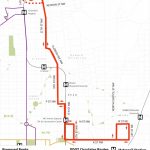
Georgetown-Union Station (33, 80)
Dupont Circle-Georgetown-Rosslyn (33, 38B, 31)
Eastern Market – L’Enfant Plaza (74, P6)
Woodley Park-Adams Morgan-McPherson Square (54, 96)
Congress Heights-Union Station (90, 92, 96, W6, W8)
National Mall (32, 74, 36)
Capital Bikshare is also providing 20 free, 30-minute rides using the code “20DCRIDES.” DDOT directs riders to use the Circulator’s website and Twitter for further updates.
The strike will continue until the union reaches an agreement with RATP Dev, according to Local 689’s statement Monday night ahead of the strike. The union’s previous contract with the company expired on April 30. According to Local 689’s statement, RATP Dev sent a “final offer” on Sunday with proposals that threatened substituting drivers with subcontractors and eliminated worker’s rights under the federal Family and Medical Leave Act. RATP Dev’s final offer also did not meet the union’s demands for fair wages that addressed inflation.
A spokesperson for RATP Dev says the company is set to go back to the negotiating table on Wednesday, and that the union’s decision to strike is “disappointing.”
“The Company proposed to extend the term of the parties’ current collective bargaining agreement beyond April 30, 2022; but ATU Local 689 rejected the Company’s offer to avoid a bus strike,” reads RATP Dev’s statement.
Local 689 has also filed unfair labor practice charges with the National Labor Relations Board against RATP Dev for bad faith bargaining and surface bargaining, according to union spokesperson Brian Wivell.
Original: D.C.’s Department of Transportation is preparing for a potential strike of D.C. Circulator workers starting Sunday. That’s after nearly two months of unsuccessful negotiations with the union representing employees.
In a statement Thursday evening, DDOT said it is working with RATP Dev, the private company contracted by the city to run the Circulator, on an “adjusted plan for limited service” in the case of strike. DDOT added that it remains “optimistic” that RATP Dev can reach an agreement with ATU Local 689, the union representing Circulator operators.
Local 689 authorized a strike earlier this month calling for a fair contract with their employer, which the union alleges “consistently acts in bad faith making productive negotiations almost impossible.”
Brian Wivell, a spokesperson for ATU Local 689, the same union representing WMATA workers, says DDOT likely publicized the May 1 date because the union’s current contract with RATP Dev expires on April 30. But DDOT’s press release even came as a surprise to the union.
“We didn’t put out that DDOT press release, and were kind of caught off guard by it,” Wivell says.
If the union’s contract lapses Saturday without another agreement reached, the union would have the unrestricted right to strike while still continuing negotiations with RATP Dev, according to Wivell. But Local 689 president Raymond Jackson says the members would like to avoid that if they can.
“We’re hoping that we can sit down at the table and work this out,” Jackson tells DCist/WAMU.
Although DDOT manages RATP Dev’s contract with the city, the agency is not directly negotiating with the union of Circulator workers.
“We believe DDOT would better use its influence by calling on RATP Dev to get serious about bargaining in good faith and put real money on the table,” a union press release reads. “Local 689 is frustrated that DDOT would publish press releases based on whatever RATP Dev tells them, despite DDOT claiming for over a year that they are unable to legally talk with Local 689. Our members were called essential workers and heroes for the last two years, but when it came time to bargain, RATP Dev seemed to forget that.”
RAPT Dev did not respond to DCist/WAMU’s request for comment on the May 1 strike warning, and a DDOT spokesperson directed DCist/WAMU to the agency’s statement from Thursday night.
The April 5 vote to authorize a strike came after a month of unsuccessful bargaining between RATP Dev and Local 689, in which the company failed to meet the union’s wage and benefits requests. According to the union’s statement on April 5, RATP Dev had proposed a 2% increase for senior operators in the first year — insufficient, the union said, considering the 8% inflation rate. Most recently, Local 689 said the company proposed a top pay increase of 6% over a three year contract — amounting to a pay cut in the first year alone. RATP Dev had also rejected the union’s ask to add the holidays Veterans Day and Juneteenth to the contract, and failed to budge on retirement proposals.
“The company and even DDOT forget that for the last two years, these workers have been working in a pandemic,” Jackson says. “They came to work every day, and they operated those buses to make sure that the rest of the essential workers got to where they needed to get to. I really find it disheartening that this is how you repay them.”
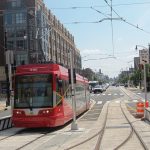
The Circulator runs six routes through some of D.C.’s busiest neighborhoods — amounting to nearly five million trips per year, according to the Circulator’s website.
“Despite driving on the same roads and many of the same passengers as WMATA, DC Circulator bus operators make as much as $5.38 per hour less at top pay rates,” reads Local 689’s press release Thursday. “These calculations don’t even factor in the stark differences in quality of benefits.”
While Wivell says striking is the last resort for the workers, Local 689 has used it — successfully — in the past, after failed negotiations with private WMATA contractors.
In late 2019, Local 689 union members out of the Cinder Bed Road bus garage in Fairfax County staged a strike in protest of Transdev, a company contracted by WMATA, over “unfair labor practices.” Workers stayed off the job for 85 days — far beyond other regional and national transit strikes — and even the drew the attention of one Sen. Bernie Sanders. Local 689 also took on that same company, Transdev, on behalf of Fairfax Connector operators at the same time as the Cinder Bed Road garage. That strike lasted days before the union reached an agreement with Transdev.
“This union has repeatedly realized that when these companies don’t listen bargain in good faith and do right by their employees [that] this union is not afraid of striking, but it’s obviously… their last resort,” Wivell says.
According to Local 689, RAPT Dev is currently using the same negotiator used by Transdev before workers striked in 2019. RATP Dev signed a five-year contract with DDOT to manage the Circulator in 2018 — to the dissatisfaction of transit workers who pushed for the operation to be brought under city control. Before RATP Dev, the private company First Transit ran the Circulator for more than a decade. While the company struck a labor agreement with unionized Circulator workers in 2016, closing the pay disparity with Metrobus drivers, labor leaders argued more needed to be done to fix the transit system. Poor oversight, safety issues, and operational flaws plagued the Circulator, according to two DDOT audits.
Jackson, president of Local 689, says workers still want the de-privatization of the Circulator — or at least a conversation with DDOT.
“That’s one of the things we would ask DDOT — if DDOT would ever come to the table,” Jackson says. “Here we are, your most important essential workers, not to take anything away from your police department, your fire department, [but] when it came time for these workers to stand up…they stood up. We had a lot of members test positive, but we still came to work. We deserve more respect than what [DDOT] has given us.”
This story has been updataed to reflect that Circulator workers are on strike, and that ATU Local 689 has filed charges against RATP Dev with the National Labor Relations Board.