Martin Austermuhle
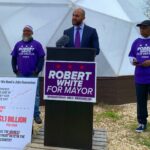
D.C. Councilmember Robert White (D-At Large) on Wednesday pledged to dramatically expand vocational education and open a network of public boarding schools if he’s elected mayor.
White’s new plan, unveiled at his downtown D.C. campaign headquarters, was framed as another tool to address crime, an issue that has risen to the top of many residents’ concerns ahead of the June 21 primary. Last month White unveiled an initiative to create 10,000 new government jobs as a means to offer struggling residents an economic alternative to crime, while in February he said he would scale up the use of violence interrupters to stop cycles of attacks and retribution.
“Violent crime in the District has risen drastically year after year for the past five years, and tragically, many of those crimes are committed by young people in a city whose economy is roaring,” he said. “But we have a higher unemployment rate than any state. Crime and unemployment are connected to education. The challenge for us is to turn a school-to-prison pipeline into a school-to-workforce pipeline.”
To do that, White first wants to lead what he said was the “most dramatic expansion of vocational education in our city’s history” by beefing up in-school training for trades ranging from plumbing and carpentry to information technology, saying that they can provide “stable, well-paying jobs.”
While D.C. does currently offer career and technical education options at 16 DCPS high schools, White said they have been an “afterthought” for Mayor Muriel Bowser and that many of the offerings — including architecture, engineering, and health sciences — still require a college degree.
Frazier O’Leary, a former D.C. Public Schools teacher and current Ward 4 representative on the D.C. State Board of Education, spoke in support of White’s plan, saying that when he started teaching there were multiple trade options for students. But they were eventually phased out. “We still need plumbers. And carpenters. And typists, and electricians, and auto mechanics. And there’s nothing in the system right now,” he said.
“People with skills don’t go out and ruin their lives. They’re able to make a life for themselves,” said Charles Wilson, a carpenter and Advisory Neighborhood Commissioner in Ward 8.
Councilmember Trayon White (D-Ward 8), who is also running for mayor, has similarly proposed restructuring D.C. schools so that all students start either a career track, college track, or entrepreneurship track as early as middle school.
A more novel part of Robert White’s plan is the creation of a system of public boarding schools starting as early as the elementary grades.
“Many young people who are disconnecting from school could succeed academically but for environmental issues like housing instability, violence and crime in their neighborhood, or parents who are not able to assist with homework or social emotional needs. These are students who have as much potential as any other, but they don’t reach their potential too often because of factors outside of the traditional school day,” he said. “We’re going to remove those factors by providing students with a 24-hour academic support environment.”
There are only a small number of public boarding schools in the U.S., and White cited one in D.C. as an example he’d like to emulate: the SEED School, a public charter high school in Ward 7, which was ranked as a Tier 1 school in the 2018-19 school year. White also cited private models like the Milton Hershey School in Pennsylvania, which offers free education to qualified low-income students.
Still, the model poses unique challenges of its own. The SEED School was criticized for not doing enough to prevent a student from committing suicide there in 2018, while another charter boarding school, Monument Academy, almost shuttered in 2019 amidst financial and security concerns. And opening new schools would also stand in contrast to White’s criticism that Bowser has allowed too many charter schools to open; White said he would open the new schools as part of a comprehensive education plan he said Bowser lacks.
“There’s no doubt that boarding schools have challenges. There are no perfect systems. But we have to build on what they have and we have to build on what works,” he said.
White said the specific details on implementing the two parts of his education plan would be hashed out by a pair of task forces in the first 120 days he’s in office; the public boarding schools would initially operate as a five-year pilot.
During recent debates, Bowser has aimed criticism at both lawmakers for proposing ideas in their mayoral campaigns that they have not moved while serving on the D.C. Council. She has also lambasted them both for entertaining the idea of doing away with mayoral control of schools. Both Robert White and Trayon White have said that Bowser has not done enough to address persistent inequities in city schools.
Bowser, Robert White, and Trayon White will take part in a live on-air debate hosted by WAMU 88.5 on Wednesday at 7 p.m. More details are here.