Amanda Michelle Gomez
WMATA is considering designating some railcars as mask-only, after making face coverings optional on all its services in April. But the tri-jurisdictional government agency is concerned about enforcement, amid increased assaults and threats against workers during the pandemic.
At a board meeting on Thursday, Chief Safety Officer Theresa Impastato said WMATA is “actively looking into” mask-only cars, and recently spoke with New Jersey transit officials who also considered the idea after riders pushed for it. A New Jersey transit union, however, said they are against the idea of mask-only cars because their members were harassed and assaulted during the pandemic and they worry about enforcing the new policy. WMATA seems to share the union’s apprehension.
“We do have some concerns around enforcement of the mask-only car and how that could potentially create conflict,” Impastato said in response to a question about mask-only cars from alternate board member, Bryna Helfer. “The quiet car [on Amtrak] has a pretty storied history of having some conflict there.”
WMATA’s mask mandate was not really enforced, but various surveys suggest mask adherence generally in D.C. was high. General Manager Paul Wiedefeld said in 2020 he would not have bus operators or station managers enforce the mask mandate with the hope of avoiding altercations, and instead called on transit police to help.
WMATA officials are trying to accommodate riders who are concerned about becoming infected with COVID-19 or spreading it, and therefore may not feel safe riding Metro since masks became optional last month. Wiedefeld said the agency’s masking decision making policy is informed by federal guidance. The Transportation Security Administration stopped enforcing the mask mandate as soon as a Trump-appointed federal judge in Florida struck down the requirement for public transportation.
The Centers for Disease Control and Prevention still recommends everyone age 2 and older wear a mask while in indoor areas of public transportation. Impastato said WMATA also advocates for wearing a mask. Some public health experts say someone is at relatively low risk if they are vaccinated, boosted, and wearing a well-fitted, high-quality mask regardless of what others do. But others also warn risk increases depending on things like the level of community transmission, time spent in a public indoor space, and an individual’s health status.
WMATA is having to balance other several health and safety concerns. The injury rate for Metrorail employees is 3.7 per 100 people, and 13 per 100 people for Metrobus employees, as of the current fiscal year to date. Assaults and threats are the most common injury, accounting for one-third. Impastato said injuries among Metrorail employees were particularly high in the winter months, during a time when many were out sick with COVID-19 and those working reported more overtime.
The injury rate for customers is significantly lower, 2.1 per million trips on Metrorail and 1.9 per million trips on Metrobus, and most have to do with trips and falls or bus collisions.
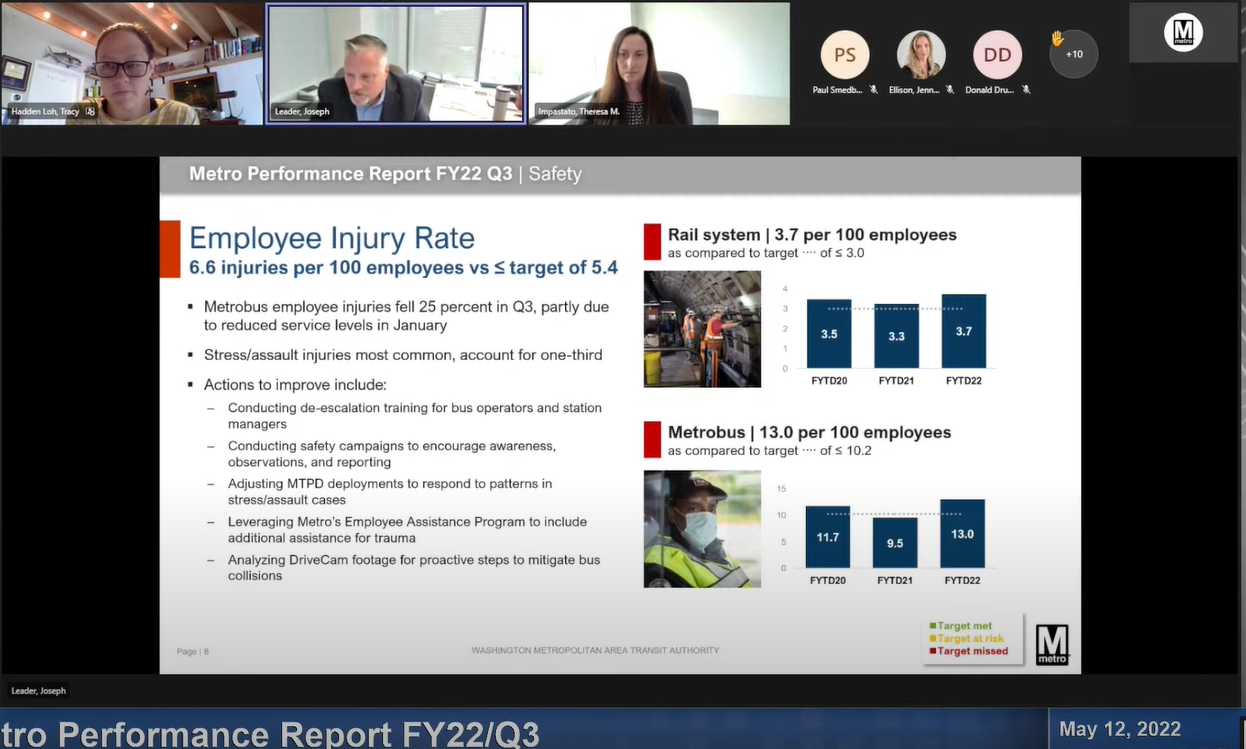
“The increase in crime across the District has impacted Metro staff,” said Impastato, adding that there’s been over 150 incidents already this year.
Chief Operating Officer Joseph Leader attributed the rise in assaults and threats to pandemic-related stress among riders, but also to mask-mandate enforcement. “We believe it had a lot to do with mental health issues, where at one point customers were not getting their medicine, not getting their treatment they needed, and coming on board and that led to altercations not only with our bus operators but our customers,” he told board members.
There appears to be a nationwide spike in violence against transit workers, leading Congress to require agencies to create a risk reduction program for transit-worker assaults. WMATA officials said the agency is responding to the incidents by conducting safety campaigns and offering de-escalation training, which 75% of Metrorail station managers have completed. Impastato said they have also created a civilian division within their transit police department to engage in community outreach.
“It’s pretty clear that the solutions to these problems don’t rest entirely within Metro’s span of control,” said Impastato.