Theater reviews are back at DCist! Each month we’ll highlight a few shows and give you our critics’ verdict: whether you should see them, skip them, or at least think about it. One note: we’ll typically try to group three reviews together with enough time for you to still get tickets; this month’s installment was meant to include three reviews, but COVID had other plans. Want to know what else is playing? Check out our monthly theater preview.
There’s Always the Hudson
Review by Missy Frederick
“You’re the spinach to my Popeye.”
Lola (Paola Lázaro) and T (Justin Weaks) throw out their share of metaphors during the fateful night when Woolly Mammoth’s There’s Always The Hudson takes place, and this one hints at a powerful bond between the pair. Both sexual assault survivors, the friends have come together for one last (?) time to attempt to right some of the wrongs committed against them over the years. They’ve got nothing to lose — they’ve resolved that they’re both going to throw themselves off of a bridge once 4:30 a.m. approaches, and that deadline looms throughout the play’s events.
There’s Always The Hudson kicks off feeling like a typical revenge fantasy — albeit a darkly funny one (“I shit on the 12 steps,” Lola says at one point, if you want a sense of her attitude towards more traditional recovery methods). But the duo’s evening-long journey, one of physical (occasionally graphic) violence, weighty confrontations, and more casual transgressions (an amusing case of avocado theft is involved), has a few surprises in store. There’s catharsis, incredulous pity, validation, and … well, nothing that can be summarized so neatly, ahead for the pair. The climatic reveal of Hudson isn’t necessarily a surprising one (at least for the cynics among us), but that doesn’t make it any less powerful.
At 90 minutes, director Jess McLeod’s Hudson moves along as a fast clip, with swift, pulsing scene changes set to an eclectic soundtrack keeping the night progressing. It features impressive supporting turns from actors playing multiple roles, including Marilyn Torres as a dead-eyed, deadpan fellow support group member, and Elan Zafir as an amiable dealer touting stoner-like wisdom (“feelings are not facts”). But it’s the frenetic energy and genuine love between Lola and T, embodied with natural ease and enviable chemistry by Lázaro (who also wrote the world premiere) and Weaks, that prove to be the heart of Hudson.
Verdict: See.
There’s Always The Hudson runs at Woolly Mammoth Theatre until June 5. Tickets are $64. Runtime is 90 minutes with no intermission. Warning: This play involves themes of sexual assault and suicide.
Desdemona: A Play About a Handkerchief
Review by Peter Tabakis
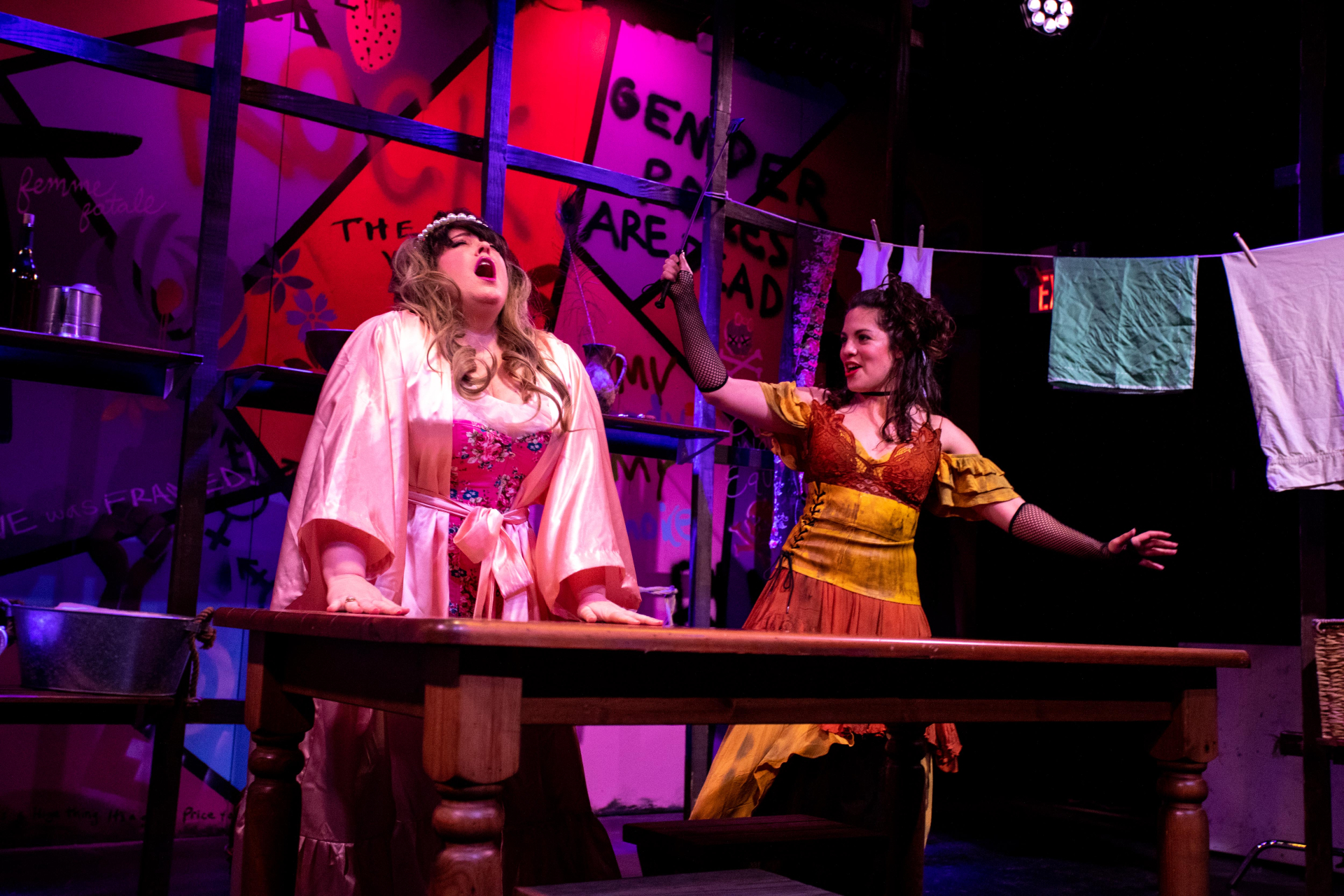
Much like Tom Stoppard’s Rosencrantz and Guildenstern Are Dead, Paula Vogel’s 1993 work Desdemona: A Play About a Handkerchief places the bit players of one of Shakespeare’s towering tragedies front and center. In this case, the minor characters in question are the three main women of Othello – Desdemona, Emelia, and Bianca – who are thinly-fleshed-out humans in the Bard’s original tale of intense jealousy and outright villainy. Vogel’s tart reimagining of Othello, produced by We Happy Few and directed by Kerry McGee and assistant director Emilia Pazniokas, unfolds across a series of vignettes in the hidden places in a Cypriot palace.
This surprisingly poignant comedy, performed at the Capitol Hill Arts Workshop, offers a feminist twist on a male-dominated story. The action, such as it is, mostly takes place in the palace garden as the handmaiden Emelia (a steely and forlorn Raven Bonniwell) tends to chores while her employer desperately rifles through the laundry. Early into the show Desdemona (Paige O’Malley, who owns the stage) has misplaced a handkerchief that was the gift of her husband Othello. She worries that if it ends up in the wrong hands, Othello will suspect she’s unfaithful to him. Spoiler: She is. The courtesan Bianca — the delightfully raunchy Gabby Wolfe — has introduced Desdemona to sex work, and business is booming.
The 42-seat theater is about as intimate a venue in which you’ll ever get to see a production this terrific. Jon Reynolds’ set features a wooden trellis in front of a wall painted with phrases — “Gender roles are dead,” “Eve was framed!,” “Rock the vote,” you get the idea — that may be a shade too on the nose. But that’s a minor misstep.
The women of Desdemona are equally defined by class as they are by inexorable, Shakespearean fates. Ivania Stack’s costume work underscores where each woman lands in the pecking order. Dressed in a dingy frock that could have been cast off by a can-can dancer, Wolfe’s Bianca is presented as a cockney-spouting party girl. Bonniwell’s Emilia wears a drab milkmaid dress as she delivers lines in a thick Irish brogue. And then there’s O’Malley’s patrician Desdemona, who’s outfitted in a shimmery pink nightgown that matches her exaggerated ego of a classic Hollywood diva. Rounding out this talented cast is the on-stage presence of violinist Manuela Osorio, playing original music (her own) that weaves together short scenes in conjunction with Jason Aufdem-Brinke’s simple yet effective lighting.
It helps if you’re familiar with the source material, especially once the title bit of fabric becomes a major plot device late in the 90-minute production. Catching every obscure reference, though, is less important than simply basking in the repartee of Othello’s complicated women. With this production of Desdemona, they get their due.
Verdict: See.
Desdemona: A Play About a Handkerchief plays until June 11, on Thursdays, Fridays, and Saturdays at 7:30 p.m., Capitol Hill Arts Workshop. Tickets at $25. Runtime is 85 minutes with no intermission. Warning: this play contains descriptions and “play acting” of sexual acts, implied intimate partner violence, and racial micro-aggressions.