 Jenny Gathright
Robert Barton was in year 27 of a 30-to-life-sentence when he found out his cellmate was being released.
“Every time I looked at him, I saw the lure of freedom,” Barton wrote in September. “I know he was oblivious to it, but the closer he got to that golden hour, the more he transformed into what was for me a mirage — the embodiment of a status (release) for which I yearn but keeps being yanked away at the moment I’m about to grasp it.”
In previous years, this would have been easier to bear, Barton wrote. Imprisoned since he was 16, he’d built what he calls a “coat of armor” to survive nearly three decades of incarceration — and the attendant pain and disappointment.
But in 2020, the year his cellmate was granted parole, the 43-year-old had just been denied a petition for early release through the Incarceration Reduction Amendment Act after a two-year legal process. The D.C. law offers some people convicted as teenagers a shot at freedom, allowing them to ask for a sentence reduction after they’ve served at least 15 years.
“I tried to soak in his rays of freedom,” Barton wrote of his cellmate, “but could only drown in the realization that I was still incarcerated.”
The rejection, however, coincided with the start of a new and transformative project – one that Barton says solidified what he imagines for himself when he’s eventually set free.
While he petitioned for his release, Barton was moved from federal prison to the D.C. Jail for easier access to his lawyers. There, he met Pam Bailey, a 65-year-old D.C.-based writer with a strong interest in social justice issues. Soon, they began to talk about what it might look like to work together on writing projects.
What started out as a series of personal blog posts has in two years grown to become a digital publication that runs upwards of six essays or reported pieces a month, mostly written by Barton and other incarcerated writers and edited by Bailey. There’s also a newsletter that Bailey sends through the Bureau of Prisons’ email system to 500 people currently incarcerated in federal prisons, most of them from D.C. (D.C. has its own jail, but not a prison, because the federal government took over much of D.C.’s criminal justice system in the late ‘90s as part of an agreement to address the city’s financial difficulties).
Barton says that More Than Our Crimes is, at its heart, about making sure incarcerated people from D.C. can still be engaged residents, even from within the walls of federal prisons. Those threads of connection with their community could help, he reasons, when they’re eventually released.
“A lot of times they come home and they’ll be second class citizens, or they recidivate because they’re not accepted in society, or they don’t feel as though they fit into society,” Barton said in a phone interview with DCist/WAMU from USP Coleman, a federal prison in Florida. “I think civic engagement makes you a citizen. It makes you feel like a citizen.”
There’s also the healing power of self-expression, which Barton says has helped transform his life.
“I think that writing is therapeutic, and it’s really served that role for me,” Barton says. “So now, a lot of times when I’m angry about something, or something is bothering me in the institution, I just write about it, and immediately after I finish writing about it, I’ve got it off my chest. It may not solve the problem, but I’ve gotten it off my chest.”
Some blog posts on More Than Our Crimes document the harsh everyday violence of life in federal prison — racist treatment from corrections officers, frequent lockdowns, and food deprivation as a method of control. Others are autobiographical essays about what it’s like to experience solitary confinement, or the challenges of trying to be an active parent from prison.
Barton grew up with his mother in southeast D.C., in what he describes as a tough neighborhood. He was exposed to drugs early, and was using and selling them by 6th grade, he says. His mother worked hard to keep him out of harm’s way, pulling together the money to send him to St. John’s College High School in Northwest, and Barton was a good student. But, he says, he also felt a lot of pressure to fit in with his neighborhood friends — and where he lived, the stakes for fitting in were high.
“I so wanted to feel like I belonged and fit in,” Barton wrote in a post on More Than Our Crimes. “I was still a child, and very confused about where and how I fit into a world that had already abused me.”
When Barton was 16 years old, his co-defendant killed someone while he was in the car. Barton was charged as an adult with first degree murder.
“I didn’t pull the trigger, but I shouldn’t have been there,” Barton wrote in the Washington Post last year.
After 23 years in various federal prisons, Barton was transferred to the D.C. Jail in 2018 while working on his petition for release — a stint he says was transformative.
It was the first time during 23 years of incarceration that Barton could see his mother frequently, since she could finally visit him in person. The D.C. Jail also had more programs and opportunities for him than most federal facilities. He served as a mentor in the jail’s Young Men Emerging unit and had access to educational programming, including an opportunity to take Georgetown University classes and attend guest lectures. He says he found himself becoming more introspective.
“Just being in an atmosphere with people that’s not of your normal peer group allows you to challenge your thought patterns,” recalled Barton.
This was also the period during which he met Bailey, through a letter-writing program of Free Minds Book Club, a local nonprofit that offers creative writing opportunities to incarcerated people. Bailey was participating in the program as a volunteer and was struck by one of Barton’s letters.
“I just immediately recognized another storyteller, another writer,” Bailey says.
Barton and Bailey kept writing letters for a few months, and eventually met in person in 2019. Their conversations quickly turned to what it would look like to start a publication together.
“I just remember saying, ‘I want to give you a platform. I’d like to help you get a platform,’” said Bailey. “And so the idea of a blog at Medium — it just started off there. We’d brainstorm ideas [and] I kept saying to him … ‘Oh, you should write about that.’ Everything, to me, was, ‘Oh, you should write about that.’”
But in 2020, they found out Barton’s IRAA petition was being denied as a result of a disciplinary infraction he’d incurred three years prior.
“I really thought he was getting out,” Bailey said. “I can’t tell you how devastating that was.”
In the midst of that hardship, Bailey encouraged Barton to continue writing. And they still started their publication: Barton wrote his introductory post on More Than Our Crimes shortly after the denial. Ultimately, he had to make the difficult transition out of D.C. and back to federal prison. He was transferred to USP Coleman where he currently resides.
Despite his transfer, the blog continues to expand and now features posts authored by contributors from federal prisons across the country. Kenneth Lighty penned an essay about what it’s like to face a death sentence from a federal facility in Terre Haute, Indiana. Antwon Holcomb wrote a poem about what it was like to watch the murder of George Floyd from a federal prison in West Virginia.
The stories are posted online and distributed through the newsletter, a listserv that Bailey says grew organically, through word of mouth.
“It started off with Rob passing the word, and then somebody else would sign up and he’d pass the word, you know,” Bailey says.
In one essay, a man named Robert Horne describes the ways he’s tried to be an active father from federal prison. He recalls with great pain the small moments he cherished with his daughter on the outside, “attempting to squeeze into those tiny chairs in her kindergarten class so we could eat breakfast together,” or watching SpongeBob SquarePants with she and her sister.
Horne, who is serving a 15-year sentence for assault, also writes candidly about the role violence has played in his life, and the remorse he feels for the actions that led to his incarceration and distance from his family.
“Violence has never really brought me any justice,” writes Horne. “But it’s a way of life I grew accustomed to, first on the streets and then in prison. Now, when I feel like I’m getting a violent impulse, I think about my daughter. She gives me hope.”
Bailey says she sends the newsletters out about every 10 days. There are two versions: one just for people from D.C., and one that has a more national focus. In addition to posts from the More Than Our Crimes blog, she summarizes and links to stories from local and national news outlets.
“I’m always scouring the news, [and] I try to get a sense of what they’re really interested in,” says Bailey.
Lately, she says, there’s been a lot of interest in housing issues, conditions at the D.C. Jail, and policing. Bailey says that members of the list are particularly interested in news that has to do with crime patterns, “because they know it’ll affect public perception” of the incarcerated population.
Barton says he hears often from people on the listserv that the newsletter is a great service.
“They love it. They hit Pam and they tell her, ‘This is the best service we ever had,’” he says.
For Bailey’s birthday in March, dozens of men at Big Sandy, a prison in Kentucky, sent her a replica of Gucci bag one of them had fashioned out of colored paper, signed with all their well wishes.
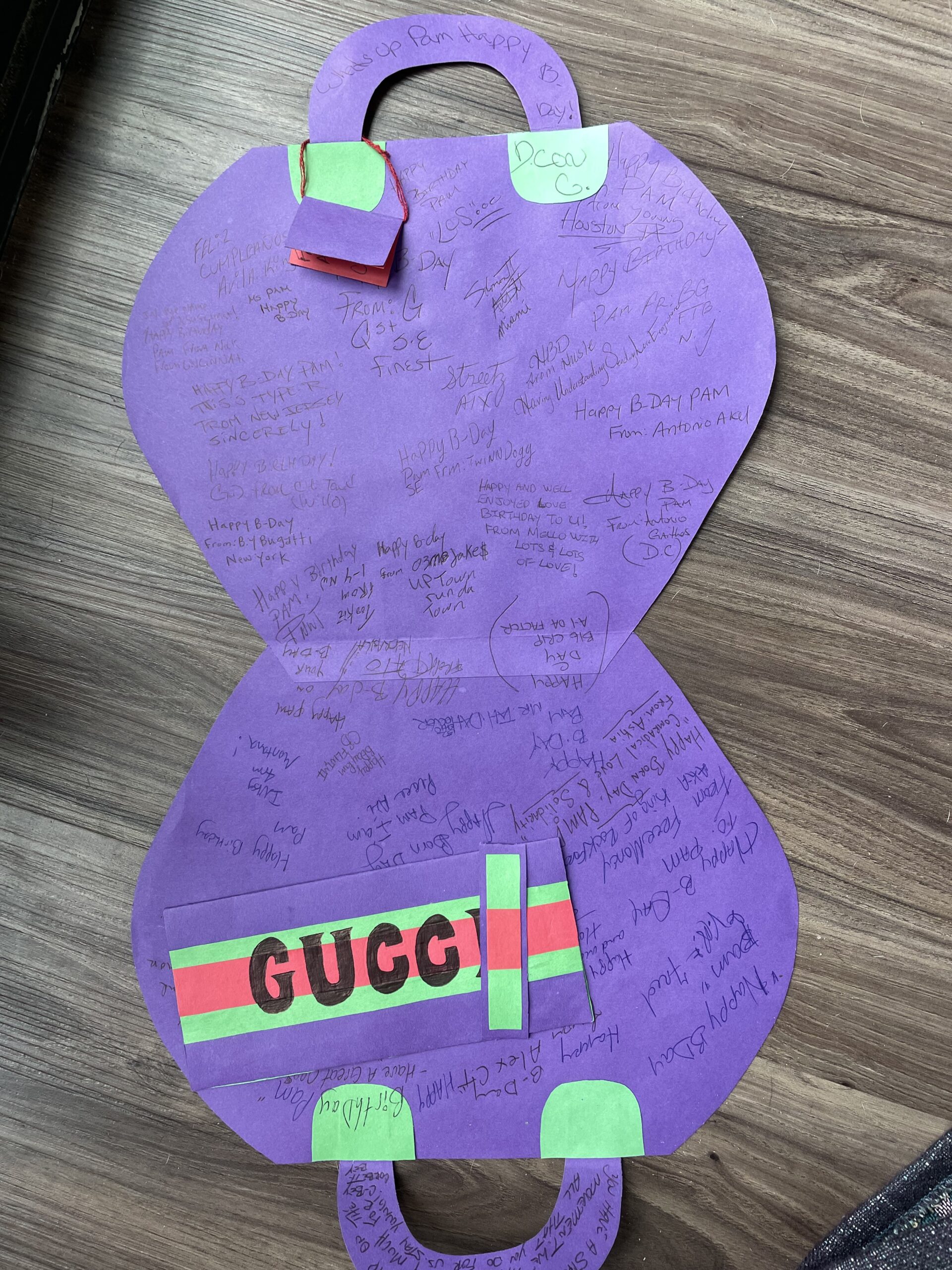
“I think [More Than Our Crimes] is a beautiful platform because it allows all the guys from D.C. to be up to date on the local news concerning us that’s locked up behind these walls,” said Angelo Daniels, who’s currently incarcerated at a Louisiana prison. He receives the newsletter and has also written for the blog. “Then they give us a platform to share our thoughts and what we think. I think it’s a beautiful thing. It was much needed.”
Barton and Bailey are currently at work on voter guides with information about candidates running for local office, which they plan to distribute to incarcerated people from D.C., (who recently regained their voting rights). They’re also crowdsourcing a report on prison living conditions in preparation for a potential Congressional hearing on the subject. And beyond his posts for More Than Our Crimes, Barton’s own writing has now been published in national outlets like the Washington Post and Politico.
But it’s still not easy for Barton to run an organization from the inside. His phone time is limited. His facility gets locked down for long stretches, which means that some weeks he is confined to his cell for between 22 and 24 hours, and given no access to email or phone. In January, Barton’s facility was locked down for three weeks after two men in his unit got into a fight over phone time.
“It’s hard because the email is down sometimes, or phone is down, or we locked down, and things of that nature,” Barton says. “But … I push through. Most of the times, I try to write two or three blogs a week and then get them to [Bailey] in the mail, so while we locked down, she has some so she don’t run out.”
Bailey has a full-time job doing communications for a nonprofit on top of helping Barton run More Than Our Crimes.
“I’m overwhelmed,” she says. “I mean, just responding to them, that alone, is my every evening. In fact, and if I get behind one evening, it’s like, ‘Oh my God.’”
Still, Bailey and Barton have ambitious goals — they want More Than Our Crimes to be a viable organization with proper funding so that they can run it full-time.
“The niche we see ourselves filling is really being the voice for D.C. residents who are still incarcerated,” Bailey says. “All the candidates and officeholders — they should be hearing from them. I think we have an obligation to them. They’re still D.C. residents and in fact, D.C. did a shameful thing when they sent them into the BOP. And I really do believe that there’s a moral responsibility to them.”
Barton will get another chance for release under IRAA in early 2023. On the outside, he says he sees himself as an advocate for issues related to prison conditions and the incarcerated population. He recently authored a blog post titled, “Willing It Into Existence: This Will Be My Last Year In Prison.”
“As the sounds of guys screaming, shouting and kicking on the doors seep into my room with the new year, I know I got this. I can deal with one more year. I can own this last year,” wrote Barton. “Damn yes, it’s 2022. But 2023 is right around the corner and it’s going to be epic!!!”