Amanda Michelle Gomez
You’d be wrong to assume that D.C.’s Dyke March is simply about marching while dyke.
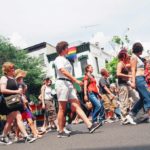
When the march was resurrected in 2019, self-described dykes of various genders, races, sexualities, and experiences demonstrated against displacement in the District. When activists and organizers gathered to plan the 2022 march, they deliberated on how best to honor their community’s diversity in this year’s theme.
Instead of marching for just one cause, they landed on a theme that calls attention to the barrage of bleak news that is weighing on a lot of dykes’ minds of late (including the hundreds of anti-LGBTQ+ bills introduced in state legislatures since January, the leaked Supreme Court opinion to overturn Roe v. Wade, and the incessant gun violence and shootings): “Dykes for Body Liberation: Hands off our bodies.”
“We believe in body liberation, which was a movement started by fat people,” says Rae Gaines, who helped organize Dyke March. “But for us, for body liberation, it also means being pro-abortion, pro-gun control, anti-displacement, and anti-police.”
“All of these topics might seem kind of disjointed, but for us, they really fall under the umbrella of body liberation,” Gaines continues, “because it means that we have the ability to say what is best for our own bodies. We have our own autonomy.”
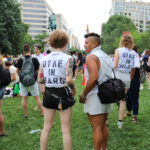
On June 10, Dyke March kicks off at Franklin Park in downtown at 6 p.m. (Organizers moved the start of the march because the original location, McPherson Square, is home to a growing number of unhoused neighbors and they wanted to respect their space.) This year’s theme will be evident in prepared chants, signs, and speeches. The idea is to create space for dykes afflicted by the wave of difficult news to shout, cry, or revel in their own perseverance, organizers say.
Organizers are strongly encouraging people to wear masks at the event to slow the spread of COVID-19. The march begins at a square of public green space where several people experiencing homelessness stay, so Gaines asked protesters to be mindful of not intruding in their space and to be inviting. American Sign Language and Spanish translators will be in attendance, and wheelchairs are available upon request beforehand (email dcdykemarch@gmail.com). Water will also be provided at the event.
The march’s theme also hearkens back to the queer movement’s roots: Pride started as a protest, not a peaceful parade featuring corporate sponsors that’s often associated with the month of June. Gaines also made clear that the march is not just for lesbians.
“We’re for dykes of all identities,” Gaines says. “Lesbian dykes. Trans dykes. Genderqueer dykes. Bi dykes. Any dykes who love and embrace the term that they’re a dyke, we want them to be able to celebrate, to speak out, and also to really have a radical and powerful space that isn’t just based in capitalism and making money and in like a bunch of rainbows stuck on different items.”
Since organizers brought back the Dyke March in 2019, themes have included “Dykes Against Displacement,” which references the city’s housing crisis, and “Dykes 4 Decrim,” which advocates for decriminalizing sex work. Part of this year’s theme (“Hands off our bodies”) is a nod to pro-abortion advocacy, and an acknowledgment that dykes too need abortion care, Gaines says. The message is meant to be inclusive of people of all genders who need such care.
D.C. is home to the country’s first-ever Dyke March, which set off from Dupont Circle in April 1993. Local dykes revitalized it in 2019, saying that mainstream Pride events often do not center them or are not led by them. Dyke March is not affiliated with Capital Pride Alliance, a nonprofit that will host a parade the day after.
A group of about 20 people planned this year’s march, mostly virtually or somewhere outdoors, organizers say. Some of today’s core organizers were involved in planning the 2019 march, like Gaines, and recall the days of meeting with a much larger group at The Potter’s House. “A lot of those folks that were at that first meeting, I’m now really good friends with,” Gaines says, “so that’s just kind of really cool, the community that’s been sparked from it.”
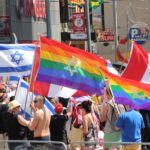
Dyke March has not been without controversy: In 2019, organizers faced allegations of anti-Semitism after they discouraged pro-Israel paraphernalia from the event. Organizers argued that while Jewish stars and symbols of Jewish culture were welcomed, Israeli symbols such as flags could alienate Palestinian dykes.
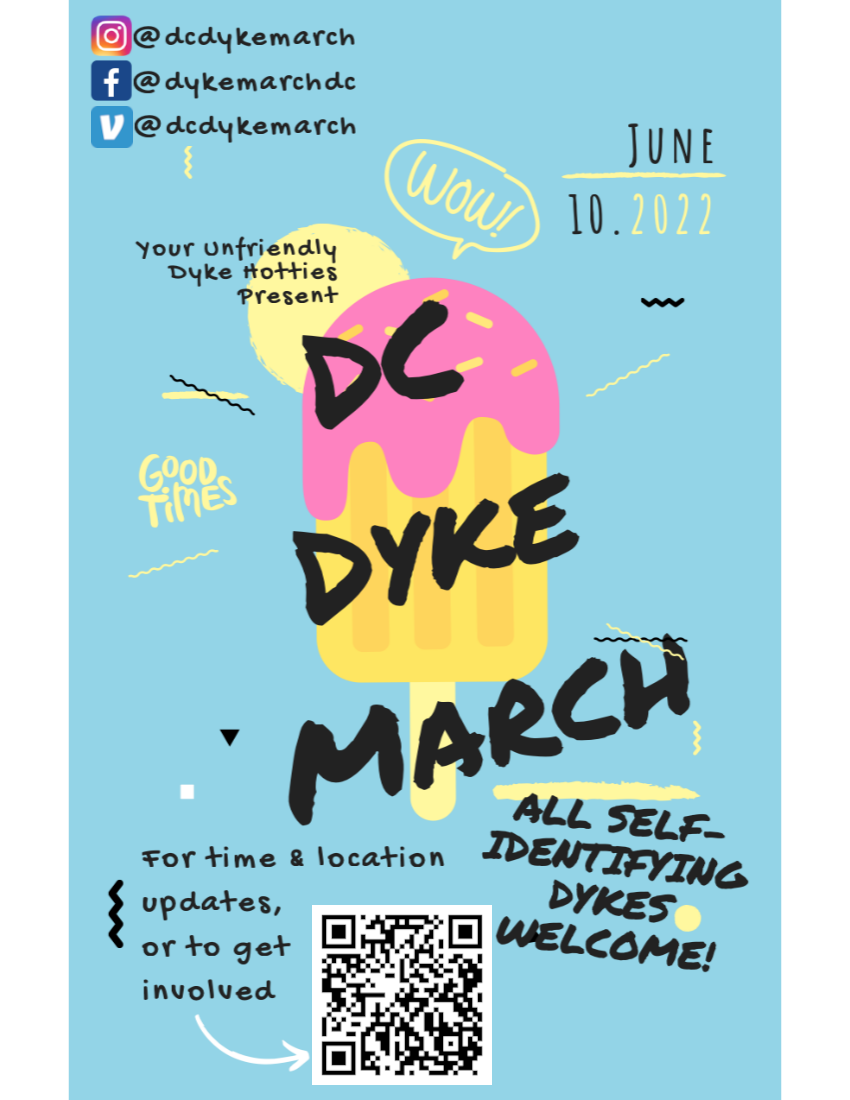
The march centers dykes, but allies are welcome to participate by donating or volunteering as marshals. Marshals will help keep the crowd moving, as well as act as a buffer between protesters and police. (Training is scheduled on Monday and Wednesday ahead of the march.) As is tradition for dyke marches, the event is unpermitted, and organizers do not communicate with police beforehand. No one outside the core group of organizers knows the march’s official route.
“Our solidarity is our primary form of safety,” says Ria Thompson-Washington, who is a seasoned organizer and joined Dyke March during the revival.
Thompson-Washington, the former executive vice president of the National Lawyers Guild, will be a legal observer at the march, meaning she’ll observe the activities of law enforcement and capture potential civil rights violations. She also led Know Your Rights workshops ahead of the march, which teaches people their rights under the law while protesting on public streets or sidewalks.
Organizers say they have also been working to ensure the march is not a de facto white space, and welcoming of Black communities. By marching for body liberation, and not simply dyke visibility, they hope to attract the diverse crowds of past marches. “I’m a fat Black woman, a fat Black queer woman. Let’s add one more layer: I’m Afro-Latina,” Thompson-Washington says. “All of them share one thing in common, and that is that the autonomy of our bodies is seen as not real. Like we don’t have access to it.”
“We are at the center of a lot of these different harms that are happening at the same time,” she adds. “I’ve been really intentional on making sure that other Afro-Latinos like myself, other Black people like myself are getting the call.”
Organizers’ activism is not limited to Dyke March. Thompson-Washington recalls her early days of organizing in South Texas — as a clinic escort assisting patients in need of abortion care — as she prepares to march, while Gaines considers more recent activism supporting migrants who are bused into D.C. from Texas and Arizona. Still, June 10 is significant to them.
“I am looking forward to being in a proverbial pile of dykes,” Thompson-Washington says. “I am looking forward to being out in the streets, beating my feet on the pavement with a bunch of people who are — we may not all be exactly alike, but are similarly identified.”
This post has been update to include Dyke March’s new meet-up location.