Martin Austermuhle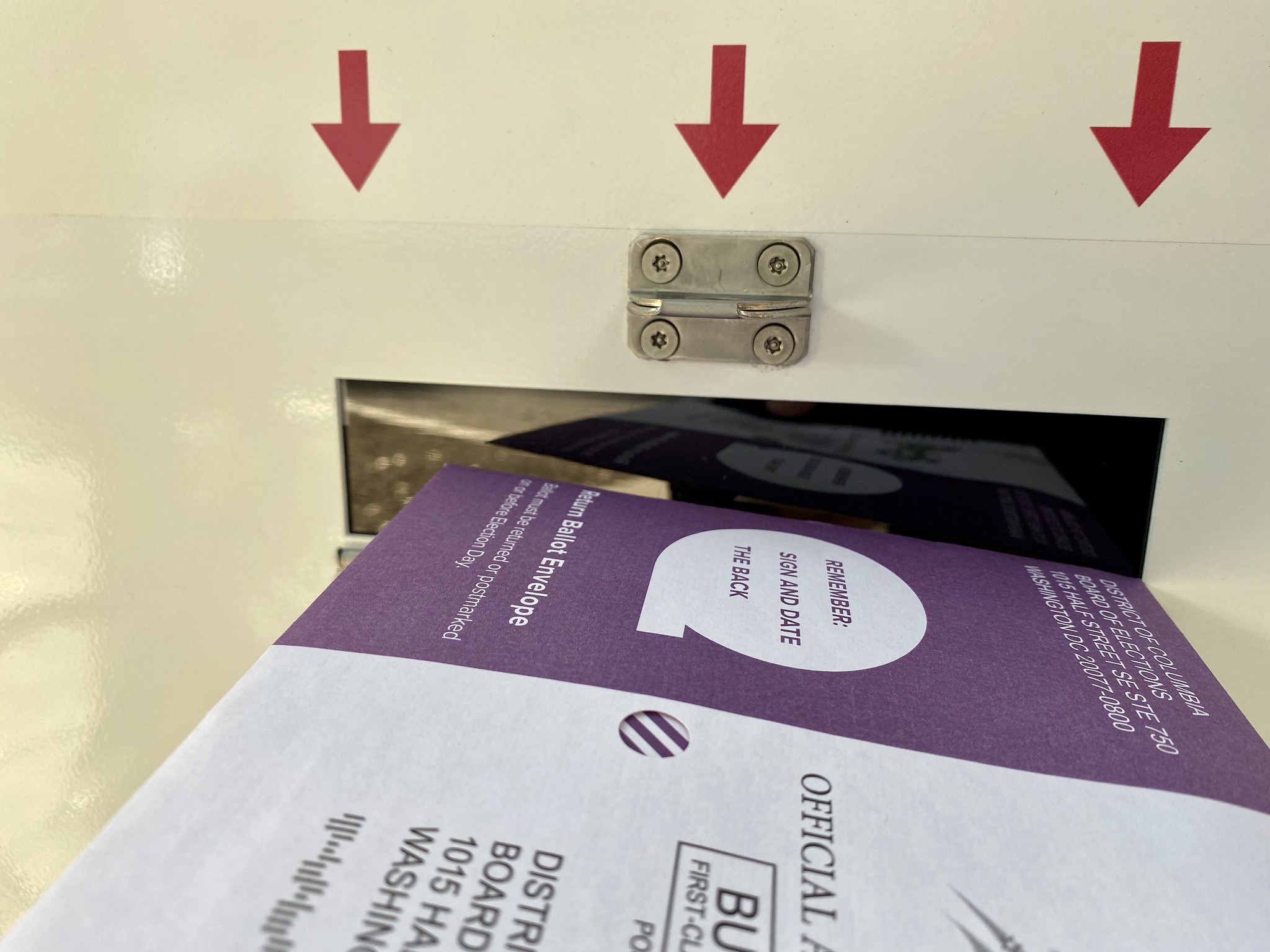
We’ve got a week left until the June 21 primary and passions are running high. Candidates are making their final appeal to residents and pushing them to vote if they haven’t already. According to the D.C. Board of Elections, some 29,739 voters have cast their ballots as of Monday, mostly by mailing them or leaving them in drop boxes. Early in-person voting continues through Sunday and any mail ballots have to be postmarked or dropped off by June 21.
And then there were six
The most crowded field in this year’s primary cycle has gotten slightly smaller. One-third smaller, to be exact.
Tricia Duncan, one of nine Democratic candidates vying for the Ward 3 seat on the D.C. Council, announced Monday that she was bowing out of the race. Duncan, a former president of the Palisades Civic Association who earned the support of outgoing Councilmember Mary Cheh (D-Ward 3), wrote in a public letter that her decision was motivated by a realization that she was unlikely to win — and that by staying in the race she risked splitting the vote and handing victory to an opponent.
“I did not make this decision easily or lightly,” she wrote. “I felt I needed to determine if I had any shot of winning, and if I didn’t, I should step aside so that a candidate who shared my values can win.”
That candidate, she wrote, is Matt Frumin, an attorney, former Ward 3 ANC commissioner, and education advocate. Duncan says she believes it’s now a “two-person race” between Frumin and Eric Goulet, the longtime council staffer and one-time budget director for former mayor Vincent Gray.
On Tuesday morning, Ben Bergmann, another Ward 3 candidate, followed suit and pulled the plug on his campaign, citing many of the same reasons. He is also backing Frumin. Henry Cohen, a high school senior, also dropped out on Tuesday afternoon and will support Frumin.
These types of late-in-the-game decisions certainly aren’t unheard of in politics, especially in hotly contested races with a crowd of candidates likely to split the vote in unpredictable ways. That’s exactly what’s happening in Ward 3, as the City Paper recently reported: the nine Democratic contenders have somewhat divided themselves into the progressive and more moderate camps, but for many voters it can still be tough to differentiate between them all.
In many ways, Goulet became the moderate to beat when the Washington Post’s editorial board endorsed him last month; he’s also gotten the endorsements of the D.C. Police Union and former mayor Anthony Williams. On top of that, Goulet has been the beneficiary of some significant outside spending by pro-charter groups D.C. Democrats for Education Reform and the D.C. Charter School Action, both of which have paid for mailers supporting Goulet. (That spending cannot be coordinated directly with Goulet, nor does he have any control over it.)
That financial support for Goulet was part of what convinced Duncan to drop out and endorse Frumin, a progressive candidate. “Matt’s campaign is not supported by outside groups pouring millions of dollars of independent expenditures to push their agendas onto an unsuspecting electorate,” she wrote. Duncan adds that while she was doing relatively well in fundraising, the June 10 campaign finance reports showed Frumin leading the way — and thus best placed to compete against Goulet. (According to D.C. Geekery, Frumin and Goulet have raised the most money overall, with Duncan landing in fourth.)
There’s more, though. Some Ward 3 voters reported having received a phone poll last week paid for by D.C. Councilmember Elissa Silverman (I-At Large) that included questions on the citywide races as well as the Ward 3 contest, which prompted some raised eyebrows.
“It’s literally got nothing to do with her. Why would she need that information unless she is planning to share it with someone?” says Tracy Hadden Loh, a member of Metro’s board and a supporter of Goulet who received one of the calls. (Under D.C. campaign finance law a shared poll would have to be disclosed as an in-kind contribution, and subject to the city’s limits on campaign giving. The City Paper recently reported on accusations that Goulet may have been handed the results of a poll conducted by an outside group; he’s denied that.)
Silverman says she paid for the poll and properly disclosed it on her campaign finance reports, and that she conducted it because she “wanted to see what Ward 3 voters thought.” She adds that she discussed the results of the poll with people in Ward 3, but didn’t actually shared the poll with anyone. “I did talk to a few folks and said that Goulet would win unless things change,” she said. “I was very careful not to hand out the poll. No one has it but me and my campaign team.”
Duncan says she did speak with Silverman, but confirms that she didn’t get a copy of the poll. “We were very careful. She already knew where my head was,” she says.
Goulet didn’t immediately return a call seeking comment. As for Bergmann, in a public letter he decried the “political machinations” that lead candidates to drop out, while conceding that if he didn’t “the risk that the wrong person will win is real,” referring to Goulet. (He also said the situation in Ward 3 is why he supports ranked-choice voting.)
It remains to be seen if there will be any further consolidation in this election cycle, which includes fellow Democratic candidates Monte Monash, Henry Cohen, Phil Thomas, Deirdre Brown, and Beau Finley. But it does seem like its coalescing into a Frumin v. Goulet contest, as Duncan said. Cheh said yesterday that she would vote for Frumin, who also received the endorsement of Attorney General Karl Racine. And Silverman endorsed Frumin on Tuesday afternoon, as did Councilmember Janeese Lewis George (D-Ward 4) and Councilmember Charles Allen (D-Ward 6).
As for those voters who already cast ballots for Duncan and Bergmann, well, there’s no way to ask for a do-over.
Robert White’s poll shows him closing in on Bowser
As the June 21 primary fast approaches, one thing is clear: not much at all is clear. That’s partly because, as Axios pointed out a few weeks ago, there’s been virtually no public polling done on the major D.C. races. In fact, the last public poll on the mayoral race came from the Washington Post in February.
There’s finally a new poll on the state of the mayor’s race, albeit from one of the mayoral candidates himself. D.C. Councilmember Robert White’s (D-At Large) campaign released a poll early this morning showing the race between him and Mayor Muriel Bowser tightening in the closing weeks of the campaign, so much so that he declared it a “statistical TIE!”
According to the poll of 500 likely Democratic voters, Bowser is currently at 41% of the potential vote, while White is at 37%, 15% of voters remain undecided, and Councilmember Trayon White (D-Ward 8) is at 6%. (See the full results here.)
How does that stack up to the Post’s poll from February? Well, that poll had Bowser at 47% of the vote, Robert White at 19% and Trayon White at 17%. Robert White’s campaign did its own internal polling in March that similarly had Bowser at 47%, Robert White at 24%, and Trayon White at 5%. Either way, Robert White’s newest poll shows him with a relatively significant jump in support. (His campaign ascribes that to intense outreach to voters.)
Now, the usual caveats have to apply here. While the poll was conducted by a well-regarded firm (Lake Research Partners), it was still paid for by White’s campaign. And if the 2016 presidential election showed anything, it’s that polls can say one thing and voters can simply do another. (Bowser’s campaign has also conducted internal polls; DCist/WAMU requested the results from those, but has not yet gotten a response.)
Still, White’s campaign aides say they are optimistic.
“We know the mayor has outspent us and her numbers are going down. We know she must be seeing the same numbers as us, because she is [attacking us],” said Luz Martínez, White’s campaign manager. “All of these undecided voters are undecided with a two-term incumbent and we’ll be able to reach them.” (Bowser has recently sent out mailers attacking White for his education proposals.)
Of course, Bowser’s campaign will be doing much the same — and with more money. According to campaign finance reports filed late last week, Bowser had $1.8 million to spend through the primary. White, by comparison, had $180,000.
Total recall, Ward 6 edition
The race for the Ward 6 seat on the D.C. Council isn’t particularly exciting right now: incumbent Councilmember Charles Allen (D-Ward 6) is currently running unopposed in the June 21 Democratic primary, increasing the chances that he’ll cruise to victory in November’s general election.
But a much smaller scale election in Allen’s ward is shaping up to be interesting — in fact, it’s a push to un-elect someone.
Earlier this month, the D.C. Board of Elections gave the green light to an effort to recall Ward 6 Advisory Neighborhood Commissioner Amber Gove from office. Gove represents ANC 6A04, a small portion of Capitol Hill to the northeast of Lincoln Park. Alexandra Kelly, one of her constituents, says in a petition that she wants to recall Gove over her support for a D.C. plan to turn North Carolina Avenue NE into a one-way street heading westbound.
The plan stems from a broader effort to build safer cycling infrastructure along C Street NE, and connect it to Lincoln Park via North Carolina Avenue. The city proposed a number of options for the avenue, including removing some parking to build a protected bike lane or simply turning it into a narrower one-way street. After a number of public meetings and lively debate over what, if anything should be done to North Carolina Avenue, Gove and the commission voted to support the one-way plan. (Gove published an op-ed in Hill Rag supporting the move here; an opponent responded with his own take here.)
Kelly says Gove’s decision to back the city’s plan was a betrayal, writing in her petition that it will reduce parking, limit electric vehicle charging options, and cause traffic problems.
“Over eighteen months, our Commission discussed options at multiple public meetings. We voted unanimously to support the design that will reduce speeding, add parking, and give pedestrians, drivers, and cyclists their own spaces,” responded Gove.
Gove already has one high-profile supporter: Allen himself.
Recalls aren’t completely novel in D.C. In fact, the only successful recalls have been of ANC commissioners. That’s largely because of the easier lift: a proposer only needs signatures from 10% of the voters in the district, which in Gove’s case amounts to roughly 190 signatures collected by Aug. 1.
What’s interesting, and could prove messy, is the timing. The elections board says that should Kelly collect the required signatures by the deadline, the recall vote would likely appear on the November general election ballot. And if Gove opts to run for re-election, that means she would appear on the ballot twice, to be recalled and reelected. (Were she recalled but reelected, her constituents wouldn’t have an ANC commissioner for just under two months.)
“A recall is costly and leaves us unrepresented,” wrote Gove, who will run for another term. “Let’s have voters decide on the November ballot instead.”
Some required reading
While we think you should read DCist first and foremost, we don’t hold a monopoly on interesting reporting on D.C. politics and elections.
- In his run for D.C. mayor, Robert White is trying to win over skeptics. (Washington Post)
- There’s accusations of sign-stealing in Ward 1. (City Paper)
- As the primary approaches, campaign spending is ramping up. (Washington Post)