The list is out! The Smithsonian has decided on four possible prime locations on the National Mall to place two new museums, the National Museum of the American Latino and the Smithsonian American Women’s History Museum.
Congress approved the new museums in December 2020, and the selection process for the the sites has been somewhat controversial from the start.
Supporters worried that the new museums would be relegated to locations far from the National Mall in the wake of conservationists calling for no new additions to “the Nation’s front lawn.”
Smithsonian Secretary Lonnie Bunch hoped to quell the unease felt by advocates of both museums in late June when criteria for selecting the new location was announced.
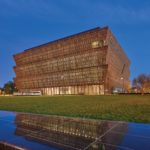
“Selection of a site is one of the most consequential decisions for a museum,” said Bunch, who was the founding director of the Smithsonian African American Museum of History & Culture, a building with distinctive architectural design at the foot of the Washington Monument.
“It is important that the steps we take ensure a transparent, inclusive and thorough process.”
The four sites currently under consideration:
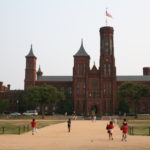
- Arts and Industries Building— The ornate structure at 900 Jefferson Dr. S.W. on the National Mall, remodeled as an exhibit space and reopened in 2021, is part of the Smithsonian and is next to the emblematic Castle.
- The Northwest Capitol site – undeveloped land bordered by Third Street, Constitution Avenue, First Street, and Pennsylvania Ave. at the foot of Capitol Hill on the Senate side, parallel to the U.S. Botanic Garden. It is under jurisdiction of the U.S. Capitol.
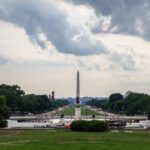
- South 14 Monument site – also known as The Reserve, is undeveloped land at the foot of the Washington Monument, bordered by 14th Street and Jefferson Drive, across the Mall from and parallel to the National Museum of African American History & Culture. It is controlled by the National Park Service.
- Tidal Basin site—undeveloped land that is near the U.S. Holocaust Memorial Museum, bordered by Raoul Wallenberg Place S.W. and Maine Avenue S.W., under control of the National Park Service.
The Smithsonian Board of Regents must announce a decision for the siting of the two museums by December. The fundraising would then begin for construction – non-federal contributions would pay for 50% of the costs – in a process that is expected to take 10 years.
In a tweet, Sen. Bob Menendez, D-N.J., the leading sponsor of the legislation in the Senate, said, “I’m thrilled that the @smithsonian has narrowed its search and is focusing on four sites on the National Mall as possible locations for the National Museum of the American Latino & Smithsonian American Women’s History Museum.” The Senator added that he “…can’t wait for the day when my three granddaughters will get to visit these museums that will celebrate the historical, cultural, & economic contributions of women and Latinos to America.”
Menendez and other high-profile members of Congress and supporters of the museums were part of a lobbying effort six months ago to make sure the museums were placed on the National Mall.
Estuardo Rodriguez, president and CEO of the Friends of the Museum of the American Latino, applauded the Smithsonian Institution for the announcement.
“Choosing a location for this spectacular museum is a momentous decision,” said Rodriguez, “which is why we remain committed to working in a unified and collaborative manner in support of the Smithsonian to ensure that a pathway is clear for each of these identified locations.”
The first three sites were part of the legislation creating the museums, and came as recommendations from lawmakers for the Smithsonian’s selection process. The fourth site, the Tidal Basin, is a surprise finalist but comes with some powerful support – the National Mall Coalition, a group of traditionalists who want to keep the green space on the Mall and not add any more buildings and monuments. The Tidal Basin is considered part of the Mall but is not part of the main stretch of museums and monuments.
Arthur Cotton Moore, famed architect and vice-chair of the coalition, developed a plan issued in March that would place both museums side by side. It is unclear if the Smithsonian would consider that option.
The museum system says each site will be evaluated on the basis of multiple criteria, including the symbolism of placement on the National Mall, existing site conditions such as vistas, security and compatibility with city plans, transportation, (including access to public transit) and environmental factors and costs – either to build a new structure or to rehabilitate an existing one.
The Smithsonian, challenged to portray American culture in an inclusive way, may soon have another museum in the wings with similar issues as President Biden signed a law June 13 creating a commission to study the potential creation of a National Museum Of Asian Pacific American History.