Martin Austermuhle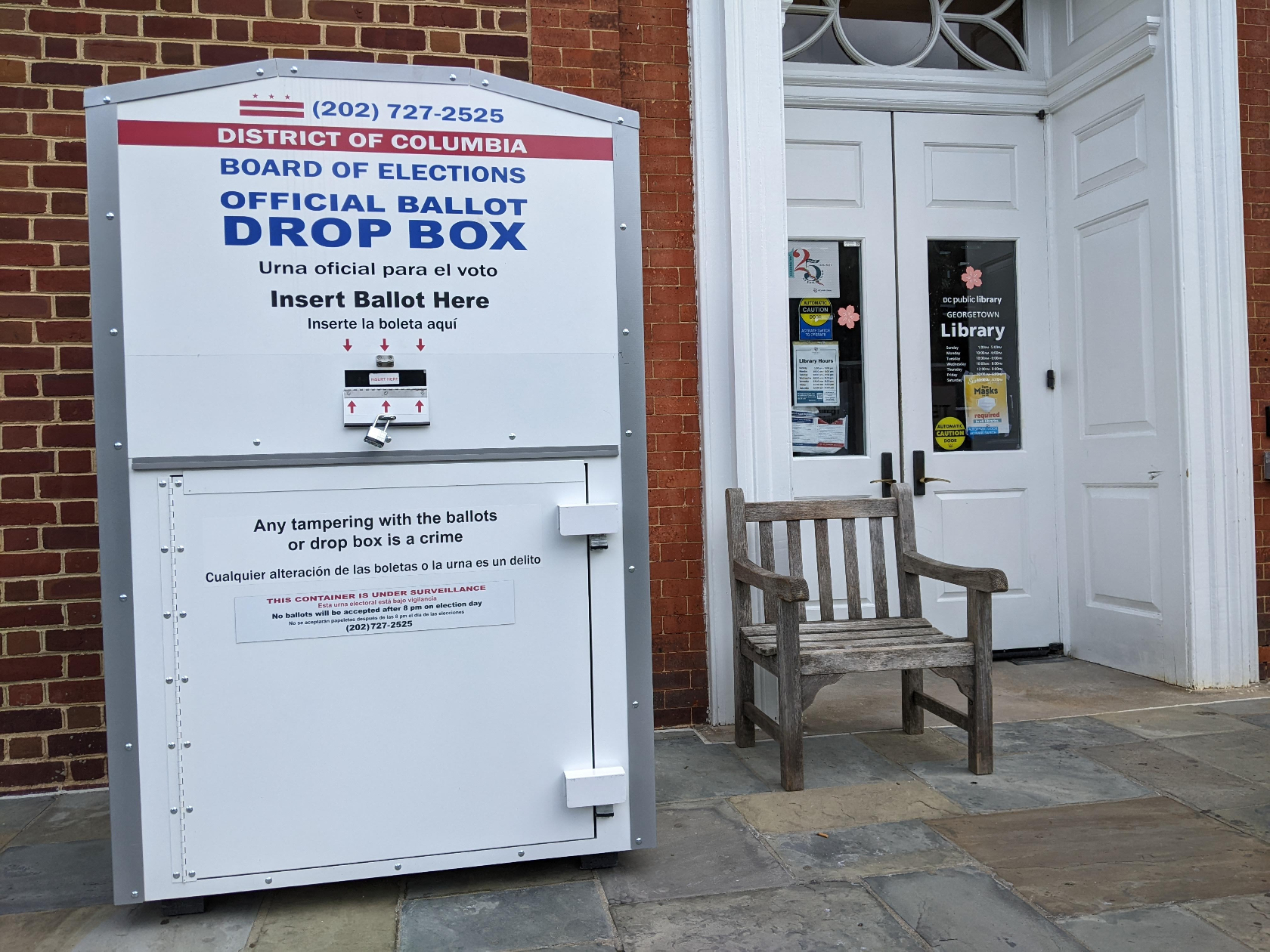
The ongoing counting of outstanding mail ballots from D.C.’s June 21 primary isn’t upending any of the outcomes in most of the races, though some results have tightened and overall turnout has jumped.
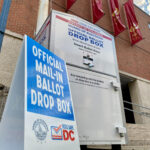
By the end of last Tuesday the D.C. Board of Elections had counted more than 91,000 votes, a mix of mail ballots and in-person votes cast early and the day of the primary. But the board disclosed late Wednesday that it still had a batch of more than 30,000 mail ballots to count, the overwhelming majority of which had been dropped off by voters on Election Day. (For context, roughly 50,000 mail ballots were left in drop boxes ahead of Election Day.)
After working feverishly late last week and into the weekend, by Monday the elections board had largely tallied the outstanding mail ballots, bringing the total number of ballots counted so far to 129,104. The counting of a smaller number of ballots still arriving through the mail will continue through Tuesday; D.C. law allows for a ballot postmarked on Election Day to be received within seven days.
The current number of votes counted translates to almost 31% turnout for the June 21 primary, higher than in any other primary dating back to 2010 — including the 2018 primary, when turnout was 18.6%.
And while the calls made on Tuesday and Wednesday for most of the races on the ballot did not change, results in some of the highest-profile races got closer as more ballots were counted. In the mayoral race, Mayor Muriel Bowser’s initial Election Day lead of almost 11 points over Councilmember Robert White (D-At Large) — which prompted her to declare her victory “decisive” — narrowed to eight-and-a-half points by Monday.
In the D.C. Council Chairperson’s race, incumbent Phil Mendelson’s initial lead of more than 10 points over challenger Erin Palmer was down to just under seven points by Monday, marking the closest such challenge the two-term incumbent has faced. In 2018, Mendelson defeated challenger Ed Lazere by 27 points. Palmer, a first-time candidate for citywide office and an Advisory Neighborhood Commissioner in Ward 4, tells WAMU/DCist that it’s “amazing” she got as close to beating Mendelson as she did, and that her performance shows a desire for new voices and ideas in government.
“I think there’s a good-government piece to this and people wanting government that works,” she said. “And that’s a broad arching principle that I think can appeal to people.”
Asked Monday about the results of his race, Mendelson said the performance of some of the incumbents on the ballot — including Bowser and Councilmember Anita Bonds (D-At Large), who won with 36% against three challengers — could be linked to a broader displeasure among voters with government at large and that some voters are unaware of what elected officials have been doing.
“Compared to years ago, people are not feeling as good about the District. I think some of that is a carryover from national politics and how horrible they are, but also a frustration over affordable housing and homelessness and violence,” he said. “I’m going to do my best to tackle and better communicate what I’m doing. We know people are not happy about crime, so I will be more outspoken on what we can do there. We know that folks are dissatisfied with affordable housing and homelessness; well I’ve done a lot there but clearly people haven’t seen that, so I need to better communicate that.”
The counting of outstanding ballots is also providing a more granular look at voting patterns in the primary. Bowser performed strongest in voter-rich Ward 3 while also winning or remaining competitive in many Black precincts east of the Anacostia River. (Another challenger, Ward 8 Councilmember Trayon White, won eight precincts in Ward 8, but only managed 8.8% of the vote citywide.) Robert White, meanwhile, claimed most precincts in the denser central areas of the city and into some of the younger and gentrifying residential areas of wards 4, 5, and 6. The outcome in Mendelson and Palmer’s race followed a similar pattern. (White won Ward 1, while Palmer won wards 1 and 6.)
And according to an analysis of the results performed by Ward 6 ANC Corey Holman, support for a particular candidate would often equate to how and when a voter cast their ballot. Bowser and Mendelson performed more strongly among voters who cast ballots early or on Election Day, while Robert White and Palmer saw better outcomes from people who dropped off their mail ballot on Election Day. (Mendelson claimed 54.8% of early and day-of votes, while Palmer took 50.7% of mail ballots dropped off on Tuesday.)
Holman said that the large number of mail ballots dropped off on Election Day — which were counted later in the week — could prove decisive in future races if the initial reported results are closer.
“We were lucky in a sense, where the Election Day and early ballots were so decisive, that a 5% or 6% swing wasn’t going to affect the outcome,” he said. “But I think the top line would be if the chair’s race were six points closer, I still think most people would have assumed Mendelson would have won Election Day, and he wouldn’t have.”
One race where the results did shift after Election Day was for shadow representative, where challenger Linda Gray was ahead on Tuesday night only to see that advantage disappear to incumbent Oye Owolewa as outstanding mail ballots were counted. According to Holman’s analysis, Gray took 49.8% of the votes cast on or before Election Day (t0 Owolewa’s 38%), while Owolewa roared back with the later mail ballots, claiming 60% of them. Owolewa is now ahead by five percentage points, and declared victory in his race Monday on Twitter.
And in the Ward 3 race, Matthew Frumin saw his lead over Eric Goulet grow as more of the later mail ballots were counted.
Previously
Incumbents Win Their D.C. Primaries, Progressives Clinch Open Races