Jacob Fenston
The National Park Service is embarking on a major project to rebuild the crumbling, sinking seawalls and sidewalks that surround the Tidal Basin, aiming to make the basin resilient to a rising Potomac River and protect the world-famous cherry trees. NPS is taking public comment on the first phase of the project online, through Sept. 12.
The sea walls around the basin date back to the 1880s, though some were rebuilt during the 1930s and 40s when the Jefferson Memorial was added. They were built atop reclaimed land — mud dredged from the river bottom — and were not anchored to bedrock. Thus, over the ensuing decades, the sea walls and walkways have literally been sinking into the earth.
NPS estimates the seawalls have settled three to four feet below where they were originally constructed.
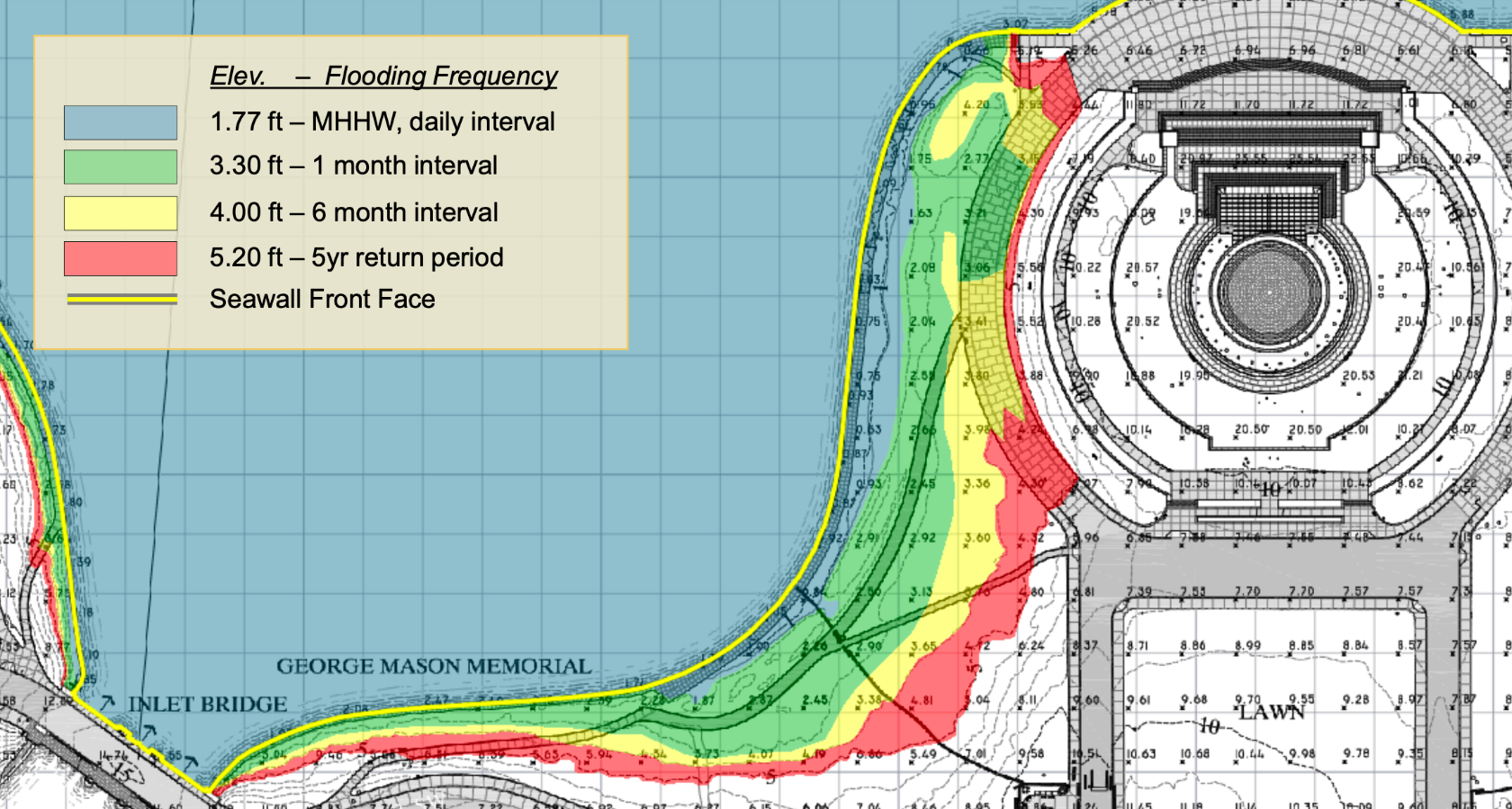
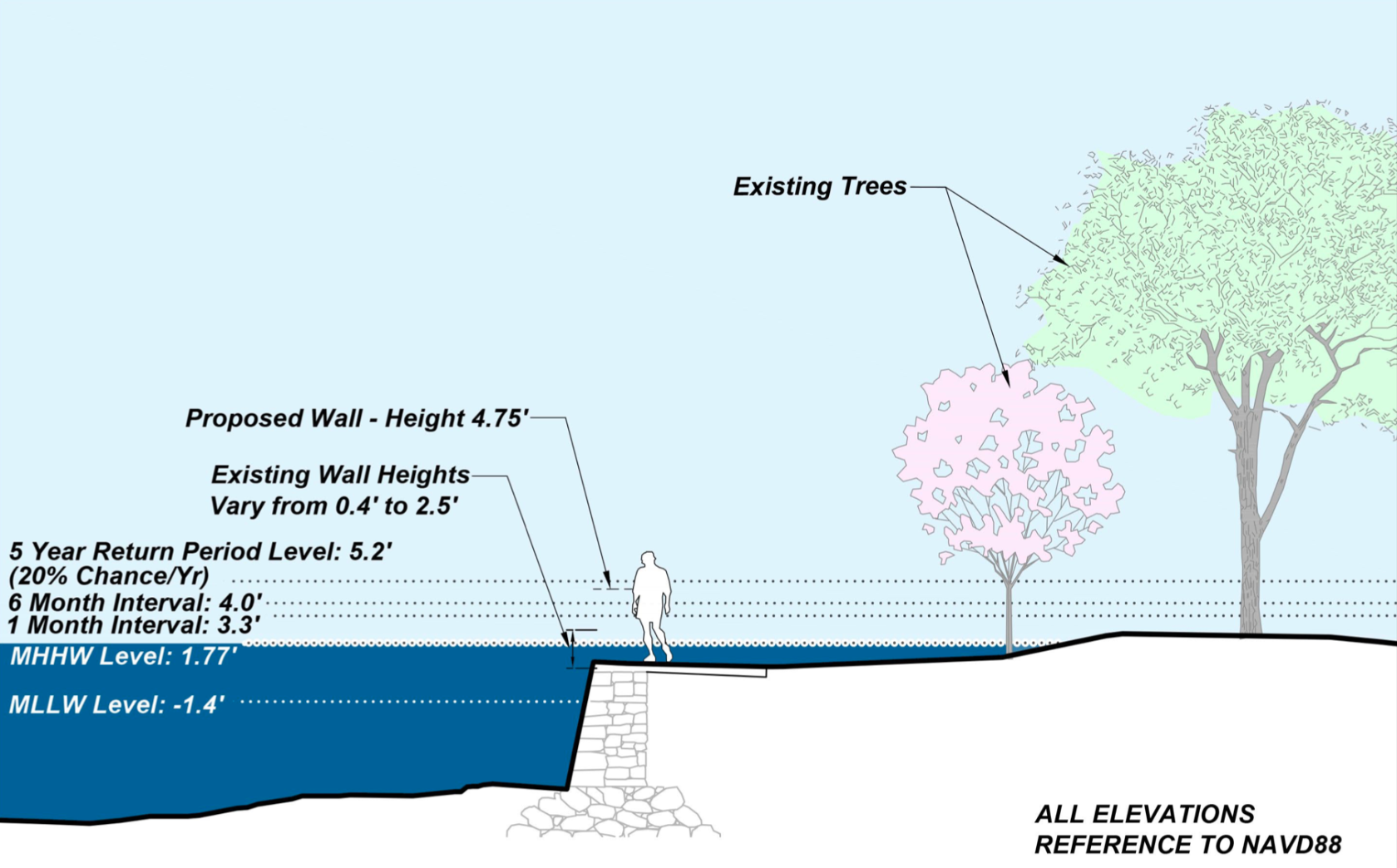
At the same time, the Potomac River (which feeds the Tidal Basin) has been rising, along with the world’s oceans — it’s about 1 ft. higher than it was a century ago. These two factors together mean the basin’s water floods the walkways regularly at high tide.
“It’s been a a priority for the Park Service for a number of years, and we have actually taken the first step into getting those badly needed repairs made,” says Mike Litterst, a spokesperson for NPS.
NPS has recently awarded a $5.7 million contract to begin the planning process, funded by the Great American Outdoors Act. Litterst says if all goes smoothly, construction could begin in summer 2023 or early 2024, though he does not have an estimate for when the project could be completed.
The first phase involves rebuilding seawalls between the Jefferson Memorial and the Roosevelt Memorial, as well as along the river in West Potomac Park. Future phases will take on the much larger East Potomac Park and the rest of the Tidal Basin.
The stone seawalls will be replaced with concrete, covered with stone veneer, making the walls stronger while maintaining their historic appearance.
One of the requirements for the design, says Litterst, is that the new seawalls be able to “withstand the changing conditions in the next 25, 50 or 75 years.”
Sea level on the Potomac is expected to rise another 3.5 ft. by the 2080s.
The seawalls will be raised by about 5 ft., and designed with reinforced foundations able to support future additions on top as sea levels rise.
The Tidal Basin sees some 36 million visitors each year — many of them crowding on to the ancient sidewalks during the few days in March or April when the cherry blossoms are in peak bloom. The project will make those sidewalks more even and accessible, and will also improve drainage of the landscaping, helping to keep the cherry trees healthy.
The basin was listed as one of the nation’s “most endangered historic places” in 2019 by the National Trust For Historic Preservation.
NPS partnered with the National Trust For Historic Preservation and the Trust For The National Mall to come up with ideas to reimagine a more resilient Tidal Basin.
Litterst says that longer-term redesign project is separate from the current seawall restoration. “What we’re looking at [with the restoration] is merely repairing what exists currently. [The redesign] is looking at if there are different ways to redo or change the design of the of the area.”
Separately, the Army Corps of Engineers is embarking on a project to restore the century-old tidal gates that allow the basin’s waters to rise and fall with the river.
The seawalls around the Tidal Basin are not the only ones in urgent need of repair: East Potomac Park (around Hains Point) and West Potomac Park (along the Potomac River) both have similarly aging seawalls, as does Anacostia Park and much of the Anacostia waterfront in D.C.