Amanda Michelle Gomez
 Aja Drain
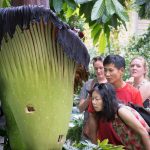
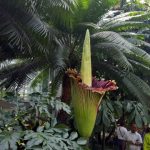
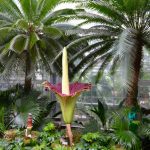
That putrid smell at the U.S. Botanic Garden is the corpse flower in full bloom.
The corpse flower is an endangered plant native to the tropical rainforests of Indonesia, and one of the federal museum’s 20 mature plants. It began opening in peak bloom Tuesday evening. At 16 years old, the plant is the oldest in the Botanic Garden’s mature flower collection.
This rare plant is a part of the Botanic Garden’s conservation efforts, with less than an estimated 1,000 wild corpse flowers remaining in the wild, according to the International Union for Conservation of Nature.
Visitors have flocked to the Garden to see a “corpse” before, with this exact same plant blooming in 2013, three plants blooming in 2017, two in 2020, and most recently a bloom in 2021. However, each plant bloom only occurs a limited number of times, and corpse flowers don’t bloom annually. The bloom emerges from an underground stem called a corm – and happens only when a sufficient amount of energy is accumulated, which can take anywhere between a few years to more than a decade. And once they do bloom, it only lasts for 24 – 36 hours.
So if you need a reason to brave that funky flower smell (we’re talking rotting flesh levels of funky), it may be awhile before the corpse flower blooms again.
Visitors can see the corpse flower in the Garden Court of the Conservatory for free between 10 a.m. and 5 p.m.